
Golden Cascade
Scientific Name
Anas platyrhynchos domesticus
Measurements:
| Feature | Male | Female |
|---|---|---|
| Length | 60–70 cm (24–28 in) | 55–65 cm (22–26 in) |
| Weight | 3.1–3.6 kg (7–8 lb) | 2.25–2.75 kg (5–6 lb) |
| Wingspan | 90–100 cm (35–39 in) | 85–95 cm (33–37 in) |
Status
The Golden Cascade is a relatively new American breed and is not yet admitted to the American Poultry Association’s Standard of Perfection. Its population remains limited but stable among small-scale farmers and hobby breeders in the United States. It is maintained through private breeding programs, primarily in Oregon and the Pacific Northwest, where it continues to gain popularity for its utility and ease of sexing.
Average Life Span
8–10 years
Breed History
The Golden Cascade was developed in 1979 by David Holderread of Corvallis, Oregon, a renowned waterfowl breeder. His goal was to create a fast-growing, productive, auto-sexing duck suitable for both egg and meat production. By the mid-1980s, Holderread had succeeded, introducing the breed to the market. The name Golden Cascade reflects both the bird’s golden plumage, derived from a brown sex-linked recessive gene, and the Cascade Mountain Range of the Pacific Northwest. Holderread’s innovation lay in breeding a drake that could produce color-sexable offspring when crossed with nearly any other breed. The breed also inherited strong laying ability and excellent growth rate, making it a true dual-purpose duck for small farms and homesteads.
Identification
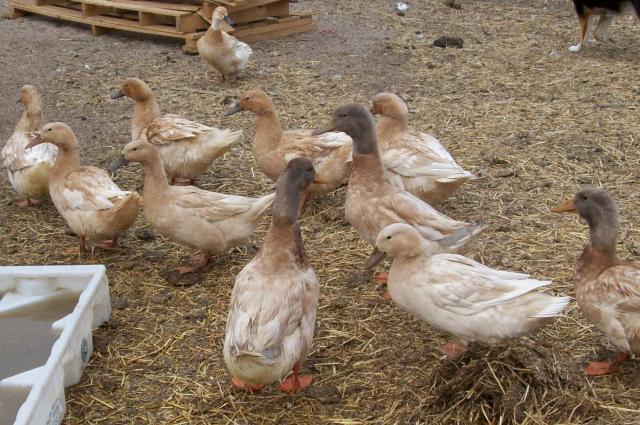
Golden Cascades are medium-to-large ducks with buff or fawn plumage and a gentle, rounded shape. Drakes have yellow bills, satin green to bronze heads, a white neck ring, reddish breasts, and white or buff underbodies. With age, males may molt into more uniform buff tones. Females display warm fawn or buff plumage, orange bills with brown markings, and lighter cream tones on the face and throat. Ducklings are auto-sexing, allowing easy identification of males and females based on down coloration.
Purpose
Golden Cascades are a dual-purpose duck bred for both egg and meat production. They are excellent layers, producing eggs from January to August, resting briefly, then continuing until late fall. Their meat is flavorful and tender, making them ideal for small farms or backyard flocks.
Breed Eggs
The eggs are white, large, and weigh around 70–80 grams. Laying performance can range from 180 to 250 eggs per year depending on the strain and care provided. Their egg production rivals top laying breeds such as Khaki Campbells and Welsh Harlequins.
Temperament & Behavior
Golden Cascades are friendly, calm, and active foragers. They thrive in free-range environments and enjoy access to water but also adapt well to smaller backyard setups. They are hardy in a variety of climates and are relatively quiet compared to larger duck breeds. Their auto-sexing trait makes flock management simpler and more efficient for breeders.
Genetic Profile
Golden Cascades carry the brown sex-linked recessive gene, enabling auto-sexing of ducklings. The breed was developed by selective crossing of Khaki Campbells, Runners, and other high-performing ducks. Traits selected for include fast growth, high egg yield, calm disposition, and predictable sex-linked coloring, making them a practical and attractive all-purpose duck.