
Hook Bill
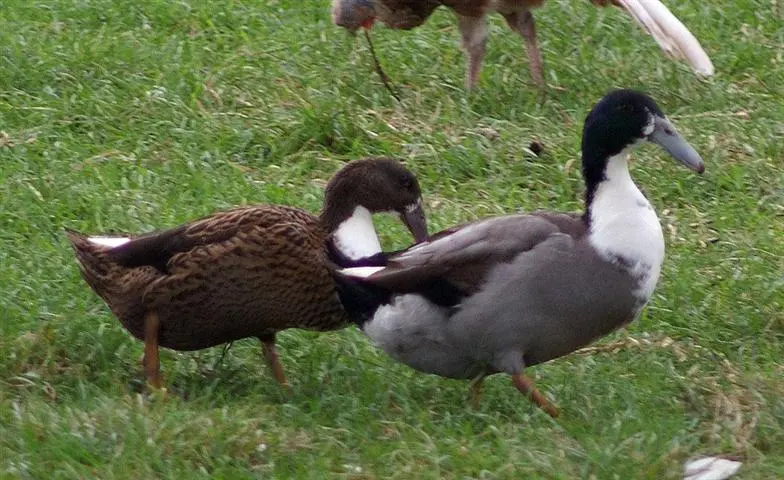
Scientific Name
Anas platyrhynchos domesticus
Alternative Names
Dutch Hookbill, Krummschnabelenten, Olandese Bec Courbe, Noord-Hollandse Krombekeend
Measurements:
| Feature | Male | Female |
|---|---|---|
| Weight | ~2 kg (4.4 lb) | ~2 kg (4.4 lb) |
| Length | 55–65 cm (22–26 in) | 50–60 cm (20–24 in) |
| Wingspan | 85–95 cm (33–37 in) | 80–90 cm (31–35 in) |
Status
The Hook Bill is critically endangered, with only an estimated 80–120 birds worldwide, including 60 breeding females and 20 drakes. Conservation programs exist in the Netherlands, Germany, and the United States, including the Hook Billed Ducks Program, aimed at preserving bloodlines and color variations. It is listed as “critical-maintained” in Holland and “endangered” at the European level by the FAO.
Average Life Span
8–10 years
Breed History
The Hook Bill originates from the province of North Holland in the Netherlands, although its exact origins remain uncertain. Early references appear in 17th-century texts and illustrations, including Francis Willughby’s Ornithologiæ Libri Tres (1676), and later in paintings by Melchior Hondecoeter and Nicolas Robert. The breed was widely kept across Europe for eggs and meat, particularly in Thuringia and the Netherlands. By the 20th century, numbers declined drastically due to water pollution and falling demand for duck eggs. By 1980, the breed was nearly extinct, with only about 15 individuals used to restart conservation efforts in the Netherlands. The Hook Bill was introduced to the United States in 2000 by David Holderread.
Identification
Hook Bills are light ducks with a distinctive downward-curving bill. Three main color varieties are recognized: dusky mallard, white-bibbed dusky mallard, and white. Dusky mallards have black heads and rumps with green lustre, grey bodies without a neck ring, and slate-grey bills. White-bibbed dusky mallards have similar coloring but with a white chest bib and white-tipped wing primaries. White Hook Bills have pure white plumage, blue eyes, orange legs, and a pink flesh-colored bill. They are medium-sized with strong flight capability, slightly elongated bodies, and rounded heads.
Purpose
Hook Bills were traditionally kept for eggs and meat and occasionally for ornamental purposes. They were managed extensively, foraging freely along canals and waterways. Today, they are primarily bred for exhibition, though they remain excellent layers and efficient foragers.
Breed Eggs
Hook Bills are productive layers, capable of producing 100–225+ eggs per year. Egg colors range from blue and green to white, depending on the variety. They reach sexual maturity by around 16 weeks, making them early and reliable egg producers.
Temperament & Behavior
Hook Bills are inquisitive and curious, requiring socialization when young to interact well with humans and other animals. Females make a loud honk while males are quieter with a raspier voice. They are generally quiet compared to other breeds, tame easily, and have excellent foraging ability. Hook Bills are capable fliers, especially in younger birds, and thrive in free-range or semi-intensive systems.
Genetic Profile
Hook Bills have a diverse range of bill curvatures, including extreme, moderate, and straight types. Careful breeding of moderately curved beaks or crosses between extreme and straight beaks is recommended to maintain fertility. The breed has several color variations, though many are rare, and it carries strong traits for foraging efficiency, early maturity, and high egg production.