
Common Shelduck

Scientific name

Tadorna tadorna

Alternative names

None widely used

Subspecies

Monotypic – no subspecies recognized

Measurements

FeatureRange / Note
Length~58–70 cm
Wingspan~110–133 cm
Weight0.9–1.6 kg
Male vs FemaleMales slightly larger, brighter in breeding plumage

Status

Widespread and common in the Euro-Siberian region. Protected under the Agreement on the Conservation of African-Eurasian Migratory Waterbirds (AEWA).

Identification

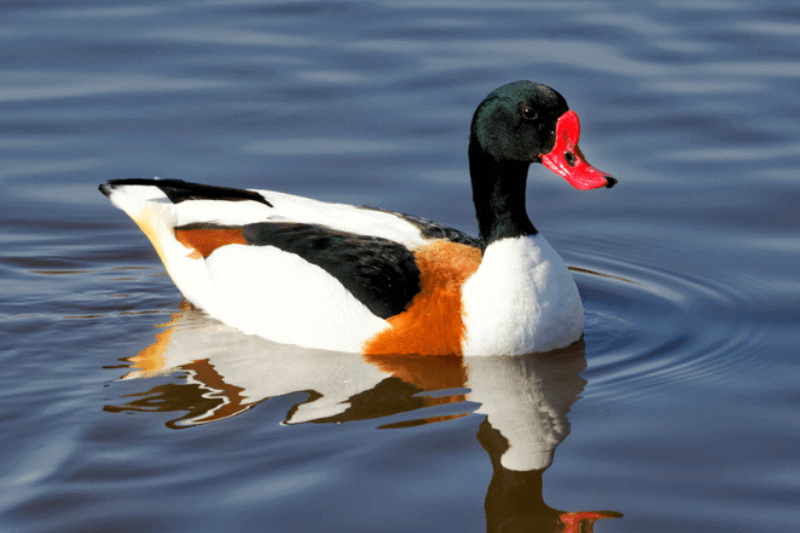
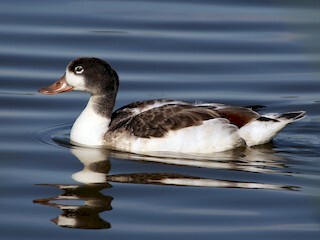
Resembles a small short-necked goose. Striking coloration: white body with chestnut patches, black belly, dark green head and neck, white wing coverts, black primary feathers, green and chestnut secondaries (visible in flight), almost entirely white underwings. Males have bright red bills with a prominent knob in breeding season; females are smaller with some white facial markings. Ducklings are white with black cap and patches; juveniles are greyish above, mostly white below, but show adult wing pattern.

Behavior

Wary, young dive under water to avoid predators while adults may act as decoys. Forms moulting flocks that can be very large, with crèches of partially grown young.

Feeding

Feeds in shallow waters, estuaries, tidal mudflats, lakes, and rivers. Often grazes and filters food in mud or shallow water.

Distribution

Breeds in temperate Euro-Siberia. Resident populations exist in westernmost Europe. Rare vagrants to North America, the Caribbean, and South America.

Habitat

Prefers open country near lakes, rivers, estuaries, and tidal mudflats. Nests in rabbit burrows, tree holes, haystacks, or similar sheltered locations.

Wintering

Migratory populations move to subtropical areas, including the Maghreb, for the winter. Resident populations in western Europe remain largely in place, often gathering in estuaries and tidal mudflats during colder months.

Breeding

Nests in sheltered cavities such as rabbit burrows or tree holes. Pairs often leave young in crèches with only one or two adults. Ducklings are raised communally in moulting flocks.

Vocalization

Loud honk, typical of shelducks.

Conservation

Not threatened; large moulting flocks reported, e.g., 100,000 at the Wadden Sea. AEWA protects the species across its migratory range.

Similar Posts

  • Fulvous Whistling Duck

    Scientific Name Dendrocygna bicolor Alternative Names Fulvous Tree Duck, Brown Tree Duck, Large Whistling Teal, Mexican Duck Measurements Feature Male Female Length 45–53 cm (18–21 in) 45–53 cm (18–21 in) Weight 748–1,050 g (26–37 oz) 712–1,000 g (25–35 oz) Wingspan 85–93 cm (33–37 in) 85–93 cm (33–37 in) Status A widespread tropical duck found across…

  • Ruddy Shelduck

    Scientific Name Tadorna ferruginea Alternative Names Ruddy Sheldrake Measurements Feature Measurement Length 58–70 cm (23–28 in) Wingspan 110–135 cm (43–53 in) Weight 1–1.6 kg (2.2–3.5 lb) Status The Ruddy Shelduck is listed as Least Concern by the IUCN due to its wide distribution and large population, estimated between 170,000 and 225,000 individuals. Populations in Asia…

  • Eaton’s Pintail

    Scientific Name Anas eatoni Alternative Names Southern pintail, Kerguelen pintail (A. e. eatoni), Crozet pintail (A. e. drygalskii) Measurements Feature Male Female Body Length 35–45 cm 35–45 cm Wingspan 65–70 cm 65–70 cm Weight 430–502 g 400–500 g Status Vulnerable (IUCN). Population stable but threatened by predation from invasive species such as feral cats and…

  • White-headed Duck

    Scientific Name Oxyura leucocephala Alternative Names White-headed Stiff-tail, Malvasía Cabeciblanca (Spanish) Measurements Feature Male & Female Length 43–48 cm (17–19 in) Weight 580–750 g (1.28–1.65 lb) Wingspan About 60–70 cm (24–28 in) Status Classified as Endangered by the IUCN. Populations are shrinking due to habitat loss, pollution, hunting, and hybridization with introduced Ruddy Ducks. Identification…

  • Cape Teal

    Scientific name Anas capensis Alternative names Cape Wigeon, Cape Widgeon Measurements Feature Range / Note Length 44–46 cm Weight 316–502 g (11–18 oz) Wingspan Not specifically recorded Status Not considered endangered. Classified as Least Concern, population is large and appears to be increasing. Identification Cape Teals are small, pale ducks with mostly grey mottled plumage,…

  • Ferruginous Duck

    Scientific Name Aythya nyroca Alternative Names Ferruginous Pochard, Common White-eye, White-eyed Pochard Measurements Feature Male Female Length About 38–42 cm (15–17 in) About 38–42 cm (15–17 in) Weight Around 600–800 g (1.3–1.8 lb) Around 600–800 g (1.3–1.8 lb) Wingspan 60–67 cm (24–26 in) 60–67 cm (24–26 in) Status A medium-sized diving duck found across Europe,…

Leave a Reply

Your email address will not be published. Required fields are marked *