
White-winged Scoter
Scientific name
Melanitta deglandi
Common name
White-winged Scoter
Measurements
| Feature | Average |
|---|---|
| Length | 48–60 cm (19–24 in) |
| Wingspan | 80 cm (31.5 in) |
| Weight | 950–2,128 g (2.1–4.7 lb) |
Status
The white-winged scoter is the largest North American scoter and one of the most widespread sea ducks on the continent. The IUCN lists it as Least Concern, though populations have declined in parts of its range due to oil pollution, habitat loss, and reduced food availability. In some regions, the species is under conservation monitoring because of its sensitivity to marine pollution and disturbance at nesting sites.
Identification
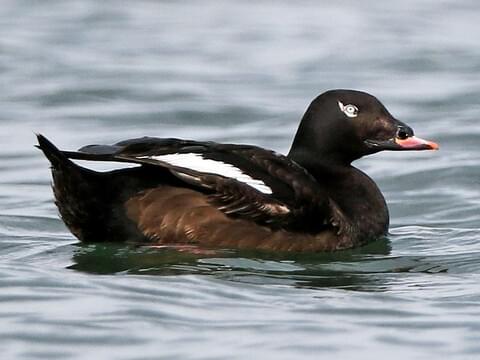
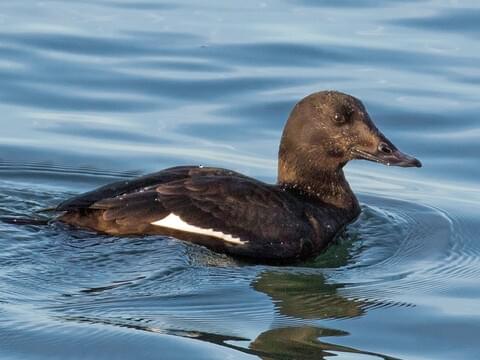
Adult males are mostly black with a bold white crescent around the eye and a white patch on the wings that gives the bird its name. Their bill is orange-red with a large black knob at the base. Females are chocolate brown with a variable facial pattern—some have white spots before and behind the eye, while others appear almost uniformly dark. The species’ “two-stepped” head profile and feathered gape help distinguish it from similar scoters.
Voice
Generally quiet outside the breeding season. During courtship, males produce a series of soft, whistling or croaking notes, while females emit grating “krrah” calls, especially when alarmed or defending nests.
Distribution
The white-winged scoter breeds across the boreal forest and tundra regions from Alaska to western and central Canada. It winters along both North American coasts and the Great Lakes, preferring large inland lakes and sheltered bays. Occasionally, it is spotted as a vagrant in Europe, particularly in Iceland, Scotland, Norway, and Ireland.
Habitat
This species favors large freshwater lakes, rivers, and tundra ponds during the breeding season. In winter, it moves to temperate coastal waters rich in mussels and other shellfish. It is often seen in large flocks, especially on migration or while feeding offshore.
Behavior
White-winged scoters form monogamous pairs, often bonding during late summer on molting or staging areas. Nests are built close to water, lined with down and vegetation, and usually well-hidden among grasses or shrubs.
Females lay 5–11 eggs, which are incubated for 25–30 days. The male remains until incubation begins, after which he leaves to molt. Females may tend large mixed broods (“crèches”) of up to 40 ducklings due to brood mixing. Young fledge in about 9–11 weeks.
They dive to forage, often in synchrony with others, and are strong flyers, capable of fast, low-level flight over open water.
Diet
White-winged scoters are benthic feeders, diving to depths of 5–20 meters to reach shellfish beds. In marine habitats, they consume molluscs, crustaceans, and occasionally small fish, while in freshwater they eat insects, larvae, and aquatic plants. Their muscular gizzards—about 8% of body mass—crush hard shells efficiently. Favorite prey includes rock clams, razor clams, Arctic wedge clams, and freshwater amphipods.
Wintering
In winter, white-winged scoters gather in large rafts on coastal bays and estuaries, often mingling with surf and black scoters. They winter from Alaska to California on the Pacific coast and from Newfoundland to the Mid-Atlantic states on the Atlantic coast, with smaller inland populations on the Great Lakes.
Conservation
While globally stable, regional declines have raised concern among researchers. Threats include oil spills, marine pollution, entanglement in fishing gear, and disturbance at coastal feeding sites. Habitat degradation in breeding and wintering areas, as well as climate-related shifts in prey distribution, are also emerging risks. Conservation measures include monitoring programs, oil spill prevention, and habitat protection along key migration routes and coastal wintering areas.