
Bufflehead
Scientific name
Bucephala albeola
Common name
Bufflehead
Measurements
| Feature | Average |
|---|---|
| Length | 32–40 cm (13–16 in) |
| Wingspan | 55 cm (21.6 in) |
| Weight | 270–550 g (9.5–19.4 oz) |
Status
The bufflehead is a small, active sea duck found across North America. It breeds in Alaska and Canada and spends the winter in coastal waters and large lakes farther south, often in the United States and on the Great Lakes. Despite facing some habitat competition from other cavity-nesting birds, its population is stable and even increasing in many areas, making it a species of Least Concern.
Identification
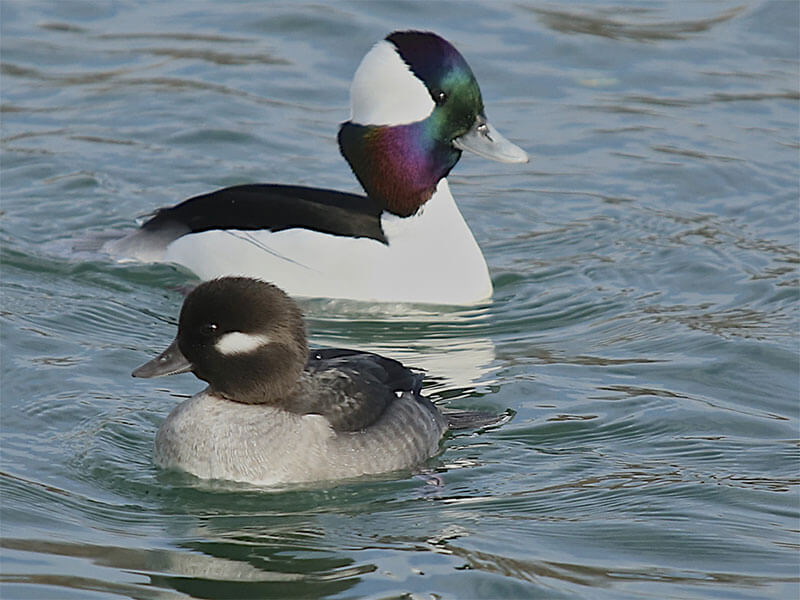
Buffleheads are easy to spot thanks to their round heads and neat black-and-white markings. Males are striking, with glossy heads that shimmer in shades of green and purple and a large white patch behind the eye. Females are smaller and more subdued, with grayish-brown plumage, a lighter underside, and a smaller white cheek patch. Both males and females have short, dark bills, perfectly suited for diving and catching small underwater prey.
Voice
Usually quiet, though they make soft squeaks and chatters, especially during courtship or when alarmed.
Distribution
Buffleheads breed in wooded northern regions of North America—mainly Alaska and Canada—and migrate south for the winter. They winter along both U.S. coasts, in protected bays, estuaries, and large inland lakes, and are occasionally seen as rare visitors in western Europe.
Habitat
During the breeding season, buffleheads nest near small lakes and ponds in boreal forests, especially where old woodpecker holes are available. In winter, they move to calm coastal waters, harbors, and large freshwater lakes, preferring areas with plenty of food and shelter from harsh weather.
Behaviour
Buffleheads are highly active, spending much of their time diving for food. They are small but powerful swimmers, often seen bobbing up and down on the surface before plunging below to catch insects, crustaceans, and mollusks.
Unlike many ducks, they don’t gather in huge flocks—most are seen in small groups or pairs. One bird often acts as a lookout while others dive. They are punctual migrants, returning to their wintering grounds at nearly the same time every year.
Breeding
These ducks are monogamous, often keeping the same mate for several years. They nest in old tree cavities—usually those made by northern flickers—close to water. Females lay about 6–11 eggs, and after hatching, the ducklings leap bravely from the nest cavity to follow their mother to water. Only the female cares for the young.
Diet
Buffleheads dive in shallow waters, feeding mainly on insects in freshwater and on crustaceans and mollusks in saltwater. They also eat small fish, snails, and bits of aquatic plants. Their dark bills help them catch prey efficiently underwater.
Wintering
In winter, buffleheads can be found across the southern parts of North America, especially along both coasts, the Great Lakes, and sheltered inland waters. They prefer calm bays and estuaries where they can dive for crustaceans and mollusks throughout the season.
Conservation
Buffleheads remain one of the most stable and well-loved sea ducks in North America. Their population benefits from the protection of northern forests and nest boxes placed by conservationists. While they are still hunted in some regions, careful management has helped keep their numbers strong.