
Red-breasted Merganser
Scientific name
Mergus serrator
Alternative names
Also called the Sawbill Duck or Fish Duck.
Measurements
| Feature | Range |
|---|---|
| Length | 51–64 cm (20–25 in) |
| Weight | Males: 950–1,350 g (34–48 oz); Females: 800–1,100 g (28–39 oz) |
| Wingspan | 66–74 cm (26–29 in) |
Status
Listed as Least Concern on the IUCN Red List. The species is protected under the Agreement on the Conservation of African-Eurasian Migratory Waterbirds (AEWA) and the Migratory Bird Treaty between the United States and Canada. Global numbers are stable, though local declines occur from wetland loss, pollution, and illegal persecution in parts of Europe.
Identification
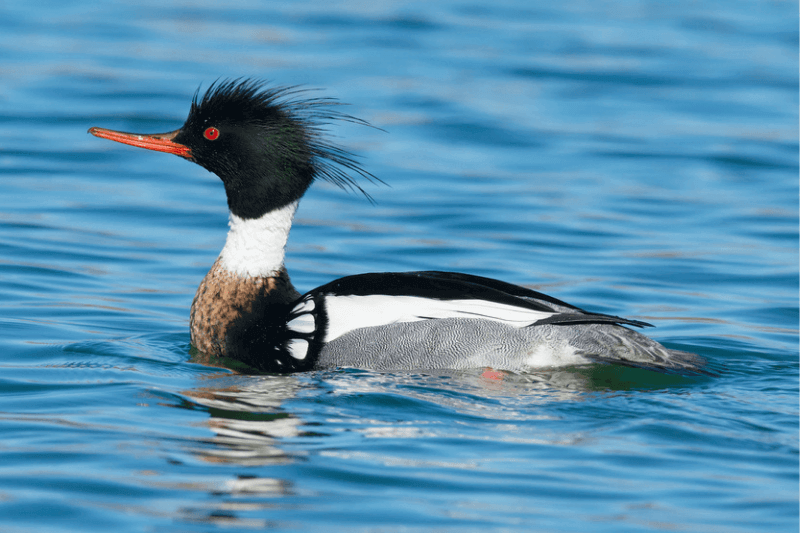
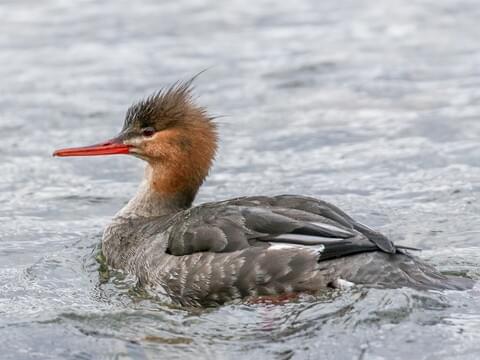
A slim diving duck with a long, thin, serrated red bill perfect for catching slippery fish. Males in breeding plumage are striking, with dark green heads, spiky crests, white necks, rusty-red breasts, black backs, and white underparts. Females have reddish-brown heads, grayish bodies, and shorter crests. Juveniles resemble females but show smaller white wing patches. The Red-breasted Merganser can be confused with the Common Merganser, but it favors coastal waters and has a darker, rustier breast. Its streamlined body and narrow bill give it a fast, elegant look in flight.
Voice
Usually quiet, but during courtship the female gives a rough prrak prrak, while the male makes a catlike meow. In flight, females may utter a harsh gruk call.
Diet
Feeds mostly on small fish, but also eats aquatic insects, crustaceans, worms, and amphibians. It dives from the surface, using its serrated bill to grip slippery prey underwater. Hunting often happens in shallow coastal waters, lakes, or estuaries.
Behavior
Active and agile, the Red-breasted Merganser dives frequently and flies rapidly with stiff, shallow wingbeats. During courtship, males perform synchronized displays, stretching and bobbing their necks while fanning their crests. They are social birds, often seen in small groups, and form larger flocks during migration and winter. Outside the breeding season, they spend much of their time at sea.
Distribution
Breeds across northern North America, Greenland, Europe, and Asia, from temperate to subarctic zones. Migrates south each year to coastal areas of North America, Europe, and Asia, where it is the merganser most often found in saltwater. Some populations in Britain, Ireland, and Iceland remain year-round.
Habitat
Prefers freshwater lakes, rivers, and estuaries for breeding and coastal bays, lagoons, and sea inlets in winter. Often found near rocky coasts or sheltered shorelines where fish are abundant.
Breeding
Nests close to water, hidden among vegetation or under driftwood. Females lay 6–12 olive-buff eggs in a simple down-lined nest. Incubation lasts about 28–30 days, and ducklings can swim and feed themselves soon after hatching. Breeding begins in late spring, from May to July, depending on location.
Wintering
Migrates to ice-free coastal waters in southern Canada, the U.S., northern Europe, and East Asia. Flocks gather in bays and estuaries rich in fish. In western Europe, some birds remain in mild areas year-round.
Conservation
Although globally stable, the species faces local threats from wetland loss, chemical pollution, and entanglement in fishing gear. Persecution by fish farmers and anglers, particularly in parts of Scotland, continues to be an issue. Conservation measures focus on protecting wetlands and monitoring migratory populations under AEWA agreements.