
Mandarin Duck

Scientific name
Aix galericulata
Alternative names
Mandarin Duck
Measurements
| Feature | Range / Note |
|---|---|
| Length | 41–49 cm (16–19 in) |
| Wingspan | 65–75 cm (26–30 in) |
| Weight | 450–600 g (approx.) |
Status
Not considered endangered. Global population is hard to estimate, but introduced populations in Europe and small feral populations in the U.S. are stable. Native populations in East Asia are declining due to habitat loss.
Identification
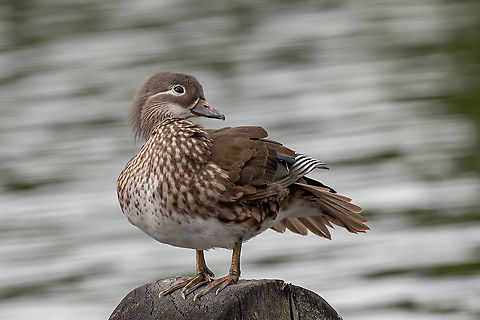
The male mandarin duck is brightly colored with a red bill, a white crescent above the eye, a reddish face, a purple breast with two vertical white bars, ruddy flanks, and two orange “sail” feathers on the back. The female is grayish-brown with a white eye-ring and a stripe running back from the eye, a paler underside, and a small white flank stripe. Both sexes have crests, though the male’s is more pronounced. After breeding, males molt into eclipse plumage, looking similar to females but retaining a bright yellow-orange or red bill and a faint eye stripe. Ducklings resemble wood duck or mallard ducklings but can be distinguished by an eye-stripe that stops at the eye, not extending to the bill.
Behavior
Mandarin ducks are generally shy and prefer cover under trees or dense vegetation. They usually form small flocks but may behave boldly when accustomed to humans.
Distribution
Native to East Asia, including eastern Russia, China, and Japan. Introduced populations exist in the United Kingdom, Ireland, mainland Europe, and parts of the United States, such as California and North Carolina.
Habitat
They prefer wooded areas near lakes, ponds, or marshes for breeding, and in winter they use marshes, flooded fields, open rivers, and coastal lagoons. In Europe, they live in more open habitats such as lake edges, water meadows, and cultivated areas near woods.
Feeding
Mandarin ducks feed by dabbling in water or walking on land. Their diet includes acorns, beech mast, grains, insects, snails, small fish, aquatic plants, small worms, frogs, mollusks, and occasionally small snakes. They feed mainly near dawn and dusk.
Breeding
They nest in tree cavities near water in spring. A single clutch has 9–12 eggs, incubated by the female while the male may guard the nest. Ducklings leave the nest shortly after hatching and follow their mother to water.
Wintering
In their native range, mandarin ducks migrate to lowland China and southern Japan. Introduced populations in Europe and North America are mostly non-migratory but may move locally to find shelter, open water, or food during colder months.
Conservation
Mandarin ducks face threats from habitat loss due to logging and accidental hunting, though they are not hunted for food. Their populations are stable in introduced ranges, and they are popular in captivity because of their striking plumage.