
Red-crested Pochard
Scientific name
Netta rufina
Alternative names
Also known as the Redhead Duck or Red-headed Pochard.
Measurements
| Feature | Range |
|---|---|
| Length | 53–57 cm (21–22 in) |
| Weight | 1.1–1.4 kg (2.4–3.1 lb) |
| Wingspan | 85–90 cm (33–35 in) |
Status
Listed as Least Concern on the IUCN Red List. Protected under the Agreement on the Conservation of African-Eurasian Migratory Waterbirds (AEWA). Populations remain stable across most of their range, though local declines occur from wetland loss and pollution.
Identification
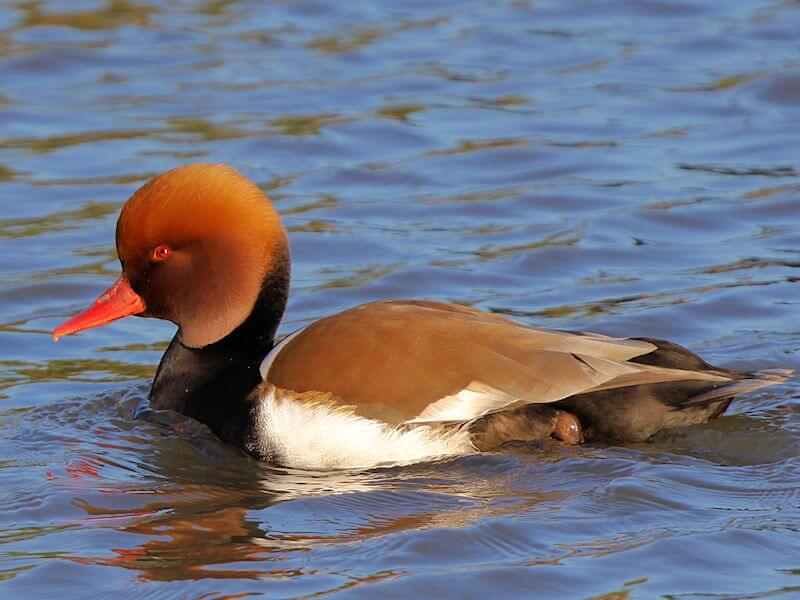
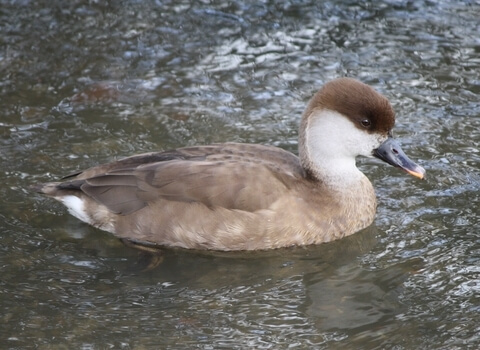
A large and colorful diving duck. Males are striking with bright orange-red heads, coral-red bills, black breasts, white sides, and brown backs. Females are softer in tone—pale brown with a darker crown, light face, and dusky bill tipped pink. In eclipse plumage, males resemble females but keep their red bills. Both sexes have deep red eyes. The rounded head and bright bill make them easy to identify even from a distance.
Voice
Males make a soft wheezing “veht” call, while females produce a coarse “vrah-vrah-vrah” sound. They are most vocal during the breeding season.
Diet
Eats mainly the roots, seeds, and leaves of aquatic plants such as pondweeds and stoneworts. Occasionally takes aquatic invertebrates like snails, insects, or small fish. Feeds by diving and dabbling, often upending to reach vegetation below the surface.
Behavior
The Red-crested Pochard is a social duck, forming large flocks in winter, often mixed with other diving ducks. It feeds mostly during the day, diving repeatedly in search of food. After breeding, it undergoes a complete molt, becoming flightless for about a month before migrating south. Non-breeders often gather at traditional molting sites with safe cover and abundant food.
Distribution
Breeds in southern and central Europe, extending east across Central Asia to Mongolia. Northern birds migrate south to North Africa, the Indian Subcontinent, and parts of Africa for winter. In the UK, many individuals originate from escapes or releases, though self-sustaining wild populations now exist mainly in central and southern England.
Habitat
Lives around deep freshwater or brackish lakes, reed-fringed ponds, and slow rivers. Occasionally found in coastal lagoons and deltas during migration or winter. Prefers clear, still waters with plenty of submerged vegetation.
Breeding
Breeds from April to June, nesting on the ground near water or among reeds. The nest is made of twigs, roots, and down.
- Clutch size: 8–12 eggs
- Egg color: Pale green
- Incubation: Around 25–28 days
Females care for the ducklings alone. The young can swim and feed themselves shortly after hatching.
Wintering
Migrates south after breeding, arriving at wintering sites from October onwards. Large flocks gather on lakes and lagoons with plenty of food and shelter. Some birds stay in southern Europe if conditions remain mild.
Conservation
The species remains widespread but depends on healthy wetland ecosystems. Drainage, pollution, and overstocked fish ponds can reduce aquatic vegetation and nesting success. Conservation actions include wetland restoration, water quality monitoring, and habitat protection under AEWA agreements. In Europe, efforts to manage fish density and preserve reed beds help support breeding populations.
