
Yellow-billed Teal
Scientific Name
Anas flavirostris
Alternative Names
Chilean Teal, Sharp-winged Teal
Measurements
| Measurement | Range | Imperial |
|---|---|---|
| Length | 360–430 mm | 14–17 in |
| Weight | 400–500 g | 0.9–1.1 lb |
| Wingspan | 600–700 mm | 24–28 in |
Status
Listed as Least Concern by the IUCN due to its wide distribution and stable population across South America.
Identification
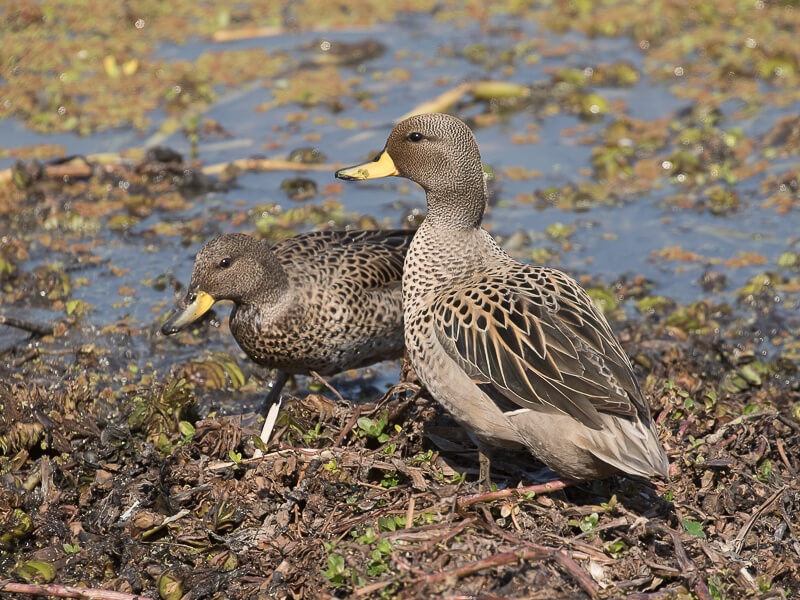
A small, compact teal characterized by its bright yellow bill with a black tip and culmen ridge. The plumage is mainly gray-brown with darker mottling, a slightly darker head, and plain grayish flanks. It resembles the yellow-billed pintail but is smaller, with a shorter neck and darker face.
Voice
Soft, whistling notes typical of teals, especially during flight or social displays.
Distribution
Found throughout South America, including Argentina, Chile, Peru, Bolivia, Uruguay, Brazil, and the Falkland Islands. Populations have also established in South Georgia and have been recorded as far east as Tristan da Cunha.
Habitat
Inhabits freshwater wetlands, lagoons, and marshes. Prefers palustrine habitats with abundant emergent vegetation rather than flowing rivers.
Breeding
Breeds mainly in temperate and sub-Andean regions. Nests are built on the ground in dense vegetation near water. Clutches typically contain 6–8 eggs. The species was first recorded breeding in South Georgia in 1971.
Diet
Feeds by dabbling in shallow waters for aquatic vegetation, seeds, and small invertebrates.
Wintering
During the non-breeding season, southern populations move northward to lower elevations and warmer regions, particularly in central Argentina, Uruguay, and southern Brazil. In mild climates, many birds remain resident year-round.
Behaviour
Typically seen in pairs or small groups. After mating, males perform a distinctive display by stretching upright and swimming alongside the female. During non-breeding periods, the species forms small flocks in shallow wetlands.
Conservation
Populations are considered stable, and no significant threats have been identified. Local conservation efforts focus on protecting wetland habitats used for feeding and breeding.
