Mexican Duck
Scientific Name
Anas diazi
Alternative Names
Mexican Mallard
Measurements
| Measurement | Range | Imperial |
|---|---|---|
| Length | 510–560 mm | 20–22 in |
Status
Least Concern globally; populations show a slow decline due to hybridization, habitat loss, and overhunting.
Identification
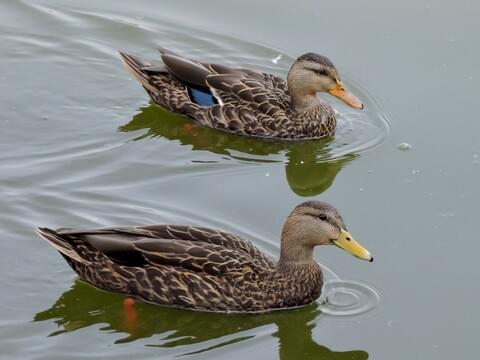
A medium-sized dabbling duck resembling a female mallard but with a darker overall body tone. Both sexes are mainly brown with a blue speculum bordered by white, visible in flight and at rest. Males and females look similar, though the male has a brighter yellow bill, while the female’s bill is duller.
Voice
Males produce a nasal, reedy call, whereas females have the familiar “quack” associated with ducks.
Distribution
Found primarily in Mexico and the southwestern United States, including Arizona, New Mexico, and Texas. Small numbers occur year-round in Colorado, with occasional records from Utah, Wyoming, Nebraska, and Montana.
Habitat
Occupies a range of wetlands—ponds, marshes, and slow-flowing rivers. It nests on the ground, often along riverbanks, though not always close to water. Feeds by dabbling and grazing, often in irrigated fields.
Breeding
Builds nests on the ground, concealed by vegetation, often near rivers. The nest is typically lined with down and plant matter. Breeding occurs during the warmer months when water levels and vegetation cover are suitable.
Diet
Feeds mainly on plant material, including aquatic vegetation and the green shoots of alfalfa. Forages both by day and at night, especially in irrigated fields.
Taxonomy
Once considered a subspecies of the mallard (Anas platyrhynchos), the Mexican duck is now recognized as a distinct species. Its close relationship to other “mallardine” ducks reflects a recent evolutionary radiation. Although hybridization with mallards occurs, behavioral and plumage cues usually maintain species boundaries under natural conditions.
Behaviour
Mostly sedentary, though some northern populations migrate south to Mexico in winter. The species typically occurs singly or in pairs, but small groups may form outside the breeding season.
Conservation
While still common, populations are declining due to habitat destruction, hunting, and hybridization with mallards, which adapt more easily to human-altered environments. Conservation efforts include wetland protection and managing mallard populations to preserve genetic purity. The Mexican duck was listed as endangered in the U.S. in 1967 but removed from the list in 1978 following population recovery.