
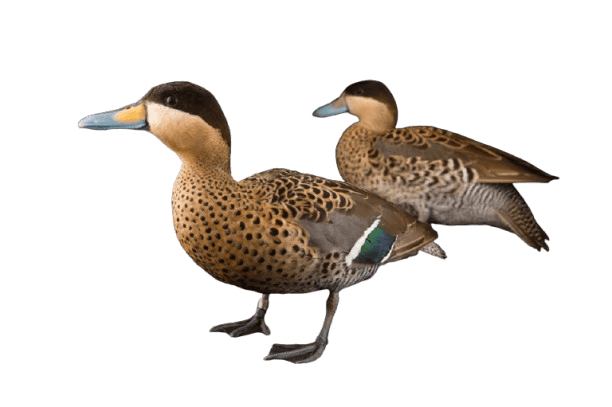
Silver Teal

Scientific Name

Spatula versicolor

Alternative Names

Silver Teal, Versicolor Teal

Measurements

FeatureMaleFemale
Length38–45 cm (15–18 in)38–45 cm (15–18 in)
WingspanAbout 70–75 cm (28–30 in)About 70–75 cm (28–30 in)
Weight400–500 g (0.9–1.1 lb)350–450 g (0.8–1.0 lb)

Status

A dabbling duck native to South America. Classified as Least Concern by the IUCN, with stable populations.

Identification

A small duck with a black cap extending down past the eyes, pale face, and finely barred body. The bill is bluish with a yellow tip. Both sexes have a green and blue speculum bordered with white. Females look slightly duller and have less yellow at the base of the bill. They do not have an eclipse plumage, keeping the same appearance year-round.

Voice

Generally quiet and calm. Soft quacks and whistles are used between pairs or family groups.

Diet

Feeds mostly on plant material such as seeds, grasses, and aquatic plants. Occasionally eats small aquatic insects.

Distribution

Found in southern Bolivia, southern Brazil, Paraguay, Argentina, Chile, Uruguay, and the Falkland Islands. Some southern birds migrate to Brazil in winter.

Habitat

Lives in shallow freshwater areas such as marshes, ponds, lakes, and reed-filled wetlands. Prefers calm waters with good plant cover.

Breeding

Nests on the ground, often hidden in thick vegetation or near water. Lays 6–10 creamy eggs between April and June. Incubation lasts about 25–27 days. Both parents care for the ducklings.

Wintering

Southern populations migrate north to milder climates during winter, especially to southern Brazil. Northern groups stay in their range year-round.

Conservation

Not currently threatened. Habitat loss and wetland drainage could affect numbers locally, but overall the species remains stable.

Similar Posts

  • Common Merganser

    Scientific name Mergus merganser Alternative names Goosander (Eurasia), Common Merganser (North America) Subspecies Subspecies Description Distribution M. m. merganser Typical form Northern Europe and northern Asiatic Russia M. m. orientalis Slightly larger, more slender bill Central Asian mountains M. m. americanus Broader-based bill, black bar across inner wing in males North America Measurements Feature Range…

  • Harlequin Duck

    Scientific Name Histrionicus histrionicus Alternative Names Painted Duck, Rock Duck, Glacier Duck, Mountain Duck, White-eyed Diver, Lords and Ladies, Blue Streak Measurements Feature Measurement Length 38–43 cm (15–17 in) Weight Around 600 g (1.3 lb) Wingspan 66 cm (26 in) Wing 188–202 mm (7.4–8.0 in) Tail 77–101.5 mm (3.03–4.00 in) Culmen 25–27 mm (0.98–1.06 in)…

  • Steller’s Eider

    Scientific Name Polysticta stelleri Measurements Feature Measurement Length 43–46 cm (17–18 in) Weight 800–860 g (1.8–1.9 lb) Wingspan 69 cm (27 in) Wing 21–22.5 cm (8.3–8.9 in) Culmen 3.7–4.2 cm (1.5–1.7 in) Tarsus 3.6–4.0 cm (1.4–1.6 in) Status Steller’s Eider is listed as Vulnerable by the IUCN. The Alaska-breeding population is Threatened under U.S. law…

  • Gadwall

    Scientific Name: Mareca strepera Alternative Names: Grey Duck, Common Gadwall Measurements: Feature Male Female Length 47–58 cm (19–23 in) 47–58 cm (19–23 in) Weight Around 990 g (35 oz) Around 850 g (30 oz) Wingspan 78–85 cm (31–33 in) 78–85 cm (31–33 in) Status Classified as Least Concern by the IUCN. Populations are stable or…

  • Barrow’s Goldeneye

    Scientific name: Bucephala islandicaAlternative names: Barrow Duck, House Duck (Icelandic: húsönd) Measurements Feature Male Female Length 49 cm (19.2 in) 43 cm (17 in) Weight 970 g (2.13 lb) 590 g (1.31 lb) Wingspan 70–73 cm (27.6–28.7 in) 70–73 cm (27.6–28.7 in) Status Listed as Least Concern by the IUCN. While its range is limited,…

  • Hardhead

    Scientific Name Aythya australis Alternative Names Hardhead, White-eyed Duck Measurements Feature Male Female Length 42–59 cm (17–23 in) 42–59 cm (17–23 in) Weight 525–1,100 g (18.5–38.8 oz) 525–1,100 g (18.5–38.8 oz) Wingspan 65–70 cm (26–28 in) 65–70 cm (26–28 in) Status The Hardhead is Australia’s only true diving duck. It’s common across the wetter regions…

Leave a Reply

Your email address will not be published. Required fields are marked *