
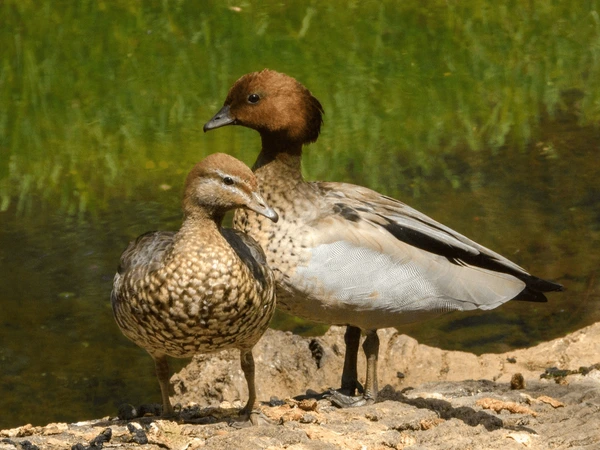
Maned Duck

Scientific Name

Chenonetta jubata

Alternative Names:

Australian Wood Duck, Maned Duck, Maned Goose

Measurements:

FeatureMaleFemale
Length45–51 cm (18–20 in)45–51 cm (18–20 in)
Weight1.0–1.2 kg (2.2–2.6 lb)0.9–1.1 kg (2.0–2.4 lb)
WingspanAbout 80 cm (31 in)About 80 cm (31 in)

Status

Common and widespread across Australia. Not threatened. The species has adapted well to farmland, parks, and urban areas.

Identification

The Australian Wood Duck looks like a small goose. The male has a dark brown head, grey body, and fine black-and-white lines on the sides. The female is lighter, with white stripes above and below the eye and a mottled breast. Both have grey wings with a white patch and black tips. Juveniles look similar to females but are lighter in color.

Voice

Females make a loud, rising “gnow” call. Males give a smoother, shorter, and higher call. Groups often make chattering sounds when flying or feeding.

Diet

They mostly feed on land, eating grasses, clover, grains, and small herbs. Occasionally, they eat insects. Unlike many ducks, they rarely swim while feeding.

Distribution

Found all over mainland Australia and Tasmania. Sometimes seen in New Zealand. Common around farms, city parks, golf courses, and wetlands with nearby grassy areas.

Habitat

Prefers open grassy areas near water—such as lakes, ponds, rivers, and flooded fields. They also thrive in farmland and urban spaces where water and grass are easily available.

Breeding

The female nests in tree hollows or nest boxes, often above water. She lays 9–11 cream-colored eggs and lines the nest with down. The male guards the nest. When the ducklings hatch, they jump from the nest to the ground and follow both parents.

Behavior

Usually seen grazing in pairs or small groups, though they form larger flocks in open fields. They are alert and quick to take flight if disturbed.

Conservation

The Australian Wood Duck population is stable and even increasing due to its ability to live near humans. It is listed as a game bird in several Australian states, where controlled hunting is permitted.

Similar Posts

  • Auckland Teal

    Scientific Name Anas aucklandica Alternative Names Auckland Islands teal, Tētē kākāriki (in Māori) Measurements Feature Measurement Length 40–45 cm Weight 400–600 g Wingspan 60–65 cm (reduced, flightless) Status The Auckland teal is classified as Near Threatened but considered the most secure of New Zealand’s three brown-plumaged teals. It is extinct from the main Auckland Island…

  • Philippine Duck

    Scientific Name Anas luzonica Alternative Names Papan, Patong Gubat (Forest Duck) Measurements Feature Male Female Length 61–66 cm (24–26 in) Slightly smaller Weight Around 1 kg (2.2 lb) Slightly less Wingspan About 90 cm (35 in) About 90 cm (35 in) Status The Philippine Duck is Vulnerable, found only in the Philippines. Once common, its…

  • Chiloé Wigeon

    Scientific Name: Mareca sibilatrix Alternative Names: Chiloé Wigeon, Southern Wigeon, Pato Overo Measurements: Feature Male Female Length 46–56 cm (18–22 in) 46–56 cm (18–22 in) Weight Around 800 g (28 oz) Slightly lighter Wingspan 75–86 cm (30–34 in) 75–86 cm (30–34 in) Status Classified as Least Concern. Populations are stable and widespread in southern South…

  • Cinnamon Teal

    Scientific name Spatula cyanoptera Alternative names Also called Red Teal or Cinnamon Teal Duck. Measurements Feature Range Length 41 cm (16 in) Weight 400 g (14–15 oz) Wingspan 56 cm (22 in) Status Listed as Least Concern on the IUCN Red List. It is managed as a migratory game bird in the United States and…

  • Labrador Duck

    Scientific Name Camptorhynchus labradorius Alternative Names Pied duck, Skunk duck, Sand shoal duck Measurements Feature Measurement Body Length Approximately 51–58 cm Wingspan Estimated around 80–90 cm Weight Not well-documented, but believed to be similar to sea ducks of comparable size (around 1–1.5 kg) Status Extinct. The Labrador duck became extinct in the late 19th century….

  • Black-headed Duck

    Scientific Name Heteronetta atricapilla Alternative Names Black-headed Duck Measurements Feature Male Female Length 35 cm (14 in) 35 cm (14 in) Weight 510 g (18 oz) 565 g (20 oz) Wingspan Not specified Not specified Status The black-headed duck is assessed as Least Concern by the IUCN. Its population is stable, and it has a…

Leave a Reply

Your email address will not be published. Required fields are marked *