Auckland Teal
Scientific Name
Anas aucklandica
Alternative Names
Auckland Islands teal, Tētē kākāriki (in Māori)
Measurements
| Feature | Measurement |
|---|---|
| Length | 40–45 cm |
| Weight | 400–600 g |
| Wingspan | 60–65 cm (reduced, flightless) |
Status
The Auckland teal is classified as Near Threatened but considered the most secure of New Zealand’s three brown-plumaged teals. It is extinct from the main Auckland Island due to predation by introduced cats and pigs but survives on predator-free islands such as Adams, Enderby, Disappointment, Rose, and other small islands.
Identification
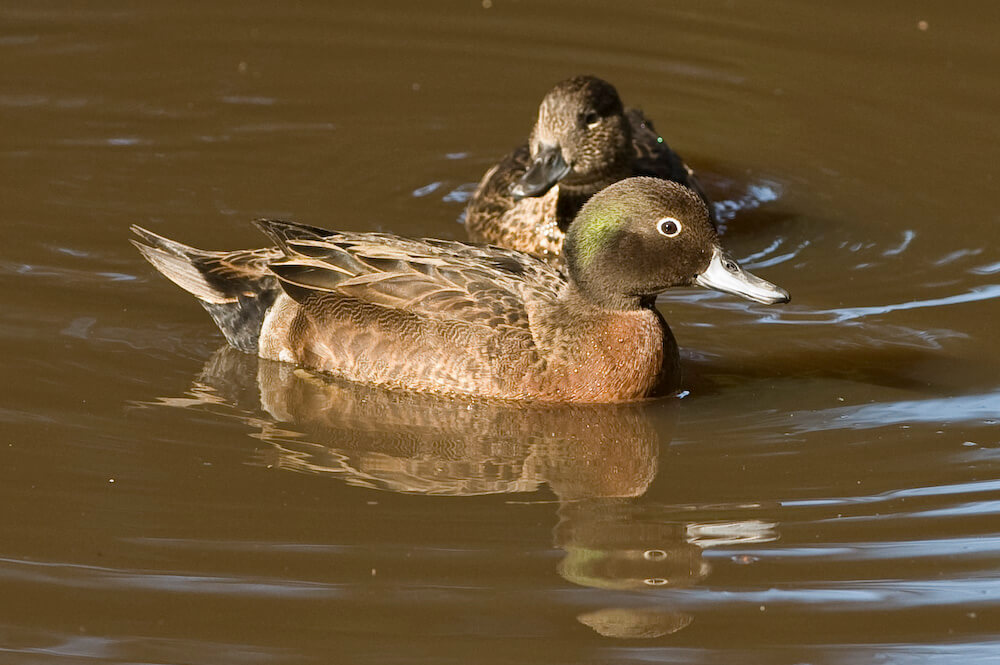
This species is a small, flightless dabbling duck with overall brown plumage. Males have a greenish iridescent head, a dark chestnut breast and barred brown flanks with a smudged white patch at the tail base. Females are uniformly darker brown. Both sexes have a clear white eye ring, dark grey bill, legs and dark brown eyes. Wings are very short with flight feathers reaching only halfway along the back. It is smaller and darker than the mainland brown teal and can be confused with Campbell teal but is identifiable by location.
Voice
The male produces soft trilling or piping sounds often heard in territorial or alarm situations. The female has a rasping growl and a rapid, high-pitched quack similar to the brown teal.
Diet
The Auckland teal is mostly carnivorous, feeding on marine invertebrates, amphipods, insects, crabs, molluscs and other small coastal organisms. It also consumes terrestrial arthropods, seeds of rushes and grasses, and occasionally feeds by dabbling in peaty pools or kelp windrows along the shoreline.
Distribution
Endemic to the subantarctic Auckland Islands, approximately 500 km south of Bluff, New Zealand. Now restricted to predator-free islands such as Adams Island, Enderby Island, Disappointment Island and a few smaller offshore islands. It has been extirpated from the main Auckland Island.
Habitat
This species inhabits tussock fields, coastal herb shrublands, kelp-strewn shorelines, peaty streams, wetlands, seepages around seabird burrows and exposed coastal platforms. It prefers secluded, vegetated areas close to the shoreline and freshwater sources.
Breeding
Auckland teal are monogamous and strictly territorial, with shoreline territories as small as 40–100 m² and more open areas up to 3700 m². Breeding begins in late October, with first broods by early December. Clutches contain 3–4 pale fawn eggs, each weighing up to 15% of the female’s body mass. Only the female incubates for 30–35 days while males guard territory. Nests are well hidden in sedges, tussock or ferns and serve as daytime shelters for ducklings. In captivity ducklings reach adult weight in 50–60 days.
Wintering
This species is sedentary and does not migrate. Pairs retain territories throughout the year while unpaired birds occupy spaces between territories or gather loosely where kelp accumulates.
Conservation
This species benefits from predator-free island habitats but remains absent from the main Auckland Island due to ongoing presence of pigs and cats. Successful eradication of rabbits on Enderby and Rose Islands in 1993 led to habitat recovery and an increase in teal numbers. The population likely exceeds 1000 individuals. Continued conservation depends on predator control, habitat preservation and potential reintroduction to restored islands.