
Silver Teal

Scientific Name

Spatula versicolor

Alternative Names

Silver Teal, Versicolor Teal

Measurements

FeatureMaleFemale
Length38–45 cm (15–18 in)38–45 cm (15–18 in)
WingspanAbout 70–75 cm (28–30 in)About 70–75 cm (28–30 in)
Weight400–500 g (0.9–1.1 lb)350–450 g (0.8–1.0 lb)

Status

A dabbling duck native to South America. Classified as Least Concern by the IUCN, with stable populations.

Identification

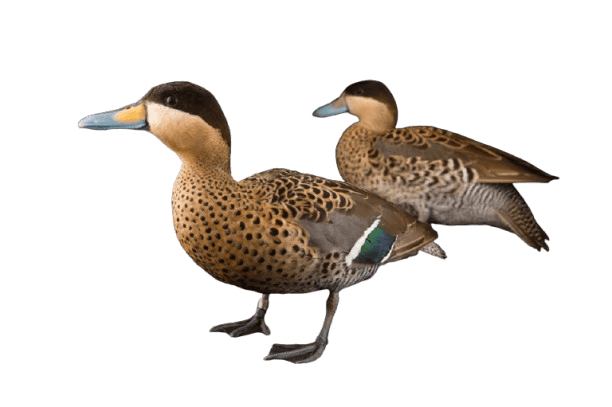
A small duck with a black cap extending down past the eyes, pale face, and finely barred body. The bill is bluish with a yellow tip. Both sexes have a green and blue speculum bordered with white. Females look slightly duller and have less yellow at the base of the bill. They do not have an eclipse plumage, keeping the same appearance year-round.

Voice

Generally quiet and calm. Soft quacks and whistles are used between pairs or family groups.

Diet

Feeds mostly on plant material such as seeds, grasses, and aquatic plants. Occasionally eats small aquatic insects.

Distribution

Found in southern Bolivia, southern Brazil, Paraguay, Argentina, Chile, Uruguay, and the Falkland Islands. Some southern birds migrate to Brazil in winter.

Habitat

Lives in shallow freshwater areas such as marshes, ponds, lakes, and reed-filled wetlands. Prefers calm waters with good plant cover.

Breeding

Nests on the ground, often hidden in thick vegetation or near water. Lays 6–10 creamy eggs between April and June. Incubation lasts about 25–27 days. Both parents care for the ducklings.

Wintering

Southern populations migrate north to milder climates during winter, especially to southern Brazil. Northern groups stay in their range year-round.

Conservation

Not currently threatened. Habitat loss and wetland drainage could affect numbers locally, but overall the species remains stable.
Similar Posts

  • Lake Duck

    Scientific Name Oxyura vittata Alternative Names Argentine Blue-bill, Argentine Blue-billed Duck, Argentine Lake Duck, Argentine Ruddy Duck Measurements Feature Male Female Length 36–46 cm (14–18 in) 36–46 cm (14–18 in) Weight 600–850 g (21–30 oz) 510–700 g (18–25 oz) Status Native to South America, the Lake Duck is found across Argentina, Brazil, Chile, Paraguay, and…

  • White-headed Duck

    Scientific Name Oxyura leucocephala Alternative Names White-headed Stiff-tail, Malvasía Cabeciblanca (Spanish) Measurements Feature Male & Female Length 43–48 cm (17–19 in) Weight 580–750 g (1.28–1.65 lb) Wingspan About 60–70 cm (24–28 in) Status Classified as Endangered by the IUCN. Populations are shrinking due to habitat loss, pollution, hunting, and hybridization with introduced Ruddy Ducks. Identification…

  • Brazilian Merganser

    Scientific Name Mergus octosetaceus Alternative Names South American Merganser, Pato-Mergulhão Measurements Feature Male Female Length 49–56 cm (19–22 in) Slightly smaller Weight Around 1.2–1.4 kg (2.6–3.1 lb) Around 1.1–1.3 kg (2.4–2.9 lb) Wingspan About 80–90 cm (31–35 in) About 80–90 cm (31–35 in) Status One of the world’s rarest waterfowl, with fewer than 250 birds…

  • |

    15 Types of Black Ducks From Around the World You Didn’t Know About

    It’s easy to overlook ducks that don’t have bright, flashy colors. Many people think these darker ducks are plain or boring, but black ducks actually have a lot to offer. They are smart, adaptable, and often have subtle details that make them just as fascinating as their more colorful relatives. But how many black ducks…

  • Masked Duck

    Scientific Name Nomonyx dominicus Alternative Names Masked Duck Measurements Feature Measurement Length 30–36 cm (12–14 in) Weight Around 300–450 g (10–16 oz) Wingspan About 50–60 cm (20–24 in) Status The Masked Duck is listed as Least Concern by the IUCN. Though often hard to spot due to its secretive nature, it remains fairly widespread across…

  • Maned Duck

    Scientific Name Chenonetta jubata Alternative Names: Australian Wood Duck, Maned Duck, Maned Goose Measurements: Feature Male Female Length 45–51 cm (18–20 in) 45–51 cm (18–20 in) Weight 1.0–1.2 kg (2.2–2.6 lb) 0.9–1.1 kg (2.0–2.4 lb) Wingspan About 80 cm (31 in) About 80 cm (31 in) Status Common and widespread across Australia. Not threatened. The…

Leave a Reply

Your email address will not be published. Required fields are marked *