
Ringed Teal

Scientific Name

Callonetta leucophrys

Alternative Names

Ringed Teal

Measurements

FeatureMaleFemale
Length35–38 cm (14–15 in)35–38 cm (14–15 in)
WingspanAround 70 cm (28 in)Around 70 cm (28 in)
Weight190–360 g (6.7–12.7 oz)190–360 g (6.7–12.7 oz)

Status

Native to south-central South America. Not currently threatened and populations are considered stable.

Identification

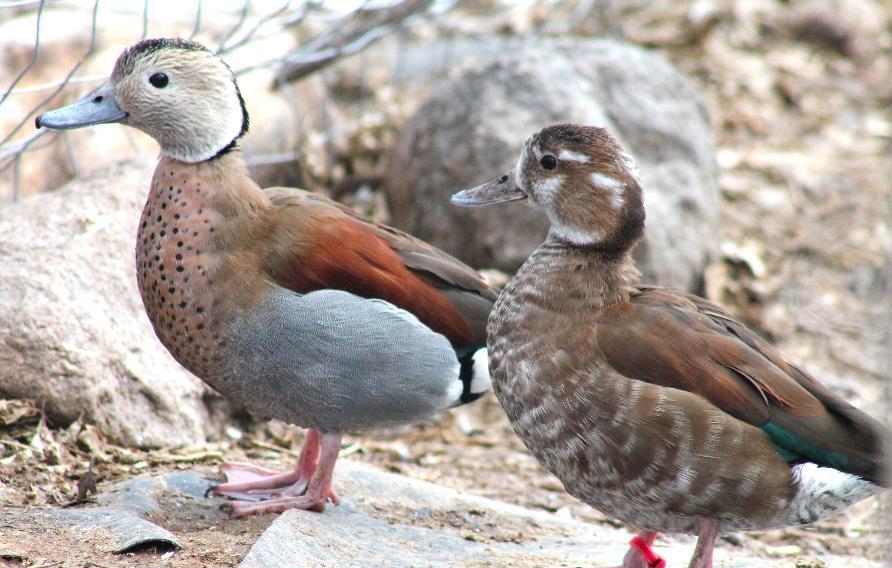
A small and colorful duck. Males have a chestnut back, pale grey sides, and a pinkish breast with black spots. A black stripe runs from the head to the neck. Females are brown with pale markings and fine barring. Both sexes have a white wing patch, pale rump, dark tail, grey bill, and pink legs. They have long claws that help them perch on branches.

Voice

Males give a soft, lingering peewoo call. Females make a cat-like mee-ow sound.

Diet

Feeds on aquatic plants, seeds, and small insects. It is a surface feeder (dabbler), often seen tipping forward to reach food.

Distribution

Found in northern Argentina, southern Brazil, Paraguay, Uruguay, and Bolivia.

Habitat

Lives in forested wetlands, marshy pools, and quiet streams in lowland wooded areas.

Breeding

Pairs form strong bonds. Nests are usually made in tree holes or sometimes in old parrot nests. The female lays 6–12 white eggs and incubates them for about 26–28 days. Both parents care for the ducklings until they fledge at around 50–55 days.

Wintering

Mostly stays within its range year-round but may move short distances after breeding.

Conservation

Currently not at risk. No major threats reported, but habitat loss and disturbance could affect local populations over time.

Similar Posts

  • Mottled Duck

    Scientific Name Anas fulvigula Alternative Names Mottled Mallard Measurements Sex Length Weight Wingspan Male 50–57 cm (19.7–22.5 in) 880–1,240 g (30.9–43.8 oz) 83–87 cm (32.7–34.3 in) Female 47–53 cm (18.5–21.0 in) 700–1,150 g (24.7–40.6 oz) 80–83 cm (31.5–32.7 in) Status Fairly common within its range. Populations are stable but closely monitored due to hybridization risks…

  • Eurasian Wigeon

    Scientific Name Mareca penelope Alternative Names Eurasian Wigeon, European Wigeon, Widgeon Measurements Feature Male Female Length 42–52 cm (17–20 in) 42–52 cm (17–20 in) Weight 500–1,073 g (1–2 lb) 500–1,073 g (1–2 lb) Wingspan 71–80 cm (28–31 in) 71–80 cm (28–31 in) Status A common and widespread dabbling duck across Europe and Asia. Classified as…

  • Hooded Merganser

    Scientific Name Lophodytes cucullatus Alternative Names Hoodie, Fish Duck, Frog Duck Measurements Feature Male Female Length 40–49 cm (15.8–19.3 in) 40–49 cm (15.8–19.3 in) Weight 453–879 g (16–31 oz) 453–879 g (16–31 oz) Wingspan 60–66 cm (23.6–26 in) 60–66 cm (23.6–26 in) Status The Hooded Merganser is a small, fish-eating duck native to North America….

  • Spectacled Eider

    Scientific Name Somateria fischeri Measurements: Feature Male Female Length 52–57 cm (20.5–22.5 in) 52–57 cm (20.5–22.5 in) Weight 1.8–2.3 kg (4–5 lb) 1.5–2.0 kg (3.3–4.4 lb) Wingspan 86–96 cm (34–38 in) 86–96 cm (34–38 in) Status The Spectacled Eider is listed as Threatened under the U.S. Endangered Species Act but Least Concern on the IUCN…

  • American Black Duck

    Scientific name Anas rubripes Common name American Black Duck Measurements Feature Average Length 54–59 cm (21–23 in) Wingspan 88–95 cm (35–37 in) Weight 720–1,640 g (1.6–3.6 lb) Status The American black duck is a large, dark-plumaged dabbling duck native to eastern North America. It remains one of the most iconic waterfowl species in the region,…

  • Lesser Scaup

    Scientific Name: Aythya affinis Alternative Names: Lesser Scaup, Little Bluebill, Broadbill Measurements: Feature Male Female Length 38–48 cm (15–19 in) 38–48 cm (15–19 in) Average Weight 820 g (1.81 lb) 730 g (1.61 lb) Wingspan 68–78 cm (27–31 in) 68–78 cm (27–31 in) Wing Length 19–20 cm (7.5–7.9 in) 19–20 cm (7.3–7.8 in) Bill Length…

Leave a Reply

Your email address will not be published. Required fields are marked *