
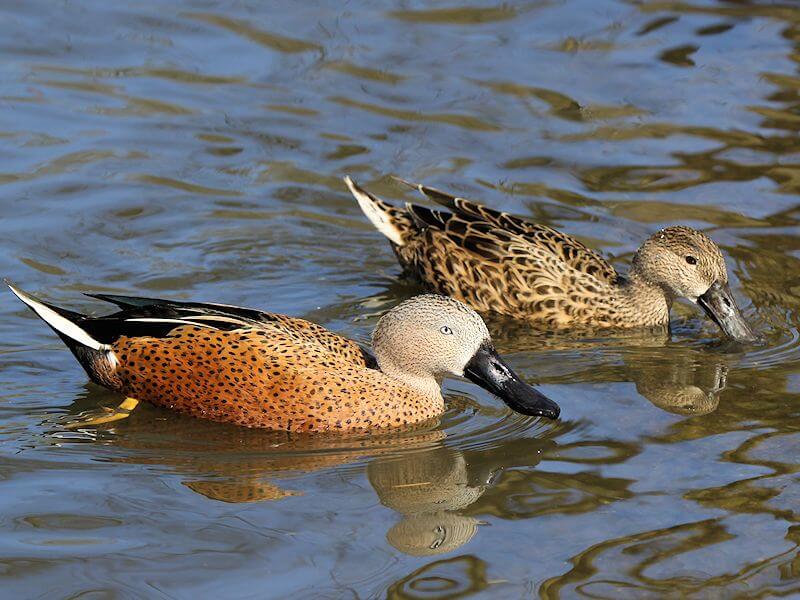
Red Shoveler

Scientific Name:

Spatula platalea

Alternative Names:

Red Shoveller, Shoveler Duck (South America)

Measurements:

FeatureMaleFemale
Length45–56 cm (18–22 in)45–56 cm (18–22 in)
Weight523–608 g (1.15–1.34 lb)Slightly lighter
Wingsspan66–73 cm (26–29 in)66–73 cm (26–29 in)

Status

A native of southern South America and still common in many areas. It is listed as Least Concern by the IUCN.

Identification

A medium-sized duck with a wide, spoon-shaped bill. Males have reddish-brown bodies, pale blue wing patches, and a green speculum. Females are mottled brown with a dark, broad bill. Both have pale blue upper wings and a long neck.

Voice

Males make soft wheezy whistles, while females give a quiet quacking sound.

Diet

Feeds mainly on aquatic plants like pondweed, grasses, algae, and eelgrass. Also eats small insects and tiny aquatic animals filtered through the bill.

Distribution

Found from Tierra del Fuego in the south up through Chile, Argentina, and the Falkland Islands. Smaller groups also live in parts of Peru, Bolivia, Paraguay, Uruguay, and southern Brazil.

Habitat

Prefers shallow lakes, marshes, reed-filled ponds, brackish lagoons, estuaries, and quiet coastal wetlands.

Breeding

Pairs form during the winter. The female lays 7–8 eggs in a nest hidden in vegetation. Incubation lasts 25–26 days, and ducklings fledge in 40–45 days.

Wintering

Partially migratory—birds from far south move north during winter, while others stay year-round in milder areas.

Conservation

Although not endangered, the species is affected by wetland loss, pollution from farms, and cattle trampling nesting sites. Protecting wetlands is important to keep their numbers stable.

Similar Posts

  • Common Pochard

    Scientific name Aythya ferina Alternative names Also known as the European Pochard, Eurasian Pochard, or simply Pochard in the UK. Measurements Feature Range Length 42–49 cm (17–19 in) Wingspan 72–82 cm (28–32 in) Weight 467–1,240 g (16.5–43.7 oz); males are heavier than females Status The Common Pochard is listed as Vulnerable on the IUCN Red…

  • Wandering Whistling Duck

    Scientific Name Dendrocygna arcuata Alternative Names Whistling Tree-Duck, Water Whistling Duck, Red Whistler Measurements Feature Male & Female Length 54–60 cm (21–24 in) Weight Around 750 g (1.65 lb) Status / Origin This species is native to tropical and subtropical regions of Australia, Indonesia, the Philippines, Papua New Guinea, Timor-Leste, Borneo, and nearby Pacific Islands….

  • Crested Shelduck

    Scientific Name Tadorna cristata Alternative Names Korean Crested Shelduck, Korean Sheldrake, Korean Mandarin Measurements Feature Male Female Length 63–71 cm (25–28 in) 63–71 cm (25–28 in) Weight Not well recorded, likely similar to other shelducks around 1.5–2 kg Slightly lighter than male Wingspan Not precisely known, estimated similar to other Tadorna species around 110–130 cm…

  • Southern Pochard

    Scientific Name Netta erythrophthalma Measurements Measurement Range Body Length 45–50 cm Wingspan Approximately 75–85 cm Weight 700–1,200 g Egg Count 6–15 eggs per clutch Incubation 20–28 days Status The Southern Pochard is currently listed as Least Concern by the IUCN, but its population has been steadily declining since the 1970s. In South America, estimates from…

  • Labrador Duck

    Scientific Name Camptorhynchus labradorius Alternative Names Pied duck, Skunk duck, Sand shoal duck Measurements Feature Measurement Body Length Approximately 51–58 cm Wingspan Estimated around 80–90 cm Weight Not well-documented, but believed to be similar to sea ducks of comparable size (around 1–1.5 kg) Status Extinct. The Labrador duck became extinct in the late 19th century….

  • Pink-eared Duck

    Scientific Name Malacorhynchus membranaceus Alternative Names Pink-eared Duck, Zebra Duck (rarely used), New Holland Duck (historical name) Measurements Feature Male Female Length 38–40 cm (15–16 in) 38–40 cm (15–16 in) Weight Not well documented Not well documented Wingspan Not well documented Not well documented Status A native Australian species that is still common in many…

Leave a Reply

Your email address will not be published. Required fields are marked *