
Lake Duck
Scientific Name
Oxyura vittata
Alternative Names
Argentine Blue-bill, Argentine Blue-billed Duck, Argentine Lake Duck, Argentine Ruddy Duck
Measurements
| Feature | Male | Female |
|---|---|---|
| Length | 36–46 cm (14–18 in) | 36–46 cm (14–18 in) |
| Weight | 600–850 g (21–30 oz) | 510–700 g (18–25 oz) |
Status
Native to South America, the Lake Duck is found across Argentina, Brazil, Chile, Paraguay, and Uruguay, and has been introduced to the Falkland Islands. It is listed as Least Concern by the IUCN, with a stable population estimated between 6,700 and 67,000 individuals.
Identification
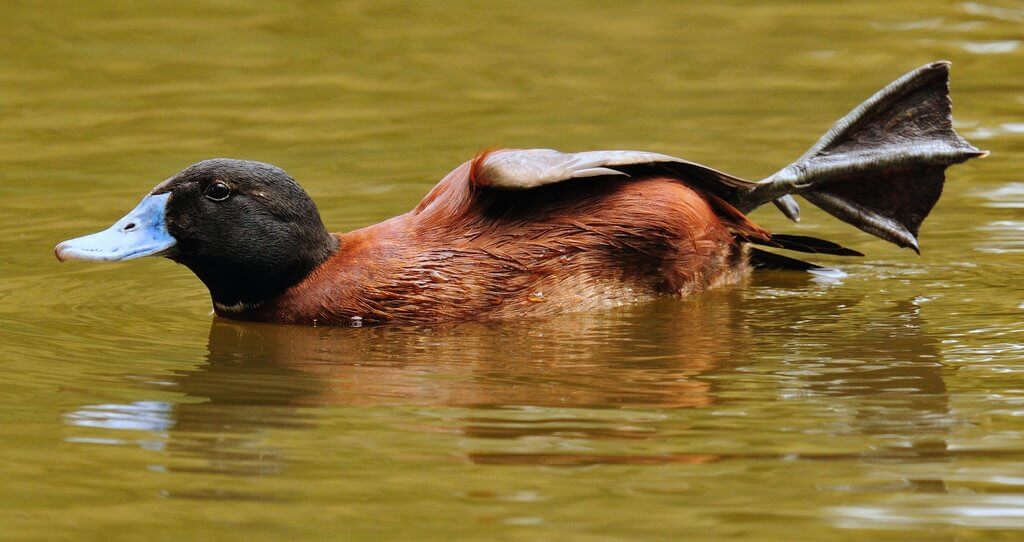
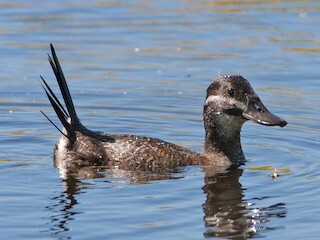
A small, compact stiff-tailed duck with a flattened head and low body profile. Males are smaller than the closely related Andean Duck and have a distinctively blue bill during the breeding season. Both sexes have short necks and a spiny, stiff tail often held upright.
Voice and Behavior
Males produce popping and rustling sounds during courtship displays. The species is known for its elaborate mating behavior and unusual reproductive anatomy. Males possess the longest penis relative to body size of any vertebrate, which can reach up to 42.5 cm (16.7 in). Both males and females have corkscrew-shaped reproductive organs, coiling in opposite directions—an evolutionary adaptation linked to mate selection and control.
Diet
Feeds mainly on small aquatic invertebrates, seeds, and plant material. It dives frequently to forage in vegetated waters.
Distribution
Found in freshwater lakes, wetlands, and marshes rich in aquatic vegetation. The species is partially migratory, moving locally depending on water levels and habitat conditions.
Habitat
Prefers still or slow-moving waters with dense aquatic plants that provide cover and nesting sites. Often seen in wetlands and lagoons rather than open rivers.
Breeding
Breeding season varies by region, typically from October to January in Argentina. Males perform noisy courtship displays to attract females. Nests are usually built among dense vegetation near water.
Conservation
Currently not threatened, though dependent on the health of wetland habitats. Maintaining natural water levels and vegetation cover helps support stable populations.