
Abacot Ranger
Scientific Name
Anas platyrhynchos domesticus
Alternative Names
Hooded Ranger, Streicherente (German for “Ranger Duck”)
Measurements
| Feature | Male | Female |
|---|---|---|
| Length | 50–60 cm (20–24 in) | 50–60 cm (20–24 in) |
| Weight | 3 kg (6.6 lb) | 2.5 kg (5.5 lb) |
| Wingspan | About 80–90 cm (31–35 in) | About 80–90 cm (31–35 in) |
Status
Once extinct in the United Kingdom but reintroduced from Germany in the 1970s. The breed is still rare but slowly growing in popularity in Europe. Not recognized by the American Poultry Association.
Average Life Span
Usually around 10 years, though egg production drops after 4–5 years.
Identification
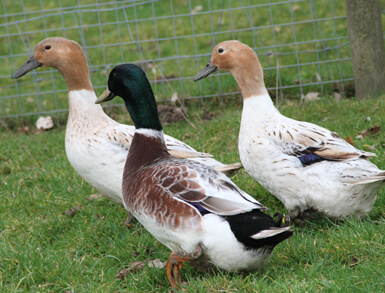
Abacot Rangers are medium-sized ducks with a creamy white body and fawn-buff “hood” on the head. Males have dark heads with a green shine and a white neck ring, while females keep their buff-colored hoods year-round. Drakes have olive-green bills, and females have slate-gray ones.
They show two plumage phases: a brighter breeding (nuptial) plumage and a darker eclipse plumage. Both sexes have elegant markings, and ducklings can be easily sexed by bill color after about eight weeks.
Breed History
The Abacot Ranger was developed in England between 1917 and 1922 by Mr. Oscar Gray of Abacot Duck Ranch in Colchester. It came from a cross between white sports of Khaki Campbells and white Indian Runner drakes. Originally named the Hooded Ranger, it performed very well in egg-laying trials at Wye College and Bentley in the early 1920s.
Although popular at first, the breed later disappeared from Britain. It survived in Germany, where it was known as the Streicherente, and was re-imported into the UK during the 1970s. It was accepted into the British Waterfowl Standard in 1983 and has since been valued for both egg production and exhibition.
Purpose
A true utility breed originally raised for both eggs and meat. Today, it’s often kept for exhibition, ornamental purposes, or as friendly backyard pets.
Breed Eggs
Abacot Rangers lay about 180–200 eggs a year. The eggs are white or cream-colored, weighing around 60–70 grams each. They have strong shells and are comparable in size to Indian Runner duck eggs. Females are good sitters and often go broody, meaning they can hatch their own eggs successfully.
Temperament & Behavior
Abacot Rangers are calm, hardy, and friendly. They tame easily and are gentle with people, making them great for families and small farms.
They rarely fly, so a low fence is usually enough to keep them contained. They are excellent foragers and love searching for grubs, insects, and snails. These ducks do best with plenty of outdoor space to roam and explore.
They are adaptable to both warm and cold climates as long as they have shelter.
Genetic Profile
The breed’s color pattern comes from a recessive “harlequin phase” gene, related to that seen in Welsh Harlequins but without the brown dilution. Bill color is sex-linked—males have olive-green bills, while females have darker gray bills.