
Andaman Teal
Scientific Name
Anas albogularis
Measurements
| Feature | Measurement |
|---|---|
| Length | Approximately 40–48 cm |
| Weight | Around 500–700 g (estimated from related species) |
| Wingspan | Approximately 70–80 cm (estimated) |
Status
The population was estimated at 500–600 individuals during surveys in 1995–1998, increasing to 674 in 2005, and further rising to slightly over 1,000 by 2014. This steady increase indicates improving conservation outcomes. However, due to its restricted range and reliance on wetland habitats, it remains vulnerable to habitat alteration and human disturbance.
Identification
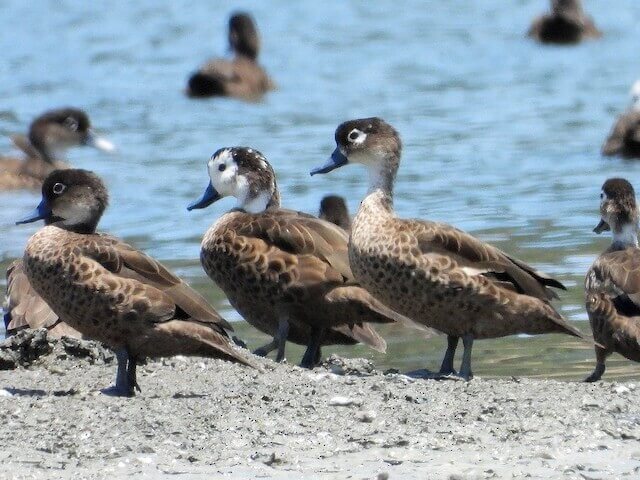
The Andaman teal is a dark brown duck with buff markings across the body. It has a pale face and throat, accented by a distinct white eye ring. The bill is bluish-grey, and the iris is red, giving the bird a striking facial appearance. Male and female plumage are similar, and the overall build is compact and typical of dabbling ducks.
Voice
It produces soft quacks and whistles similar to other teals. Vocal activity increases during the breeding season and at night when foraging.
Diet
This species feeds mainly during the night, particularly in rice fields. Its diet consists largely of molluscs and arthropods, but it may also consume aquatic vegetation and small invertebrates found in shallow wetlands.
Distribution
The Andaman teal is endemic to the Andaman Islands of India and has also been recorded on Great Coco Island in Myanmar. It is restricted to this island group in the Bay of Bengal, making its distribution highly localized.
Habitat
The species inhabits inland pools, mangroves, lagoons, and wetlands. It also frequents rice fields for nocturnal feeding. These calm, shallow water bodies with dense vegetation provide essential cover and feeding grounds.
Breeding
The breeding season occurs from July to October. Nests are built on the ground in reed patches and constructed from grass. The clutch comprises around nine eggs. Earlier assumptions that the species bred in tree hollows have been disproven by recent studies.
Wintering
This species is non-migratory and remains within the Andaman Islands throughout the year, showing no distinct wintering movements.
Conservation
While the population has shown an upward trend over recent decades, the Andaman teal remains vulnerable due to its limited range and wetland dependency. Habitat degradation, agricultural expansion, and human disturbance pose potential threats. Continued monitoring and habitat protection are essential to ensure sustained recovery.