
Australian Shelduck
Scientific name
Tadorna tadornoides
Alternative names
Also called the Chestnut-breasted Shelduck or Mountain Duck.
Measurements
| Feature | Range |
|---|---|
| Length | 56–72 cm (22–28 in) |
| Wingspan | 94–132 cm (37–52 in) |
| Weight | 1.3–1.6 kg (2.9–3.5 lb) |
Status
Protected under the National Parks and Wildlife Act 1974. Populations are stable, and the species benefits from farmland and water body conservation in Australia.
Identification
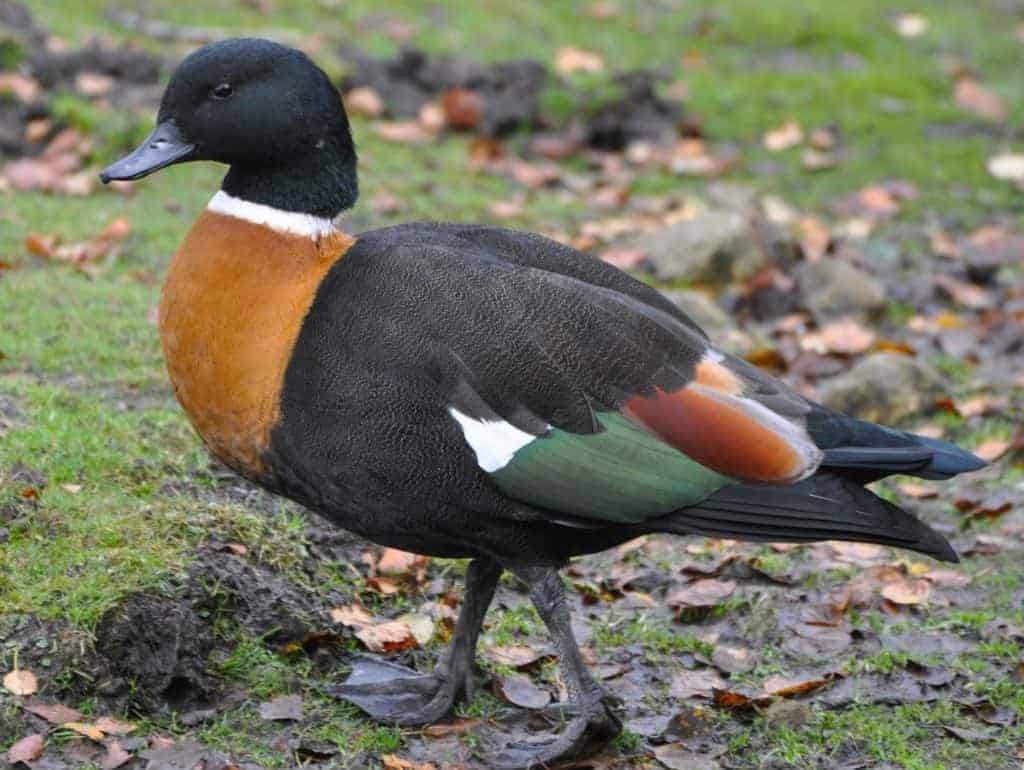
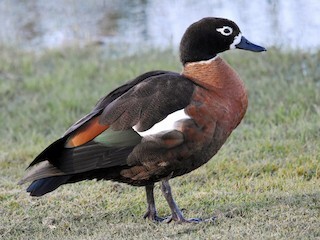
A large, brightly colored shelduck with a small head and bill. Males have a black head and neck tinged green, a white neck ring, dark brown underparts, and a chestnut breast. Females have a white eye-ring, slightly smaller size, and a chestnut breast. Both sexes display chestnut and black wings with a green speculum and some white markings visible during flight. Downy young are white with brown crowns and stripes, while juveniles are duller with fewer distinguishing markings.
Voice
Males produce a deep honk similar to a goose, while females emit a high-pitched, penetrating “zeek, zeek” call. Both sexes are vocal when humans approach, and their calls vary with social and breeding contexts.
Diet
Omnivorous: grazes on grasses, tubers, saltbush, samphire, algae, insects, crustaceans, and molluscs. They feed by grazing, dabbling, and filtering in shallow water or on land.
Behavior
Highly social, forming flocks of up to 1,000 individuals. Wary of humans but can adapt to urban areas. Upright posture on land while grazing, and they sit high in water. Juveniles dive frequently; adults dive mainly when flightless during moulting or when threatened.
Distribution
Mainly breeds in southern Australia and Tasmania, with winter movements farther north. Vagrants occasionally reach Kimberley and Central Australia.
Habitat
Prefers lakes and open freshwater environments. Can use saltwater habitats if fresh water is nearby. Key moulting sites include large wetlands like Lake George (NSW) and the Coorong (SA).
Breeding
Monogamous, sometimes forming permanent pair bonds. Nests in tree hollows, rabbit burrows, or cliff-face hollows lined with down. Females lay 8–15 eggs and incubate them for 30–33 days while males defend the territory. Downy flightless young gather in crèches of 20–40, sometimes up to 100. Breeding season: July to December.
Wintering / Seasonality
After breeding, some populations migrate to large wetlands to moult. Flocks congregate at key sites to replace flight and tail feathers.
Conservation
Some local populations have increased due to the creation of farm dams and wetland habitats. Clearing of some land for agriculture has not had a significant negative impact on overall population trends.