
Bronze-winged Duck
Scientific name
Speculanas specularis
Alternative names
Also called the Spectacled Duck or Pato Perro (“Dog Duck”).
Measurements
| Feature | Range / Note |
|---|---|
| Length | ~56–60 cm (estimated from related sources) |
| Weight | ~1–1.3 kg (estimated) |
| Wingspan | Data not widely documented |
Status
Near Threatened (IUCN). Population estimated at fewer than 7,000 individuals.
Identification
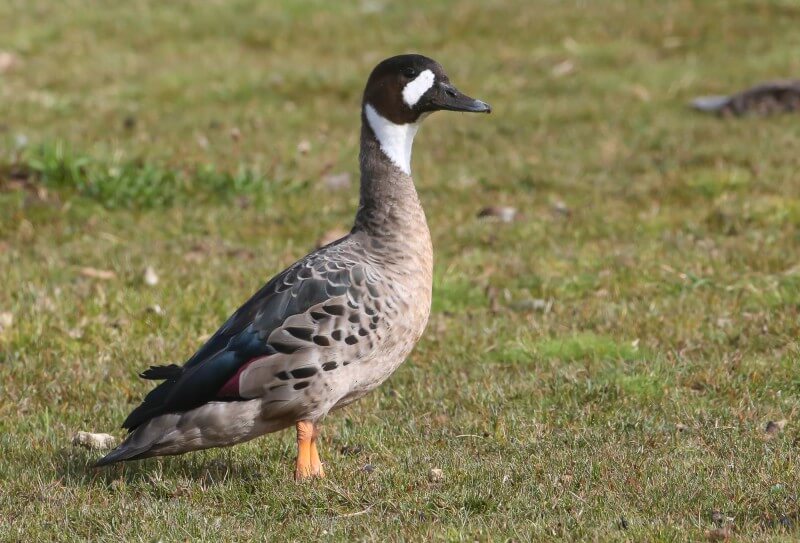
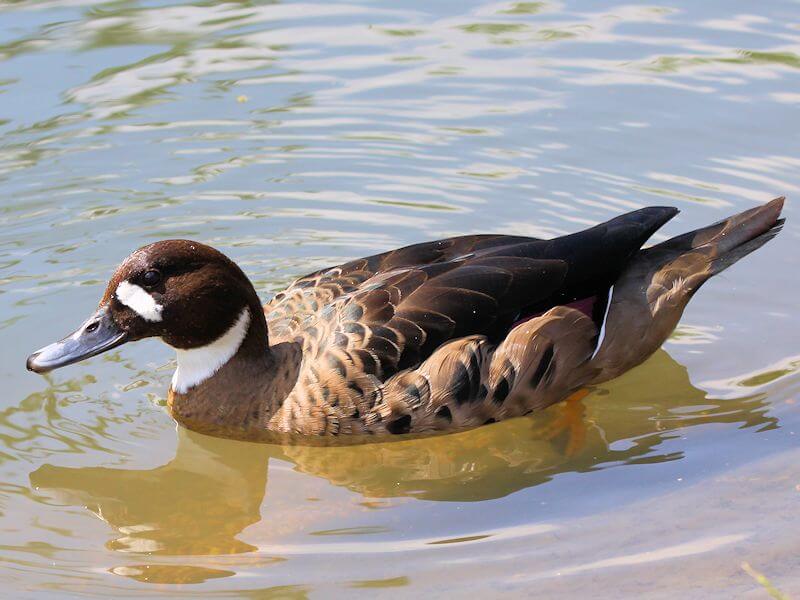
A river duck with striking markings. Both sexes are alike: dark brown hood, white oval patch between the lores and malar, large white gular crescent. Back is dark chocolate, abdomen pale gray-buff. Wings display a brilliant bronze speculum, giving the species its common name. The duck is medium-sized, with a small, rounded head and a short, dark bill.
Voice
The female emits a harsh barking call, which inspired the local name “Pato Perro.” Male vocalizations are quieter.
Diet
Omnivorous: consumes seeds of water plants (water crowfoot, water milfoil, pondweed), leaves, aquatic insects, caddis fly larvae, and small snails. Forages primarily in shallow streams, forested rivers, and along stony shores; may feed on land in captivity. Does not usually dive for food.
Behavior
Shy and elusive. Usually seen alone or in pairs rather than in flocks. Prefers heavily forested rivers but also occurs on slow-moving rivers, ponds, and forest-adjacent wetlands.
Distribution
Found in central and southern Chile and adjacent Argentina, including forested Andean slopes and Patagonian wetlands. Northern populations may inhabit high Andean plateaus.
Habitat
Prefers forested rivers, fast-flowing streams, and riverine wetlands. Usually avoids open areas, relying on forest cover for safety. Can be found from sea level up to 1,500 m.
Breeding
Breeds mostly in rivers near forested regions, sometimes in ponds or wetlands close to rivers. Nesting habits are not widely documented but are tied to sheltered aquatic habitats.
Seasonality
Non-migratory but may move locally along rivers and streams depending on water levels and food availability.
Conservation
Population is small, and the species is sensitive to habitat disturbance. Conservation focus includes protecting forested rivers and wetlands in the southern Andes.