
Chestnut Teal
Scientific name
Anas castanea
Alternative names
None widely used; sometimes simply called Chestnut Duck.
Measurements
| Feature | Range |
|---|---|
| Length | 38–48 cm |
| Weight | 600–700 g |
| Wingspan | 75–90 cm |
Status
Listed as Protected under the National Parks and Wildlife Act 1974 (Australia).
Identification
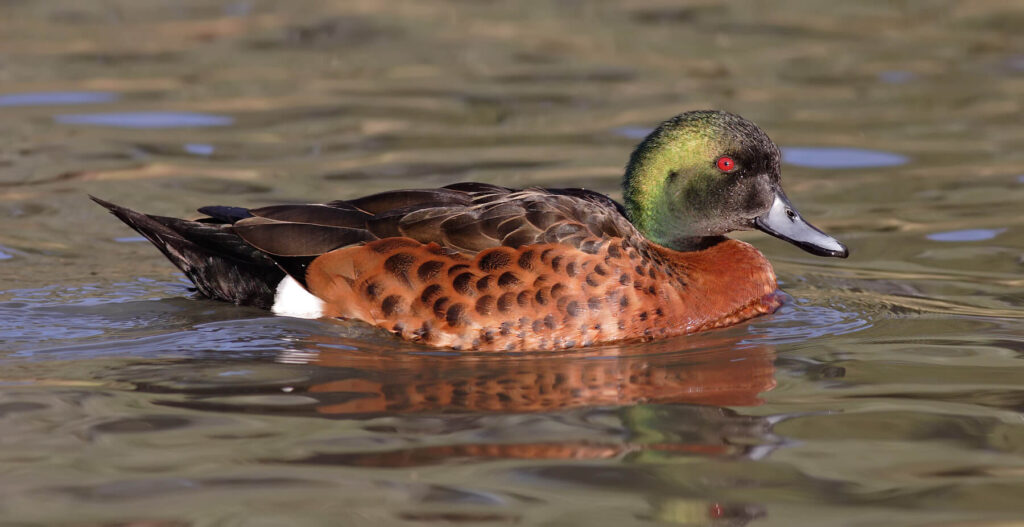
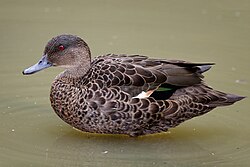
A small dabbling duck with a rounded head and short neck. Males stand out with glossy green heads, chestnut-brown necks, breasts, and flanks, dark brown backs, and a black undertail with a white patch. Females are mottled brown and grey with a pale throat streaked brown and a dark eye stripe, closely resembling the Grey Teal. Both sexes have deep red eyes, blue-grey bills, and green-grey legs and feet. The speculum on the wing is glossy green to purple, edged in white. In flight, they show white underwings and contrasting brown coverts.
Voice
Males produce sharp whistles and soft grunts, while females give a loud, chuckling “laughing” quack repeated many times. Calls are similar to the Grey Teal but slightly deeper in tone.
Diet
Feeds mainly on seeds, aquatic plants, insects, crustaceans, and molluscs. They are often seen dabbling or up-ending at the water’s edge, especially during the rising tide when food is washed in.
Behavior
Usually found in pairs or small groups, though larger flocks may gather outside breeding season. Chestnut Teals form long-term monogamous pairs. Both parents defend the nesting site and brood, and males stay near the female during incubation to help guard against predators. If threatened, adults may feign injury to distract danger from ducklings.
Distribution
Common across south-eastern and south-western Australia, with strong populations in Tasmania and southern Victoria. Occasionally found as far north as New Guinea and Lord Howe Island, and as far south as New Zealand.
Habitat
Prefers coastal estuaries, tidal flats, and wetlands. Tolerant of saltwater but requires fresh water for drinking. Also uses inland lakes, reservoirs, and even sewage ponds during dry periods. Nesting sites include tree hollows over water or grassy areas close to wetlands.
Breeding
Breeding pairs remain together year-round. Nests are built in down-lined hollows 6–10 m above water or on the ground in dense vegetation. The female lays 9–11 eggs, incubating them for about 28 days. Ducklings leave the nest within a day of hatching and are cared for by both parents. Occasionally, females “dump-lay” eggs in another’s nest, creating large clutches.
Wintering
Many Chestnut Teals stay near breeding areas year-round, but some move short distances between coastal and inland wetlands in response to seasonal changes in water levels and food supply.
Conservation
Populations have declined due to wetland loss, drainage, and coastal development. Despite these threats, the species adapts well to artificial nest boxes and protected sanctuaries. Major predators include foxes, ravens, lizards, and raptors. Hunting remains a minor threat in some regions, but populations are considered stable overall.
