
Green-winged Teal
Scientific Name
Anas carolinensis
Alternative Names
American Teal, Green-winged Teal
Measurements
| Feature | Male | Female |
|---|---|---|
| Length | 31–39 cm (12–15 in) | 31–39 cm (12–15 in) |
| Weight | 140–500 g (4.9–17.6 oz) | Slightly lighter |
| Wingspan | 52–59 cm (20–23 in) | 52–59 cm (20–23 in) |
Status
A common and widespread dabbling duck across North America, the Green-winged Teal is listed as a species of Least Concern due to its large and stable population. Some scientists once considered it the same species as the Eurasian Teal (Anas crecca), but most authorities now treat it as separate based on clear differences in behavior, appearance, and genetics.
Identification
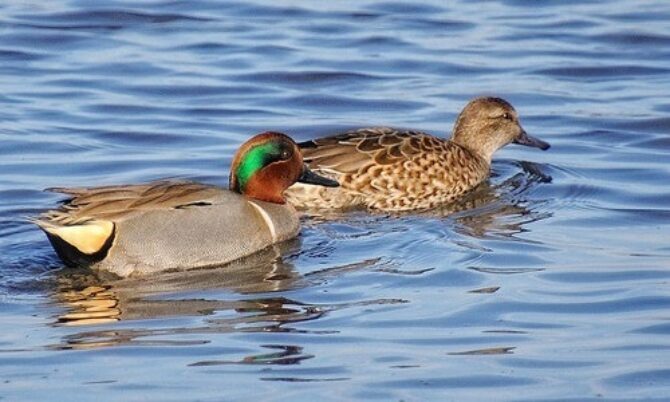
The male Green-winged Teal is one of the most striking small ducks, with a chestnut head crossed by a bright green eye patch and a gray body with a vertical white stripe on the side of the breast. The female is mottled brown, resembling a small female Mallard, but shows a distinct green patch (speculum) on the wing. Both are small, compact ducks with short necks and a rapid, twisting flight. In eclipse plumage, males resemble females but retain their green wing patch.
Voice
Males produce a clear, thin whistle “preee-trrr”, while females have a soft quack or kek-kek call. They are quite vocal, especially during courtship or when flying in flocks.
Diet
Mostly plant-based, feeding on the seeds and shoots of aquatic plants, grasses, and sedges. They also eat small insects, crustaceans, and mollusks, especially during breeding season. These ducks often feed by dabbling or picking along mudflats and shallow waters, sometimes grazing in flooded fields.
Distribution
Breeds across northern North America, from Alaska and Canada to the northern United States, and winters as far south as Central America and the Caribbean. They can also be seen in Hawaii and occasionally reach South America.
Habitat
Prefers shallow freshwater wetlands, marshes, and ponds surrounded by grasses or brush. During migration and winter, they gather in estuaries, flooded fields, and rice paddies. They avoid treeless open areas, favoring sheltered sites with emergent vegetation like cattails and bulrushes.
Breeding
Arrives early in spring, nesting soon after the snow melts. The female builds a well-hidden nest in tall grass or brush near water, laying 5–16 eggs. She incubates alone for 21–23 days. Ducklings grow quickly and can fly at about 6 weeks old, among the fastest-growing of all ducks. Males leave after incubation to molt in groups on quiet waters.
Wintering
Highly migratory. Winters from southern Alaska and the U.S. to Central America. Often found in large flocks on calm lakes, marshes, and estuaries, where they feed and rest together.
Conservation
The Green-winged Teal faces threats from habitat loss due to wetland drainage, pollution, and hunting pressure. However, it is protected under the Migratory Bird Treaty Act, and its populations remain stable, supported by ongoing wetland conservation projects across North America.