
Stejneger’s Scoter
Scientific Name
Melanitta stejnegeri
Alternative Names
Siberian Scoter, Macreuse de Sibérie (French), Negrón siberiano (Spanish)
Measurements
| Feature | Measurement |
|---|---|
| Body Length | 53–60 cm |
| Wingspan | Around 86–99 cm |
| Weight | 1.1–1.8 kg (males heavier than females) |
Status
Least Concern (IUCN), although localized declines have occurred. It was formerly grouped with the White-winged Scoter (Melanitta deglandi) but is now recognized as a full, monotypic species.
Identification
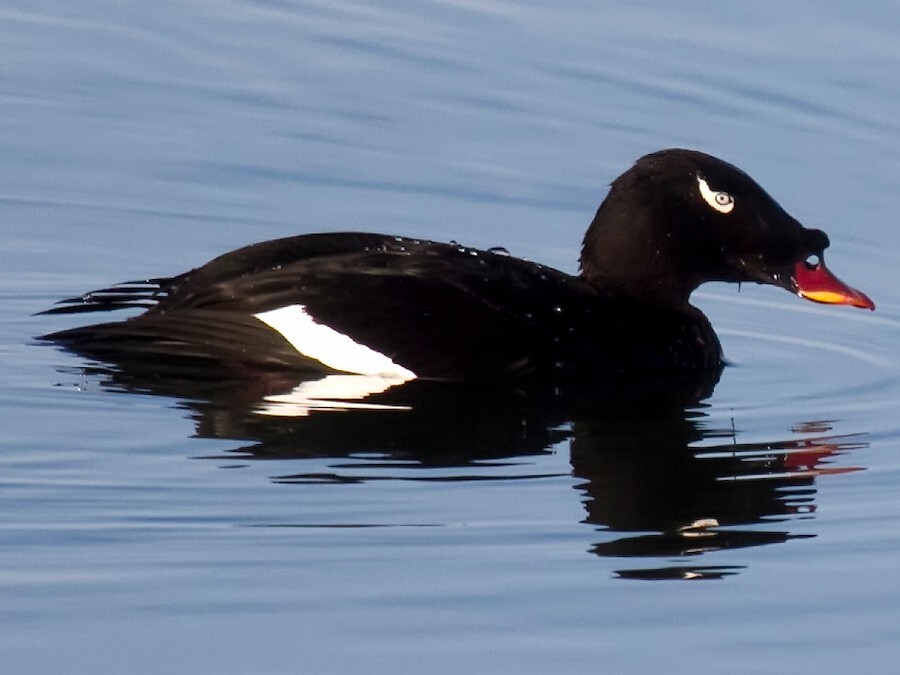
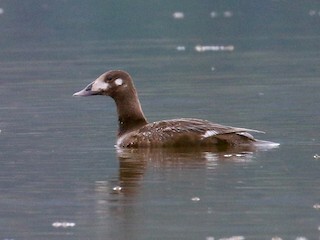
A large sea duck with males almost entirely black. The male has an orange-yellow bill with a large, swollen black knob at the base that rises above the bill line, giving a “Roman nose” profile. The nostrils can appear as a joined slit beneath this knob. Females are dark brown, with paler patches on the cheeks similar to other scoters but often show a subtle puffiness near the upper bill base. Compared to White-winged Scoter, Stejneger’s has a more sloping facial outline and an acute angle of feathering along the bill base instead of a right angle. Juveniles resemble females but are paler with more distinct facial markings.
Voice
Their calls are poorly documented but are believed to resemble other scoters—low whistles and soft grunts produced mainly during courtship or flight.
Diet
A diving duck that feeds on aquatic invertebrates. In freshwater habitats it consumes insects, crustaceans and small molluscs. In marine environments, it feeds largely on bivalves, gastropods and crabs. Off the coast of Japan, crabs become the primary prey at depths of 30–40 m, highlighting its strong diving ability.
Distribution
Breeds in northern Asia east of the Yenisey Basin across Siberia to Kamchatka, with small populations in Mongolia, Sakhalin and northeastern Kazakhstan. Winters in coastal East Asia—Russia’s Pacific coast, Sea of Okhotsk, Korean Peninsula, northern China, the Kuril Islands and Japan. Rare vagrant to Europe, and occasionally appears in Alaska and western North America.
Habitat
Breeds near small freshwater ponds, lakes and river edges within boreal forest and southern Arctic tundra. Some populations occupy high-altitude lakes up to 2,000 m in Kazakhstan. Winters at sea in shallow, coastal waters rich in shellfish. Young birds may remain at sea for their first year.
Breeding
Nesting begins from late May to June. Pairs are monogamous, establishing small territories near water. The nest is a shallow scrape lined with vegetation, concealed in grasses or shrubs near water margins. Clutches consist of 6–9 eggs, each laid roughly every 36 hours. Incubation is done by the female, likely for 27–30 days. Chicks hatch covered in dark down on top and white underneath and are able to swim soon after hatching. They fledge at around 50–55 days.
Wintering
Winters mainly along Pacific coastlines in sheltered, shallow, marine waters. Some may remain on unfrozen inland lakes. Wintering flocks are dense and often include thousands of individuals.
Conservation
Currently not globally threatened. Main concerns include oil spills, coastal habitat degradation, entanglement in fishing gear and disturbance in breeding wetlands. Climate change-caused shifts in Arctic wetland ecology may also impact breeding success. Though not heavily hunted, it is vulnerable to environmental change due to its dependence on specific coastal feeding grounds.