
Brown Teal
Scientific Name
Anas chlorotis
Alternative Names
Pāteke in Māori.
Measurements
| Feature | Measurement |
|---|---|
| Length | 48–54 cm |
| Weight | 500–700 g |
| Wingspan | 75–86 cm |
Status
The brown teal is endangered, with fewer than 1000 adult birds remaining. It is listed as Endangered by BirdLife International and will be reflected as such in the IUCN Red List. Historically abundant across New Zealand, populations drastically declined due to hunting and predation from introduced mammals. Legal protection began in 1921, and ongoing conservation programmes have helped re-establish populations in predator-controlled areas.
Identification
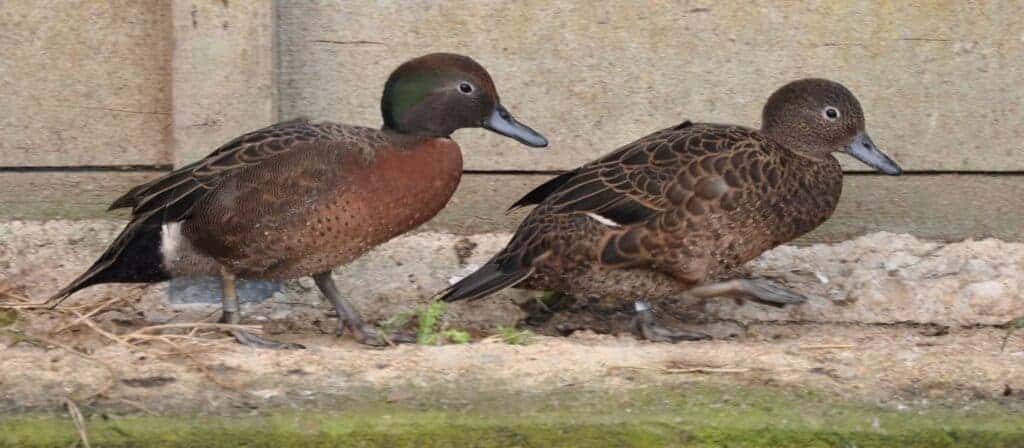
During non-breeding season, males, females, and juveniles all appear similar, showing mottled brown plumage and a distinct white eye ring. In breeding season, males develop a green head, chestnut breast, and white flank stripe, sometimes accompanied by a white collar. Females remain mottled brown year-round. Plumage variation among males occurs, with some showing brighter colours than others.
Voice
The male produces a soft wheezy whistle, while the female gives a loud, rasping quack. Vocalisations are more frequent during the breeding season, particularly at night when they are most active.
Diet
This species feeds by dabbling and upending. Its diet includes aquatic invertebrates, insects, larvae, crustaceans, and molluscs such as pipi and wedge shells. They crush smaller molluscs whole in the gizzard, while for larger cockles, they use a unique method of inserting their bill between shells and extracting the flesh with rapid pumping motions. At night, they may forage on land away from waterways.
Distribution
Once widespread across mainland New Zealand, the brown teal is now primarily found on offshore islands and in mainland predator-proof sanctuaries such as Tawharanui Regional Park. Reintroductions have been conducted in areas including the Awapoto River in Abel Tasman National Park, where populations have successfully bred since 2017.
Habitat
Brown teal inhabit coastal wetlands, estuaries, streams, and damp pasturelands. They prefer shallow freshwater or brackish environments and use streams and dense vegetation as refuge during the day due to their largely nocturnal nature.
Breeding
They construct nests from dry grass and lined with down, usually near water or under cover of vegetation such as large Carex. The female lays four to eight creamy-brown eggs and incubates them for 27–30 days. The male stays nearby, guarding the territory aggressively against other waterfowl.
Wintering
The species is non-migratory and remains within its local territories year-round, using coastal wetlands and streams as seasonal refuges. During winter, they continue nocturnal foraging while relying on sheltered wetlands for protection.
Conservation
Protection efforts include captive breeding, predator control, and reintroduction programmes. The original captive populations were sourced mainly from Great Barrier Island, which has raised concerns over loss of genetic diversity compared to other populations.
Some historical populations, such as the Fiordland brown teal, showed evidence of hybridisation with mallards and grey ducks before extinction. Ongoing management focuses on predator eradication, habitat restoration, and improving genetic representation in released flocks.
