
Redhead
Scientific name:
Aythya americana
Alternative names:
Red-headed duck, Red-headed pochard
Measurements
| Feature | Range |
|---|---|
| Length | 40–56 cm (16–22 in) |
| Weight | 1,030–1,080 g (36–38 oz) |
| Wingspan | 74–84 cm (29–33 in) |
Status
The redhead’s population is healthy and stable, with an estimated 1.4 million birds in North America. It accounts for about 2% of the continent’s duck population. The species has benefited from protective hunting regulations and wetland conservation efforts, and it is listed as Least Concern under the IUCN Red List.
Identification
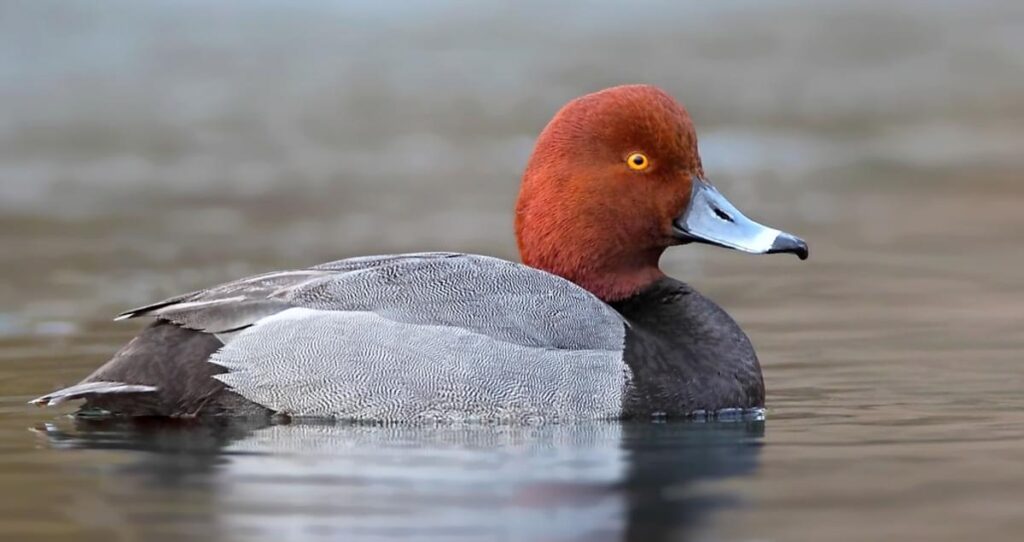
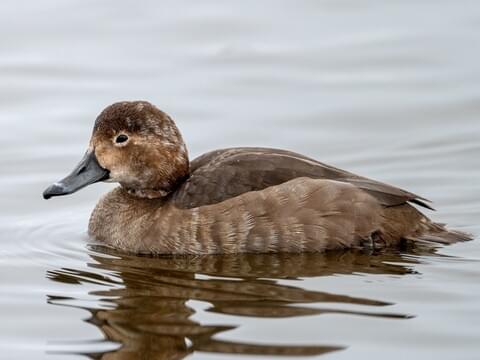
A medium-sized diving duck distinguished by the male’s rich copper-colored head, black breast, and pale blue bill tipped with black. Its bright yellow eyes and rounded head profile set it apart from the canvasback, which has a longer sloping forehead and red eyes. Females are mottled brown with a paler face and a blue-gray bill marked with a darker tip. Both sexes have gray backs, white bellies, and black rumps. Like other pochards, redheads have large webbed feet, a broad bill for underwater foraging, and legs positioned far back on the body, making them strong divers but awkward walkers.
Voice
Males produce a cat-like wheee-oww or soft coughing call during courtship displays, particularly when extending the neck in the “neck-stretching” display. Females emit a low, rough errrr sound when inciting a male. Outside the breeding season, both sexes are mostly silent.
Diet
Omnivorous and opportunistic, redheads consume aquatic plants, pondweeds, wild rice, wild celery, grasses, and seeds, along with mollusks, snails, and insect larvae. During breeding season, they favor protein-rich animal matter such as gastropods and larvae, while in winter they switch primarily to a plant-based diet suited to coastal and inland wetland environments.
Behavior
Redheads are social and often gather in large flocks, especially during migration and wintering. They dive efficiently for food and are agile swimmers. They form pair bonds during migration, with elaborate courtship rituals involving neck-stretching, head-throwing, and soft vocalizations. Females are known for occasional brood parasitism—laying eggs in the nests of other diving ducks such as canvasbacks and scaups.
Distribution
Redheads breed across North America’s prairie pothole and boreal regions, especially in British Columbia, Alberta, Saskatchewan, Manitoba, and the Dakotas. During migration, they travel south through the Great Plains and Great Basin, wintering along the Gulf of Mexico, the southern U.S., Mexico, and the Caribbean. Small numbers reach Central America.
Habitat
Breeding occurs in semi-permanent wetlands surrounded by sedges, cattails, or bulrushes. They prefer deep freshwater marshes with dense emergent vegetation for nesting. In winter, they shift to large coastal bays, estuaries, reservoirs, and inland lakes sheltered from strong wave action, where aquatic plants are plentiful.
Breeding
Pairs form during winter or early spring, with nests built by females from dense plant material, often over or near water. Redheads are notable brood parasites—females sometimes lay eggs in the nests of other ducks, reducing the hatching success of the host species. A typical clutch has 5–7 eggs. Ducklings are independent feeders and fledge at about 8 weeks, though the mother may abandon them 2–4 weeks earlier.
Wintering
In winter, redheads move to warmer regions where lakes and wetlands remain unfrozen. The largest concentrations occur along the Gulf Coast, particularly in Texas, Louisiana, and Florida. They feed in mixed flocks, mainly on aquatic vegetation and seeds, and occasionally mix with canvasbacks and scaups.
Conservation
The redhead remains secure thanks to conservation efforts focused on wetland protection and regulated hunting. Stable breeding habitats in semi-permanent wetlands have supported population growth. Continued protection of migratory stopovers and wintering wetlands is vital for maintaining its healthy numbers.