
American Black Duck
Scientific name
Anas rubripes
Common name
American Black Duck
Measurements
| Feature | Average |
|---|---|
| Length | 54–59 cm (21–23 in) |
| Wingspan | 88–95 cm (35–37 in) |
| Weight | 720–1,640 g (1.6–3.6 lb) |
Status
The American black duck is a large, dark-plumaged dabbling duck native to eastern North America. It remains one of the most iconic waterfowl species in the region, though it has experienced population declines in recent decades. Despite these declines, it is listed as Least Concern by the IUCN due to its wide range and stable overall numbers.
Identification
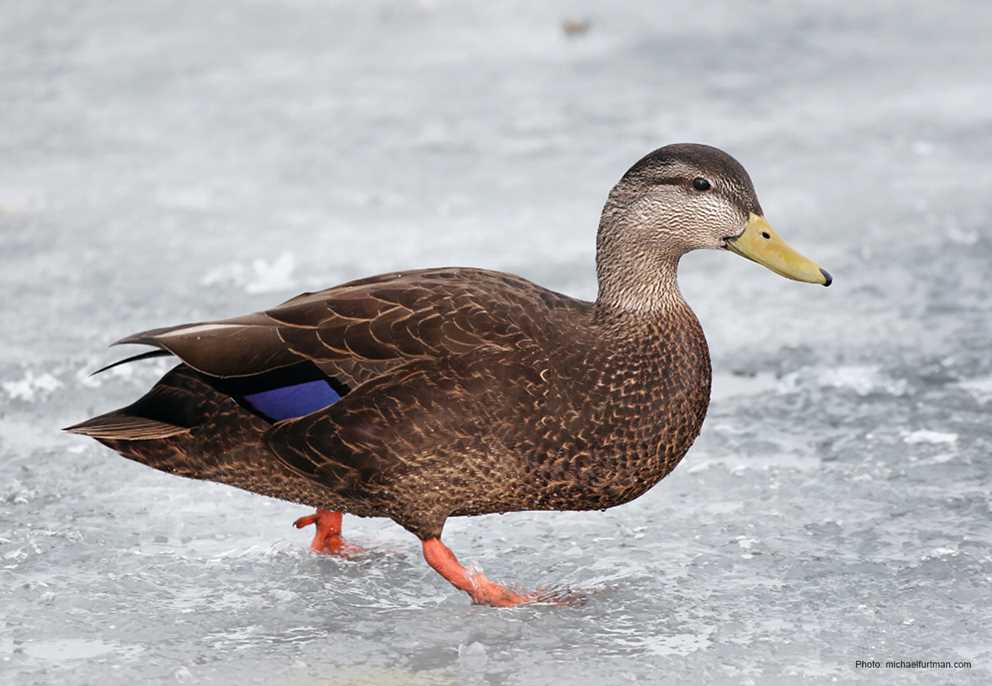
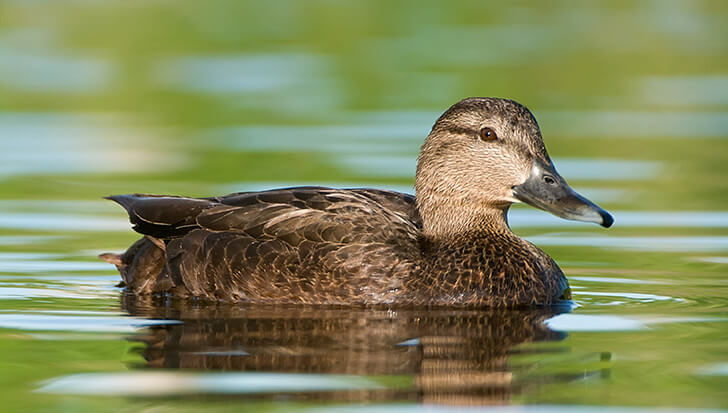
The American black duck closely resembles the female mallard but has a darker, chocolate-brown body and lighter brown head and neck. Males and females look similar, but males have a yellow bill while females’ bills are dull green with darker markings. The speculum feathers are a glossy violet-blue bordered in black, lacking the white bands seen in mallards. In flight, the contrast between its dark body and pale underwings is distinctive.
Voice
Its call is similar to that of the mallard—a series of loud quacks, with the female’s voice being slightly deeper and raspier.
Distribution
Found throughout eastern North America, breeding from Saskatchewan and the Great Lakes to Newfoundland, the Atlantic coast, and the northeastern United States. In winter, it migrates to the east-central and mid-Atlantic U.S., frequenting coastal marshes, estuaries, and agricultural wetlands.
Habitat
This species inhabits freshwater and coastal wetlands—bogs, marshes, lakes, rivers, and brackish estuaries. It prefers shallow, vegetated waters and is often seen in tidal marshes during winter. American black ducks adapt well to both inland and coastal environments.
Behaviour
They feed by dabbling in shallow water or grazing on land, consuming aquatic plants, seeds, grasses, insects, mollusks, and small fish. Outside the breeding season, they often form small groups or mixed flocks with mallards and other dabbling ducks. They are wary and quick to take flight when disturbed.
Breeding
Breeding occurs across northern and northeastern North America, typically in marshes, bogs, and forested wetlands. Nests are hidden on the ground among dense vegetation. Females lay 6–14 eggs, creamy-white to buff green in color. Incubation lasts about 25–26 days, with both parents defending the nesting territory early on. Ducklings fledge in about six weeks and initially feed on aquatic invertebrates before shifting to vegetation.
Wintering
During winter, American black ducks migrate south to coastal and inland wetlands along the Atlantic Flyway, from southern Ontario and New England down to the Carolinas. Many spend the season in tidal marshes, estuaries, and flooded agricultural fields, where they forage in mixed flocks with mallards. Some individuals remain year-round in the Great Lakes region if open water and food sources are available.
Conservation
The American black duck has faced long-term population declines due to wetland loss, hybridization with mallards, hunting pressure, and climate-related changes. Habitat destruction from urbanization and rising sea levels further threatens its breeding and wintering grounds.
Conservation programs by the U.S. Fish and Wildlife Service, Atlantic Coast Joint Venture, and Boreal Forest Conservation Framework focus on wetland restoration, land protection, and habitat management. Despite regional declines, the species remains widespread and is still considered Least Concern globally.