Ducks With Hoods: Meet Nature’s 8 Hooded Waterfowl Wonders

A hood refers to the large, fan-shaped crest or patch of feathers on the back of a bird’s head. Most birds use them for courtship and display—either to communicate with members of their own species or to intimidate others, since they often make the bird appear larger than it really is.
For birders, hoods are also incredibly useful for identification, as that bold, fan-shaped head is often the feature that gives certain birds their signature look or even their names.
Hoods can either be recumbent (not noticeable when not raised) or recursive (more constantly visible and always giving the head a distinct shape and outline, even when relaxed).
Only a few ducks have hoods, and it’s not just ducks either: very few bird groups in general show this kind of feature. In fact, crests and hood-like structures occur across roughly 20–30 orders of extant bird species. This simply tells us that hooded ducks are special in their own right and well worth appreciating.
So, how many hooded ducks can you think of apart from the ones that literally have “hood” in their names? Let’s take a look at some of the most popular duck species that wear this striking head crest.
1. Hooded Merganser
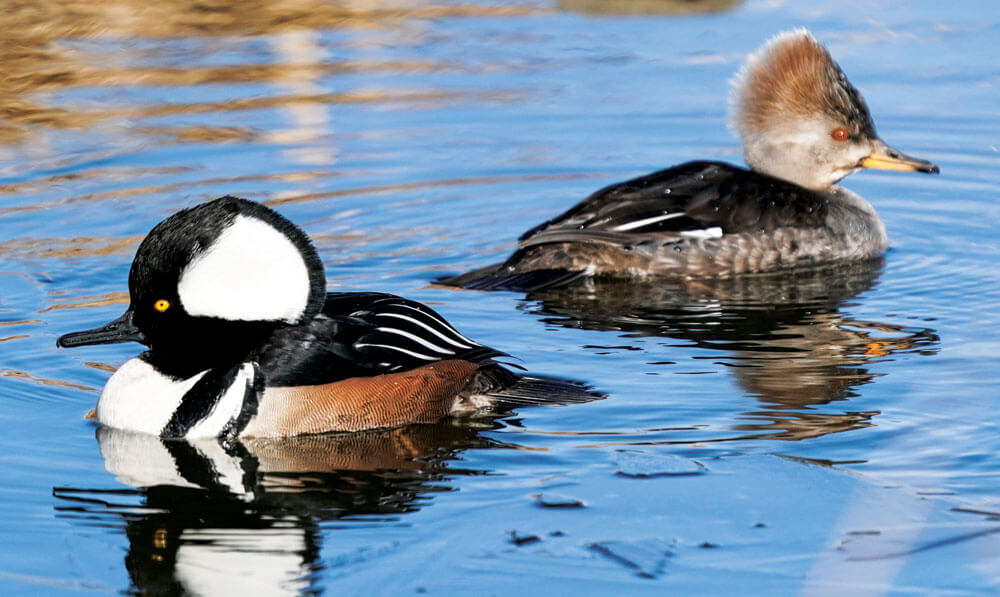
The first hooded duck we are all familiar with is the one that actually carries the name itself, the Hooded Merganser.
In the field, it is a striking bird, especially in breeding plumage, where the male displays a bold, high-contrast pattern and an unmistakable expandable crest that he can raise into a dramatic fan or flatten into a sleeker profile.
Both males and females possess this hood-like crest, and although the female is more subdued in colour, the shape and structure remain equally distinctive. This ability to expand or compress the crest gives the bird a strong change in silhouette, which is one of its most useful identification features in the wild.
In terms of size, the Hooded Merganser is the second-smallest merganser species, exceeded in compactness only by the smews of Eurasia. It is also the only merganser found naturally only in North America, which adds to its interest for birdwatchers outside its range.
Behaviorally, these ducks are short-distance migrants. They tend to migrate southwards in winter, favoring sheltered waters across the United States where lakes, rivers, and ponds remain unfrozen and suitable for diving and foraging.
2. Bufflehead
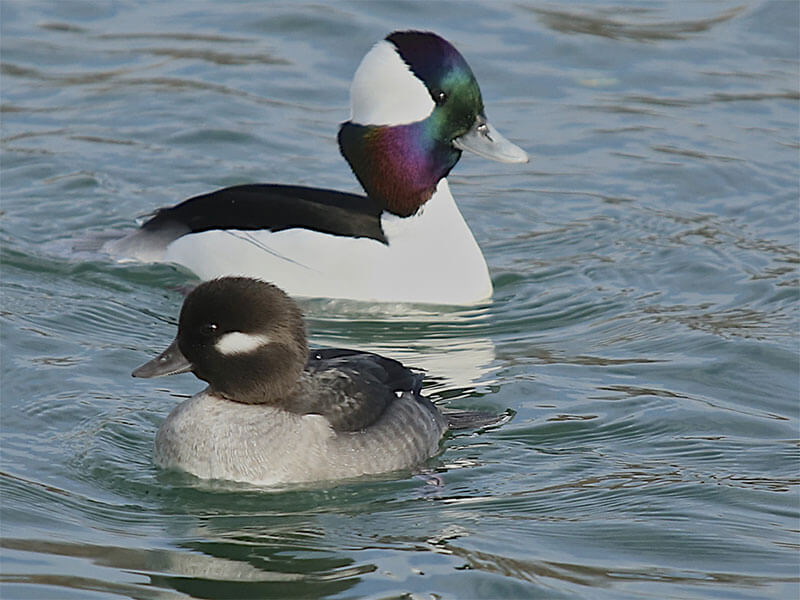
The next hooded duck commonly encountered in the field is the Bufflehead, a species that is often confused with the Hooded Merganser due to its similarly striking head pattern and compact diving form.
Adult males have a crisp black-and-white plumage and an iridescent head that shifts between green and purple tones in good light. A clean, bold white patch behind the eye gives the head a distinctive, high-contrast “masked” appearance.
Females are more muted, showing soft grey tones with a smaller white cheek patch and a pale underside, but they still retain that characteristic head pattern that makes the species easy to identify.
Buffleheads are migratory ducks, spending the winter on protected coastal waters as well as open inland lakes and reservoirs. They are widely distributed along both the east and west coasts of North America and also occur in the southern United States during the colder months. In addition, they are regularly seen wintering on the Great Lakes.
3. Red-crested Pochard
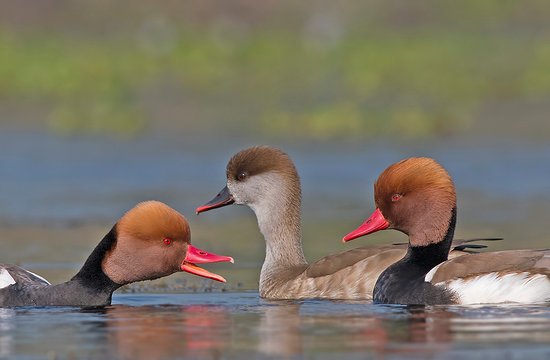
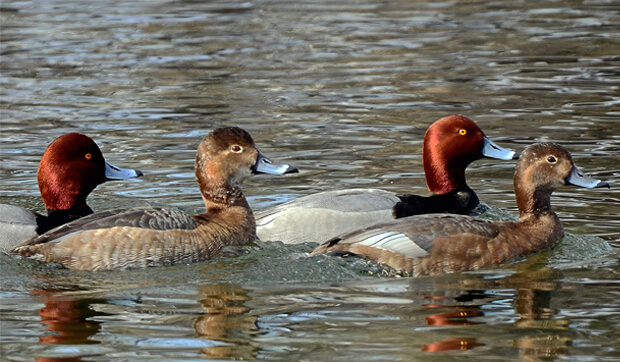
The Red-crested Pochard is a large diving duck that also stands out with its beautiful, glowing orange hood.
The adult male is unmistakable in the field. He carries a rounded, glowing orange head paired with a bright red bill and a contrasting black breast. The body is equally striking, with clean white flanks, a rich brown back, and a black tail that completes the bold colour palette. The female is more subdued but still elegant, showing mainly pale brown plumage, a darker crown and back, and a soft whitish face that gives her a gentler expression compared to the male.
This species breeds in lowland marshes and lakes across southern Europe, with its range extending eastwards through steppe and semi-desert regions around the Black Sea into Central Asia and Mongolia. During winter, it migrates to warmer waters in the Indian subcontinent and parts of Africa.
4. Ring-necked Duck
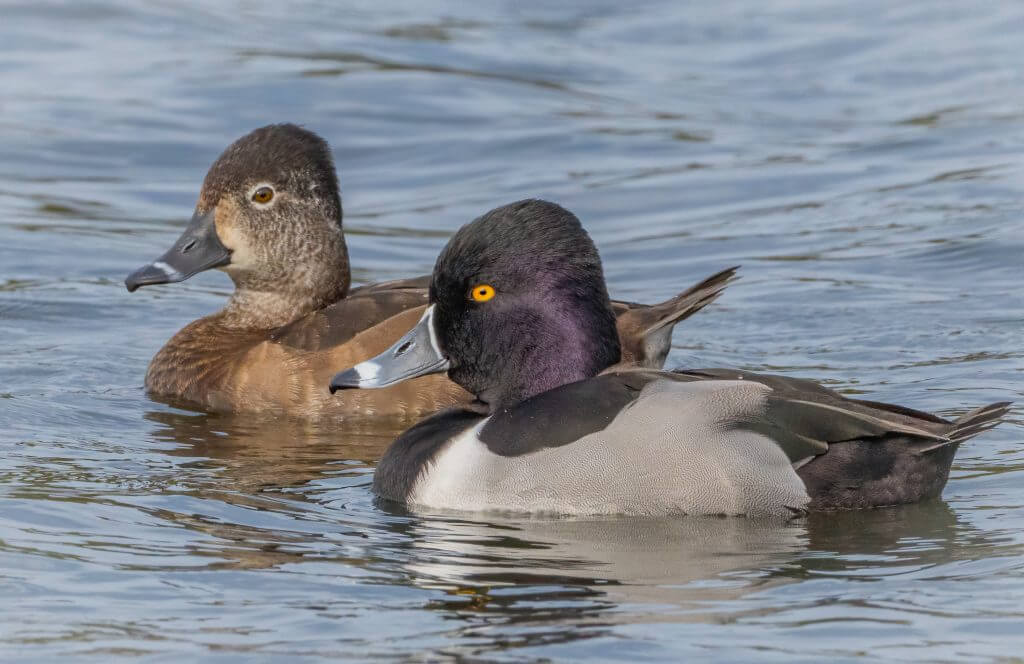
The Ring-necked Duck is another hooded-looking species, with an angular head shape that gives the strong impression of a dark, structured “hood” sitting neatly over the crown.
Males are slightly larger than females and are especially striking in breeding plumage. They show a glossy black, sharply contoured head, contrasted by a grey bill marked with two thin white rings. The body is equally well patterned, with a black back, a clean white breast, a bold white stripe along the wing, and bright yellow eyes that stand out against the dark head.
Females are more subdued but still show the same angular head shape. Their plumage is mostly grey-brown with a darker brown back, a dark bill with a faint pale band, and brown eyes highlighted by a subtle whitish eye-ring.
Ring-necked Ducks breed in wooded lakes and ponds across northern North America, particularly within the boreal forest regions of Canada and the northwestern United States. They are omnivorous feeders, typically diving for food but also dabbling at the surface when conditions allow.
5. Blue-billed Duck
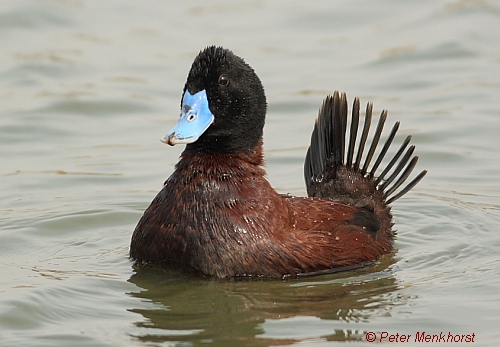
The Blue-billed Duck is another hooded-looking species, where the male’s glossy head and neck form a deep, dark “hood” that contrasts sharply with its richly colored body and vivid bill.
During the breeding season, the male is particularly striking. His head and neck become a sleek, glossy black that reads like a smooth, fitted hood, set against a warm chestnut body. The bill, which is slate-blue for much of the year, intensifies to a bright, vivid blue in breeding condition, giving the species its common name and adding a strong flash of colour to an otherwise dark head profile. Outside the breeding season, the plumage becomes duller and more grey-toned, but the compact, hooded head shape remains.
The female is more understated, retaining a darker, brown-toned plumage throughout the year, with softer feather edges and a less conspicuous bill, but still sharing the same compact diving-duck build.
This species is endemic to the temperate regions of Australia, with a distribution spanning southern Queensland through New South Wales and Victoria, and extending into Tasmania. It is typically associated with deeper wetlands, where it can be seen diving for food below the surface.
The Blue-billed Duck is also known for its elaborate courtship behavior. Males perform a range of complex displays, including head-rolling, preening movements, and dramatic underwater actions where the head is submerged in a forward-leaning posture.
Duck Identification Posters/Charts
Celebrate the beauty of ducks with detailed, high-resolution identification posters designed for both learning and decor. Each chart features vibrant colors, sharp details, and a smooth premium finish that’s perfect for classrooms, study spaces, living rooms, or offices.

6. Falcated Duck
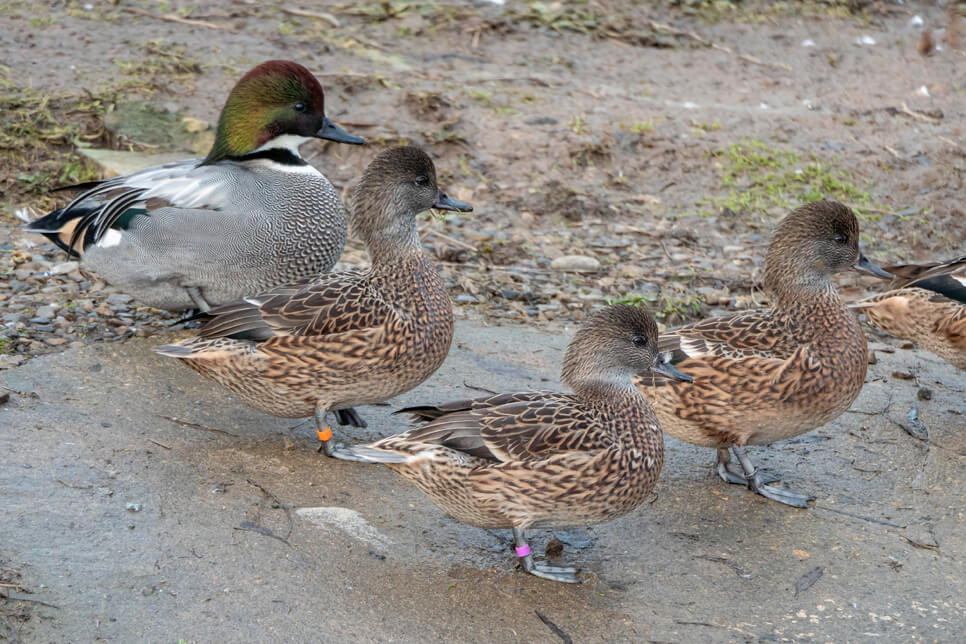
The large, crested head of the Falcated Duck can also give the impression of a flowing “hood” or a soft mane.
The breeding male is unmistakable. His body is finely patterned in delicate grey vermiculations, giving a soft, textured appearance across the flanks and back. From this refined body pattern, the long, sickle-shaped tertials sweep elegantly over the rear of the body, creating one of the species’ most distinctive features and the origin of its name.
The head is striking, with deep green colouring and a clear white throat. It is surrounded by a darker green neck band and a slightly bronzed crown, which gives the head a warm and rich appearance.
The female is more subdued, dressed in dark brown plumage with a pattern reminiscent of a female wigeon, making her less conspicuous but still recognisable in structure and shape.
This species is native to the East Palearctic region, breeding from eastern Siberia and Mongolia through to northern Japan, and migrating as far south as India during the winter months. It is currently listed as Near Threatened on the IUCN Red List, with hunting pressure (both for food and its beautiful feathers) being one of the primary threats to its populations.
7. Smew
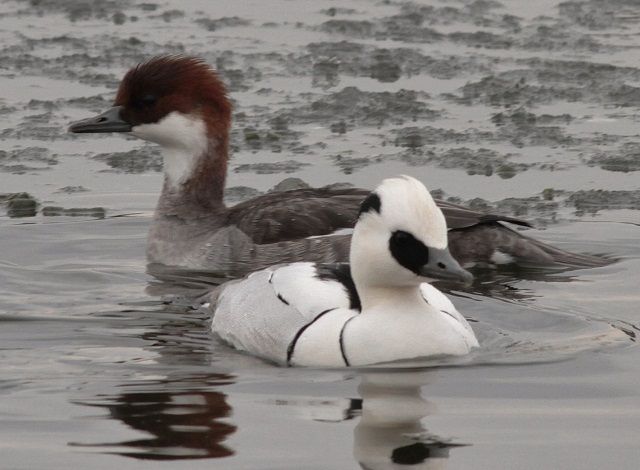
The Smew stands out not just for its beautiful contrasting black and white colors, but also for the way its head pattern forms a tight, hood-like mask across the face.
The adult male has crisp black-and-white plumage that creates a bold contrast, with fine dark markings breaking up the white in a way that is often described as a “cracked ice” pattern. In flight, it appears sharply monochrome, almost graphic in its contrast, making it easy to identify even at a distance.
Females and young males are mainly grey, with a warm chestnut forehead and crown, pale cheeks and chin, and darker markings around the eyes. Because of this reddish head coloring, they are sometimes referred to as “redhead” smew.
This shy diving duck breeds across the northern Palearctic, from Scandinavia all the way east to Chukotka. It is closely tied to forested wetlands, relying on trees near freshwater lakes and rivers for nesting.
8. Common Goldeneye
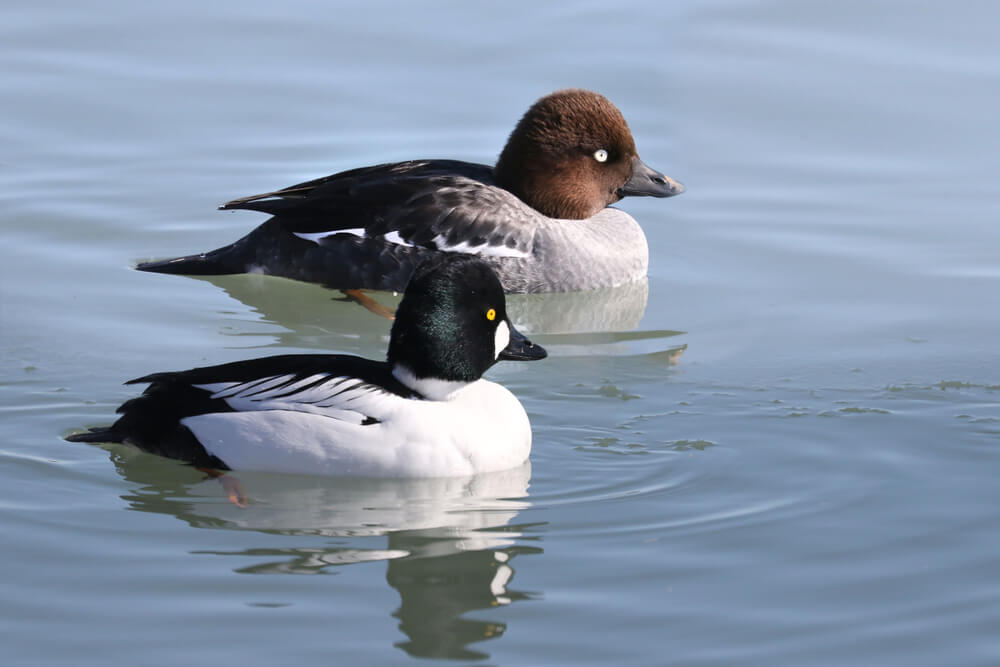
The final duck species we had to include in this list is the Common Goldeneye, thanks to its large, bulbous head, which gives it a naturally hooded appearance.
The species is named for its striking golden-yellow eyes, which are one of its most distinctive features. Adult males show a dark head with a subtle greenish sheen, broken by a clean circular white patch just below the eye. This contrasts with a dark back and a bright white neck and underparts, creating a sharp, high-contrast look. Females are more muted, with a warm brown head and a mostly grey body, but they still share the same characteristic head shape.
Common Goldeneyes are cavity nesters, typically using holes in large trees and often returning to the same nesting sites year after year. They also readily accept nest boxes where natural cavities are limited.
During the breeding season, they are notably territorial and highly active in courtship, with elaborate displays between competing males and interested females. Their breeding range lies within the taiga, where they inhabit lakes and rivers across boreal forests in Canada, the northern United States, Scotland, Scandinavia, the Baltic region, and northern Russia.