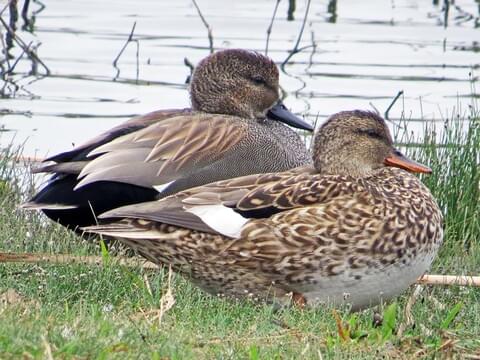
Hawaiian Duck Vs Mallard: Notable Differences Explained
Among the many ducks that resemble the Mallard, one that often goes unnoticed—largely because some birders don’t realize it’s a separate species—is the Hawaiian Duck. Mallards are well known for interbreeding with closely related indigenous wild ducks, and in some cases, this widespread hybridization has become a serious conservation concern. In fact, the mixing of gene pools has been cited as a threat that can ultimately lead to the extinction of native species.
Unfortunately, this is the very fate that has impacted the Hawaiian Duck. Today, truly pure Hawaiian Ducks are found only in a handful of locations. So, if you think you’ve spotted one, there’s a good chance you may actually be looking at a Mallard–Hawaiian Duck hybrid.
So how can you tell a pure Hawaiian Duck apart from a Mallard—especially female Mallards, which look strikingly similar? Below are some of the most notable differences.
About the Hawaiian Duck

The Hawaiian Duck, also known as the Koloa, is a native duck found only in Hawaii. Its scientific name is Anas wyvilliana, and it belongs to the same family as the Mallard. Locally, it is often called Koloa Maoli, which simply means “native duck.”
This species was once found across most of the Hawaiian Islands, but things have changed over time. Due to over-hunting, habitat loss, and introduced predators like the mongoose, their numbers dropped significantly. Today, their main stronghold is on Kauaʻi, with smaller populations found in places like North Kohala. Some birds have also been reintroduced to islands such as Maui, Oʻahu, and Hawaiʻi, but overall, the species is still considered endangered.
One of the biggest challenges facing the Hawaiian Duck is hybridization with Mallards. Because Mallards were introduced to the islands, they began interbreeding with the native ducks. This has made pure Hawaiian Ducks much harder to find in the wild, and in many areas, what you’re seeing may actually be hybrids. Still, there is hope—some relatively pure populations are believed to remain, especially on Kauaʻi.
In terms of appearance, Hawaiian Ducks look very similar to female Mallards. Both males and females have a mottled brown body, which can make identification tricky. However, there are a few subtle traits. Their wing patch (speculum) is usually green to blue with white borders. Their tails are generally darker overall, unlike the more contrasting tail of a Mallard. Males tend to be slightly larger and have a darker head and neck, while females are a bit lighter in color. Their bills also differ slightly—males usually have an olive-green bill, while females have a dull orange bill with dark markings.
Notable Differences
Here are some quick features you can use to distinguish Hawaiian Ducks from female Mallards.
1. Size
One of the first differences you can notice between these two ducks is size. The Hawaiian Duck is generally smaller than the Mallard, both in length and weight.
The Mallard is a medium-sized waterfowl and tends to be more robust. It measures about 50–65 cm in length, with a wingspan of around 81–98 cm. It is also fairly heavy compared to many dabbling ducks, weighing between 0.7 and 1.6 kg depending on the individual.
In contrast, the Hawaiian Duck is noticeably smaller. Males average about 48–50 cm in length, while females are even smaller at around 40–43 cm. In terms of weight, males average about 604 grams, and females around 460 grams. Overall, the Hawaiian Duck is typically about 20–30% smaller than a Mallard.
This difference is not always easy to judge in the field, but when the two species are seen side by side, the Hawaiian Duck often looks more compact and lighter in build.
2. Overall Plumage

Another useful feature is overall plumage color. Hawaiian Ducks usually have a darker, more uniform appearance compared to Mallards.
They tend to be rich brown throughout the body, with less contrast between the different parts of their plumage. This gives them a more subdued look overall. In contrast, female mallards often show a lighter, more patterned appearance with more variation in tones of brown and buff.
Because of this, Hawaiian Ducks can sometimes look more solid in color, while Mallards appear more streaked or mixed in shading. This difference can be subtle, but it becomes easier to notice when you compare multiple birds together in the field.
3. Eye Ring

Hawaiian Ducks typically have a pale eye ring that stands out gently against their darker face. It is usually light buff or whitish in colour, giving the eye a slightly highlighted look without being too bold.
In Mallards, the eye area is usually less distinct. Female Mallards may show some faint pale markings, but they are often less clear or not as consistently visible as in Hawaiian Ducks.
This subtle eye ring can be a helpful clue, especially when observing the head closely in good lighting.
4. Tail


The tail is another helpful feature when comparing these two species. In Hawaiian Ducks, the tail is generally dark overall and has a more uniform look. Both males and females may show some mottling or speckling, but the tail does not have strong contrasting colours.
Mallards, on the other hand, have a more clearly patterned tail. They often show a mix of black and white, creating a noticeable contrast, especially when the bird is in flight or lifting its tail while swimming.
Because of this difference, the Hawaiian Duck’s tail tends to look more blended and less striking, while the Mallard’s tail appears more sharply marked.
5. Sexual Dimorphism
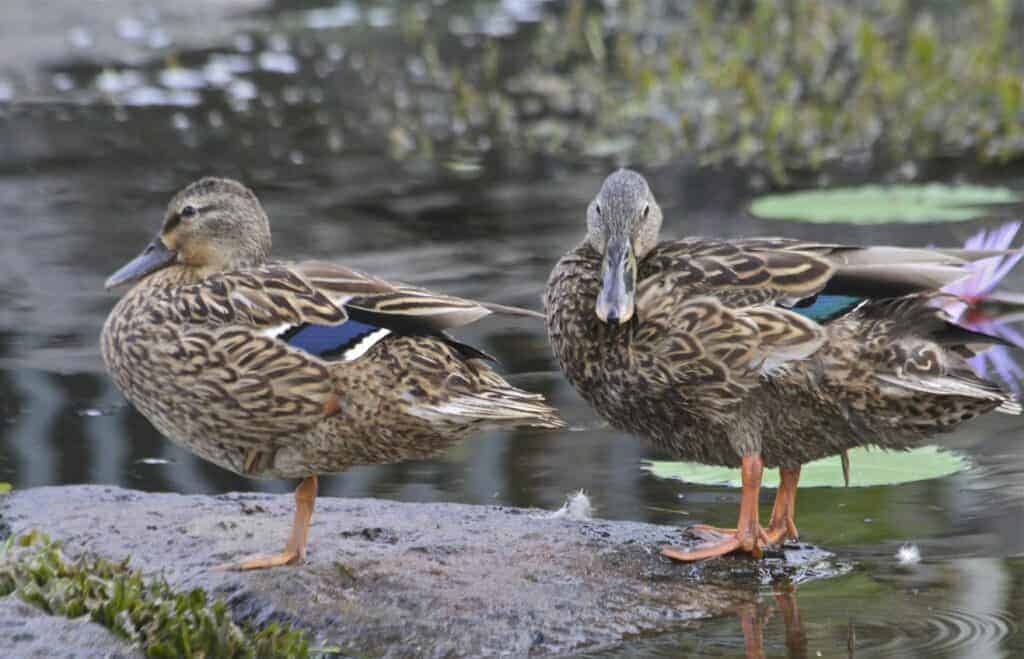
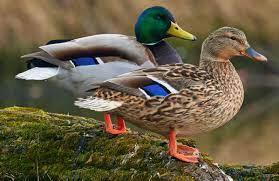
One final clue that can be useful, especially when you are watching a group of ducks, is the lack of strong differences between males and females.
In Hawaiian Ducks, both sexes look quite similar. They are mostly brown and mottled, with only subtle differences in shade and size. Males do not show the bright green head or the curled black tail feathers that are typical of male Mallards.
In Mallards, the difference between the sexes is very clear. Males are usually much more striking, with a green head and a distinct curled tail feather, while females are more plain and brown.
So, if you are observing a group of ducks and only see brown, similar-looking birds with no brightly colored males, there is a good chance you may be looking at Hawaiian Ducks rather than Mallards or hybrids.
Duck Identification Posters/Charts
Celebrate the beauty of ducks with detailed, high-resolution identification posters designed for both learning and decor. Each chart features vibrant colors, sharp details, and a smooth premium finish that’s perfect for classrooms, study spaces, living rooms, or offices.