
15 Most Strange Looking Ducks on the Planet

Most of us watch ducks gliding across ponds, rivers, and lakes without giving much thought about them. They’re familiar, almost part of the everyday scenery in parks and wetlands around the world. But spend a little longer studying these birds, and you start to realize ducks are anything but ordinary.
There are over 130 species of ducks worldwide, and while many fit the classic image of a calm, floating birds with glossy feathers and flat bills, others look like they’ve taken a completely different evolutionary path. Some have extravagant crests, others have oversized bills, unusual color patterns, or shapes that seem more suited to a fantasy illustration than real life.
Maybe it’s that combination of beauty and oddity that makes them so fascinating. Or maybe it’s the surprise factor: just when you think you know what a duck looks like, another species shows up and completely changes your expectations.
From the elegantly strange to the outright bizarre, these are the ducks that make you stop, stare, and wonder how nature got so creative.
1. Musk Duck
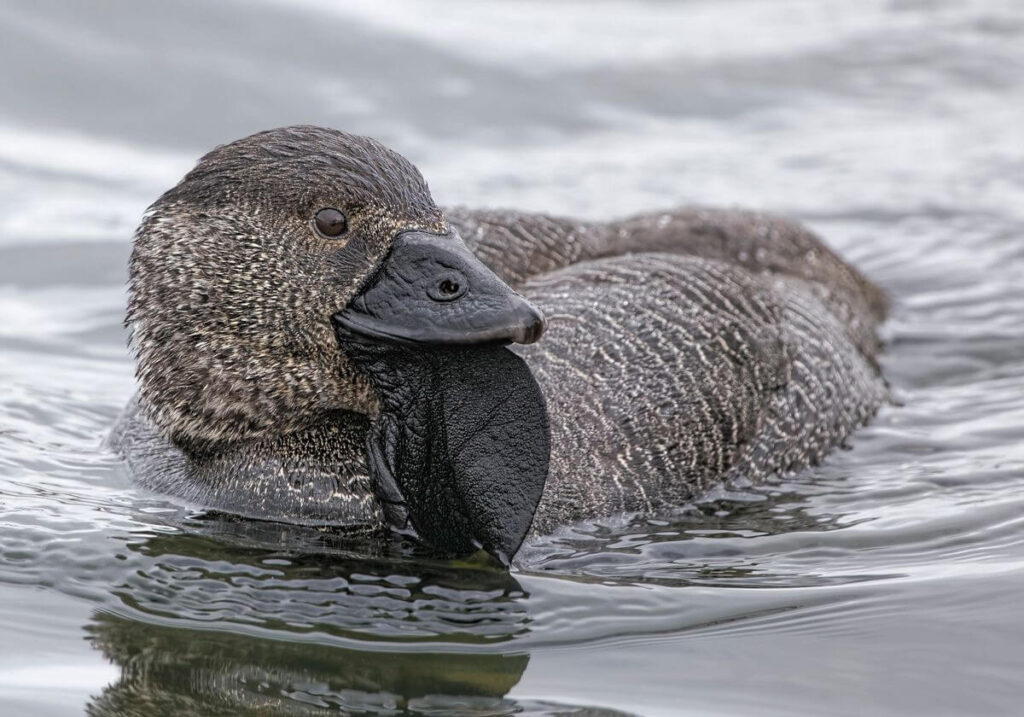
Weird waterfowl don’t get much weirder than the Musk Duck. Native to Australia, this deep-diving duck carries an air of awkward mystery, from its unusual looks to its even stranger behavior during the breeding season.
In breeding season, males show an enlarged leathery lobe under the bill, giving the head a bulky, almost top-heavy appearance. They’re also known for the strong musky odour they produce at this time, which is unusual even among waterfowl, and it is where the species gets its name.
Their courtship display is also one of the most unusual in any duck species. Males sit low in the water, raise the tail, and kick hard behind them to throw up jets of water while giving a thin, whistling call and inflating a throat sac.
Outside the breeding season, they are quiet birds that spend most of their time underwater. They don’t fly often, but when they do, they fly swiftly and cover long distances with rapid, shallow wingbeats. However, take-off is difficult, and landings tend to look awkward and unsteady.
2. Knob-billed Duck

The Knob-billed Duck looks like someone stuck a handle on its face and forgot to remove it. That oversized black knob on the male’s bill is impossible to ignore, and once you see it, you won’t mistake this duck for anything else.
Found across tropical wetlands in sub-Saharan Africa, Madagascar, and parts of South and Southeast Asia, this species has a bold, almost patchwork appearance. Adults show a white head dotted with dark spots, a clean white neck and underparts, and glossy blue-black upperparts that shimmer with green and blue iridescence in good light.
Males are noticeably larger than females and carry that prominent bill knob, which gives the species its name and adds to its already unusual look. Females lack the knob and appear more streamlined by comparison.
Unlike many ducks, they often nest in tree holes, though they will also use tall grass when needed, which is another reminder that this is not your typical, pond-dwelling duck.
3. Pink-eared Duck
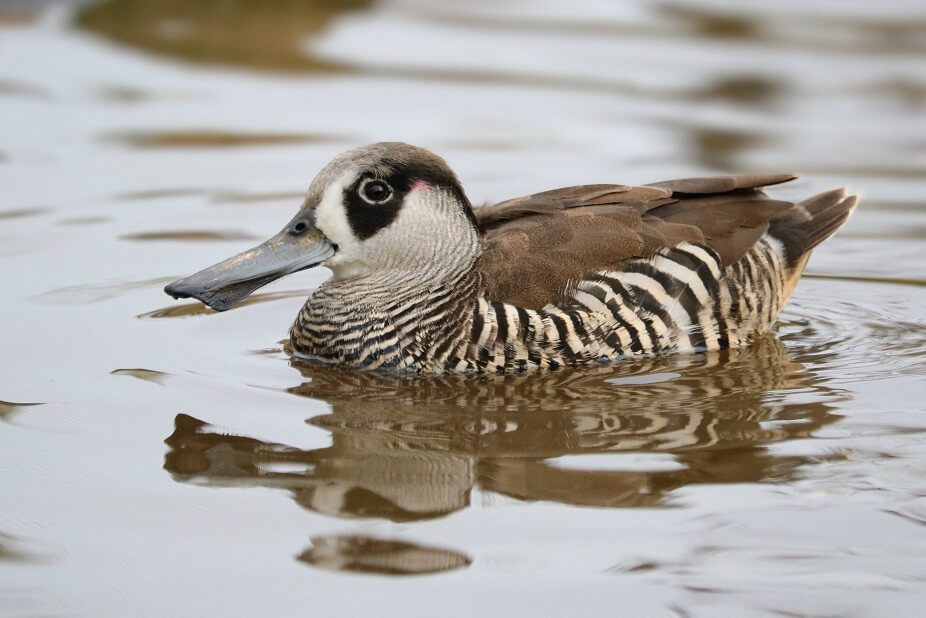
Have you ever noticed a tiny, odd detail on a bird and wondered if you were imagining it? The Pink-eared Duck has exactly that: a small pink spot near its face that many birders either miss completely or assume isn’t really there. The subtle detail is exactly what gives the Pink-eared Duck its name.
This small duck, found in Australia, shows a brown back and crown, bold black-and-white barring along the sides, and a mostly white face marked with dark eye patches. The overall effect is striking, and from a distance, the patterning can look almost zebra-like.
Its bill is another standout feature: it’s broad and spatulate, similar to a shoveler’s but smaller. It’s specially adapted for filtering tiny organisms from the water, with flexible edges that help strain algae and plankton.
Even its feeding behavior is unusual. Pairs often spin in tight circles on the water, creating a small vortex that pulls food upward, making it easier to feed.
4. Mandarin Duck
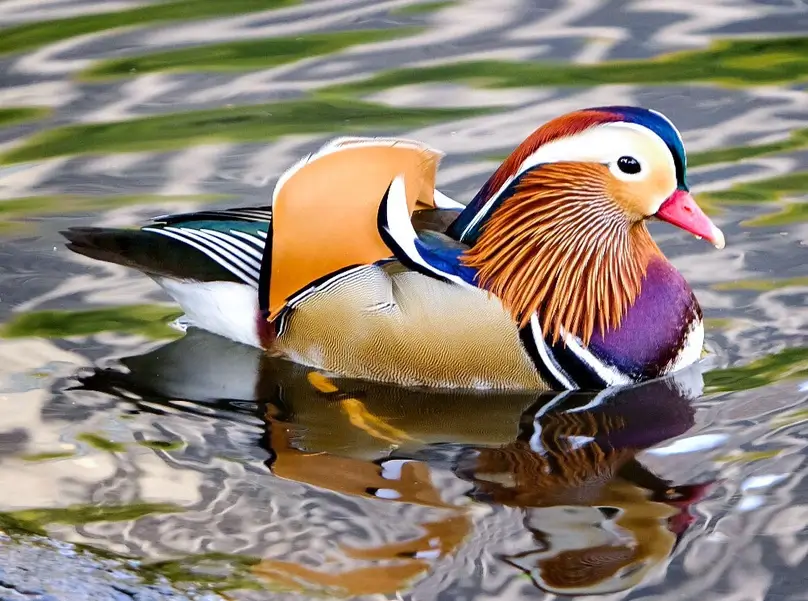
The Mandarin Duck stands out for a different kind of strangeness: its colors are so bold and elaborate that it almost doesn’t look like a real duck at all.
In breeding plumage, the drake is a riot of color, with a red bill, a white crescent above the eye, a reddish face with “whiskers,” and bold patterns that seem to belong to different birds all at once. A raised crest adds to the effect, giving it a slightly theatrical look. The female, by contrast, is much more subdued, with greyish-brown plumage and a neat white eye-ring with a stripe trailing behind it.
Both sexes have crests, though the male’s is far more pronounced, especially with its richer tones. Despite their flashy appearance, Mandarin Ducks are surprisingly shy, often keeping to sheltered waters with overhanging trees and forming smaller, quieter groups.
Their striking looks have made them a favorite in zoos and ornamental collections, where they often draw attention as one of the most colorful and unusual ducks around.
5. Hook Bill

The Hook Bill looks like it belongs to a prehistoric age, as if nature tried to redesign a duck and accidentally bent the bill the wrong way and then decided to keep it.
This is a Dutch domestic breed, named for its unusual hooked bill, which immediately sets it apart from other waterfowl. It has a long history in Europe, where it was traditionally kept for both eggs and meat, though some were also bred purely for ornamental purposes.
There are a few recognised colour varieties. The dusky mallard type shows a black head and rump with a green sheen, grey-toned body plumage, and no white neck ring, along with a slate-grey bill. The white-bibbed version is similar but has a clear white chest patch and white-tipped wing feathers. The pure white variety is the most striking, with bright white plumage, blue eyes, orange legs, and a pale pink bill.
6. Freckled Duck
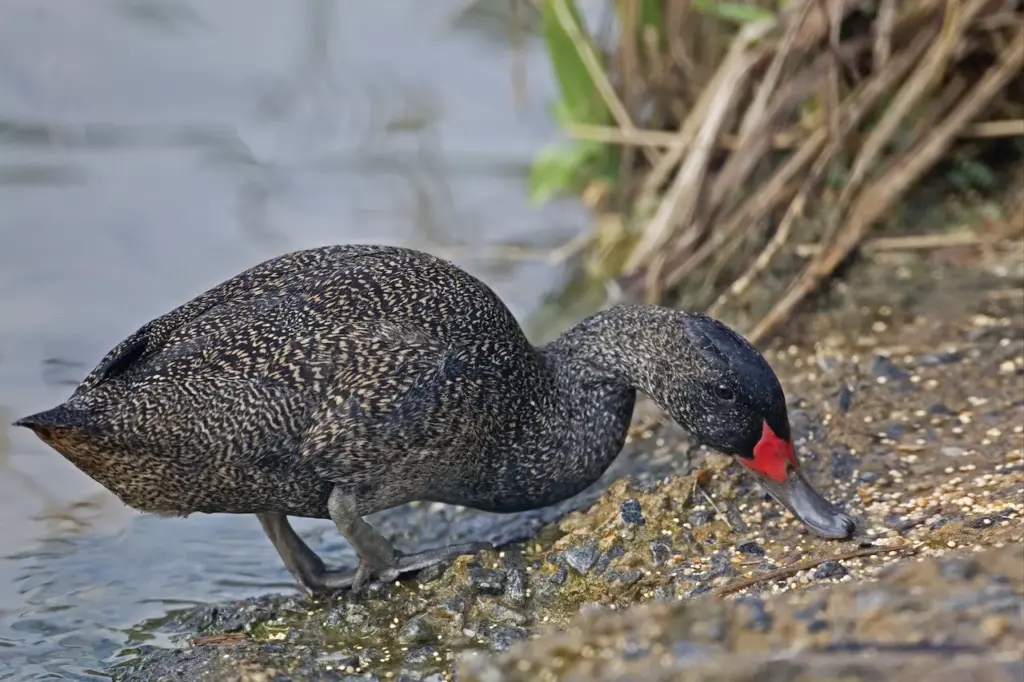
Also referred to as the Monkey Duck, the Freckled Duck really lives up to its “freckled” look. Its dark plumage is covered in tiny white flecks, giving it the appearance of a bird sprinkled with paint or dusted with snow.
This Australian endemic duck is mostly dark grey to black, but the small white spots break up its plumage in a very distinctive way. The result is a mottled, textured look that makes it stand out. Both sexes also share slate-grey legs, feet, and bill, which keeps the overall color palette fairly muted.
During the breeding season, males develop a noticeable change at the base of the bill, where the culmen can turn to shades of red. The deeper the red, the more dominant the male is, and this plays an important role in mating success within groups.
7. Northern Shoveler
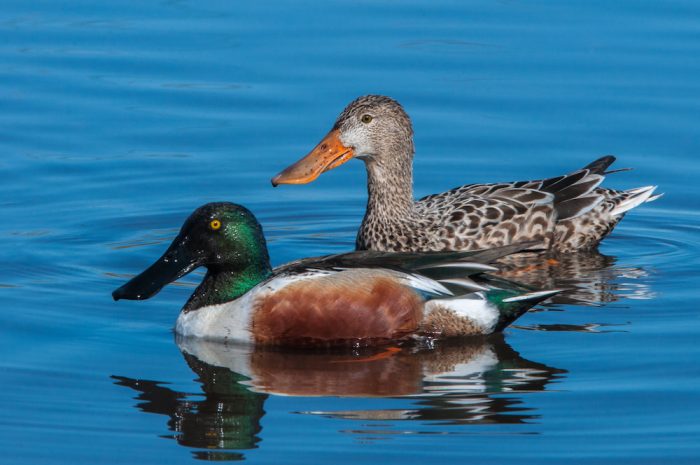
The Northern Shoveler is another duck that also looks like it belongs to the prehistoric age, with its oversized, spoon-shaped bill, which gives it a slightly exaggerated, almost ancient appearance. The huge bill makes it instantly recognizable and hard to mistake in the field.
This species is widespread across the Northern Hemisphere, breeding in northern Europe, the Palearctic, and much of North America, before migrating to southern Europe, the Indian subcontinent, Southeast Asia, Central America, and parts of northern South America for winter.
The male is striking in breeding plumage, with an iridescent dark green head, white breast, and chestnut flanks and belly, though at a distance the head can look almost black. The female is far more subdued, mottled brown like other dabbling ducks, but still easy to pick out, thanks to her long, broad bill tinged with orange along the edges.
The wide, flat shape of the its huge bill is lined with fine lamellae, which are comb-like structures that work like a sieve, letting the bird filter tiny invertebrates, crustaceans, and plankton from the water surface. This adaptation reduces competition with other dabbling ducks and makes shallow, invertebrate-rich wetlands their preferred habitat.
8. King Eider
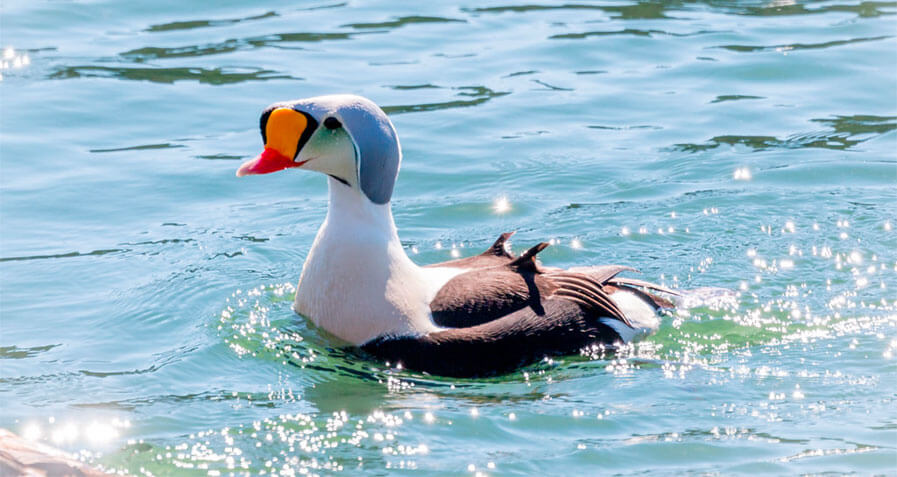
Did you know that the soft filling inside some quilts actually comes from Eider ducks? The term eiderdown is named after these birds, whose insulating feathers have been prized for centuries.
The King Eider, one of extant species of Eider ducks, is a large sea duck that breeds along Arctic coasts across northeast Europe, North America, and Asia, where it uses a range of tundra habitats. It is a true northern specialist, built for life in some of the harshest environments on Earth.
The male is one of the most striking sea ducks, with a mostly black body, a buff-tinged white breast, and a multicolored head. The face is pale bluish-grey with a green cheek patch, while the red bill is separated from the face by a thin black line and topped with a distinctive yellow knob. The female, often called a “queen eider,” is far more subdued, with warm brown plumage that is slightly paler on the head and neck.
Found across the Arctic, this species is very hardy and lives in remote coastal areas where most other ducks can’t cope.
Duck Identification Posters/Charts
Celebrate the beauty of ducks with detailed, high-resolution identification posters designed for both learning and decor. Each chart features vibrant colors, sharp details, and a smooth premium finish that’s perfect for classrooms, study spaces, living rooms, or offices.

9. Surf Scoter
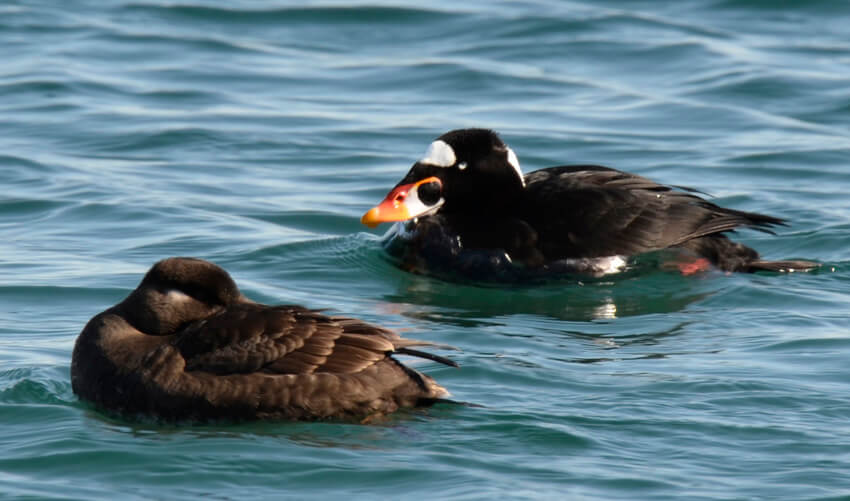
You can’t deny the male Surf Scoter is definitely a weird-looking duck with its bill looking like it was assembled from different colored parts and then slightly inflated for effect.
This large North American sea duck is mostly black in the male, broken only by a couple of bold white patches on the forehead and nape. The female is smaller and browner overall, with a more uniform and subdued appearance.
The male’s bill is especially strange up close: swollen in shape and marked with patches of white, red, and yellow (which sometimes appear bright orange from a distance), with a dark spot near the base adding to the odd pattern.
Like other sea ducks, Surf Scoters go through a full moult where they temporarily lose their ability to fly, usually in mid to late summer, making them especially vulnerable for a few weeks.
They breed in northern Canada and Alaska, then migrate south to spend the winter in more sheltered coastal waters.
10. Wood Duck
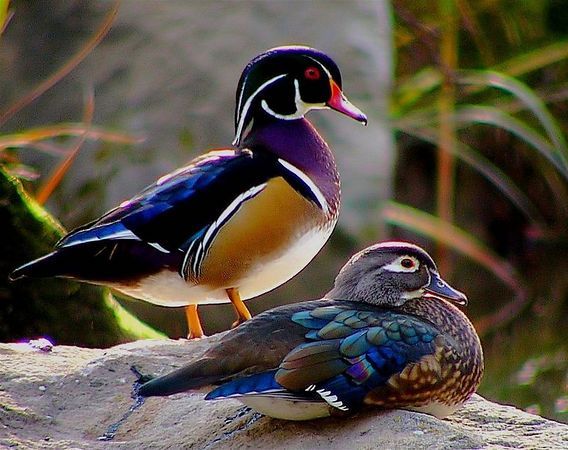
The Wood Duck is one of the most colorful ducks in North America, and the male in particular looks almost unreal when you first see it.
It has striking multicolored, iridescent plumage, red eyes, and a bold white flare running down the side of the neck. It also has a crested head that adds to its sharp, patterned look. The female is much plainer but still distinctive, with a white eye-ring, a whitish throat, and a softer brown overall appearance.
Both sexes have a noticeable crest, and the wings show an iridescent blue-green speculum edged with white, which flashes clearly in flight.
Wood Ducks are also adaptable feeders, eating a mix of seeds, berries, acorns, and insects, so they’re classed as omnivores. In parts of England and Wales, they are considered an invasive species, and releasing them into the wild is not allowed.
11. Long-tailed Duck

Long-tailed Duck is probably more beautiful than weird, but its amazingly long tail certainly makes it stand out in a strange way.
This is a medium-sized sea duck that breeds in the tundra and taiga regions of the Arctic and spends the winter along northern coastlines of the Atlantic and Pacific Oceans. It is a strong diving duck that’s often seen far out at sea rather than close to shore.
The male is especially distinctive, with a long, pointed tail measuring around 10 to 15 cm (3.9 to 5.9 in), along with a dark grey bill marked by a pink band. In contrast, the female is more subdued, with a brown back and a shorter, pointed tail.
In recent years, numbers have dropped in parts of its winter range, especially in the Baltic Sea, where birds are vulnerable to accidental capture in fishing nets. Because of this decline, the species is listed as Vulnerable by the International Union for Conservation of Nature (IUCN).
12. Patagonian Crested Duck

The Patagonian Crested Duck can look quite dramatic and a bit strange when it is calling, especially during courtship or when defending its territory (see picture above).
This South American duck has a grey face, chin, and neck, while the body is covered in a mix of brown and grey feathers that give it a mottled, slightly rough appearance. Its red eyes with black pupils add to its striking look, making it quite hard to miss up close.
It is found in southern South America, including Chile, Argentina, and the Falkland Islands, where it lives in a range of wet habitats such as marshes, swamps, lakes, pools, and sheltered coastal bays. Unlike many ducks, it is non-migratory and stays in the same general area year-round, simply moving to more sheltered spots during the colder months.
13. Torrent Duck
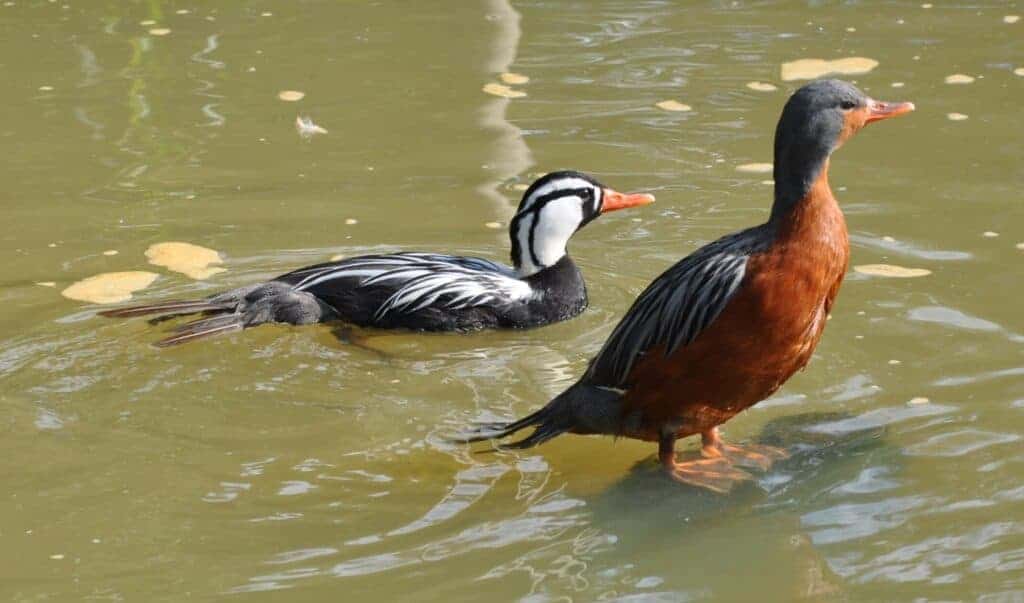
There’s no denying that the Torrent Duck is a little strange-looking, with its small body and unique markings, but that’s not where its weirdness ends, for its choice of habitat is pretty odd too.
This South American duck holds territories on fast-flowing streams, usually high in the Andes above 1,500 metres (4,900 ft). It is an incredibly strong swimmer, able to navigate white water with ease, though it prefers short, low flights rather than long-distance travel.
Males are especially striking, with a sharp black-and-white pattern across the head and neck and a bright red bill. In flight, they show dark wings with a green speculum that flashes briefly as they move. Females are smaller and more subdued but still distinctive, with grey upperparts and head, orange underparts and throat, and a paler yellowish bill.
It’s a duck that seems completely at home in roaring rivers where most other birds would struggle to stay upright.
14. Crested Duck
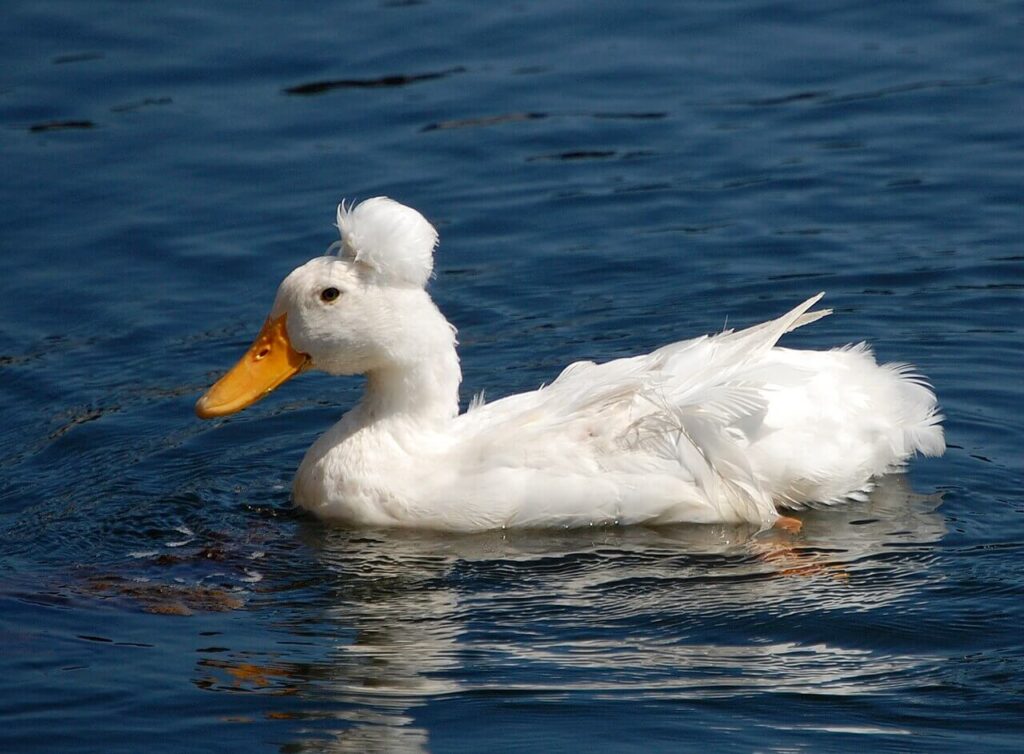
The Crested Duck is a domestic duck breed that is named for its strange but beautiful fluffy crest, which sits on top of the head like a misplaced tuft of feathers.
The unusual head tuft is caused by a genetic trait that affects skull shape and feather growth, which is why it shows up unpredictably and varies in size and form.
Despite its unusual appearance, the Crested Duck is otherwise similar to other domestic ducks. It is kept for eggs, meat, and ornamental purposes, and its eggs can range in colour from white to blue, green, or lightly tinted shades.
It is a classic example of how a single trait can turn an ordinary duck into something that looks surprisingly unusual.
15. Bufflehead
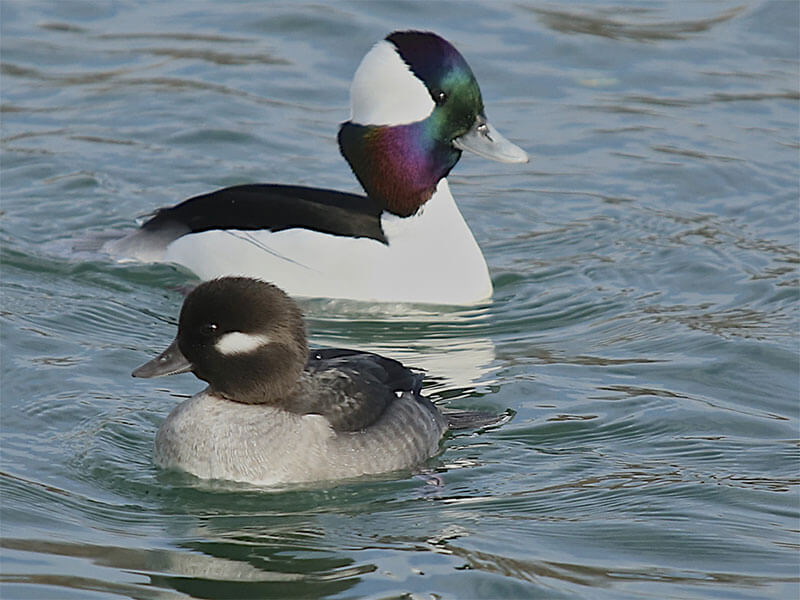
The last strange looking duck on our list is the Bufflehead, thanks to its large, rounded, and “puffy” head, which looks almost oversized for its body.
The Bufflehead is a small sea duck in the goldeneye group, breeding in Alaska and Canada before migrating south across North America for winter. Despite its size, it is extremely active, spending much of its time diving and resurfacing in quick, continuous movements.
Males have striking black-and-white pattern and an iridescent head that changes color in the light. Females are more subdued, mainly grey with a smaller white cheek patch and pale underside.
Interesting fact: The Bufflehead was added to the coat of arms of Sidney, British Columbia, in 1995.

