Mottled Duck Vs Black Duck: A Complete Identification Guide
Mottled Duck and American Black Duck (often simply called Black Duck) are two species that look very similar, largely because they both belong to the North American “Mallard complex,” which also includes Mexican Ducks. Both have dark, mottled plumage and a very similar speculum color range, which can make telling them apart a bit tricky at first glance. So, how can you distinguish between them? Here’s a quick guide to the key features to look out for.
Mottled Duck and Black Duck Appearance
Before we dive into the key differences between these two species, let’s first take a look at how each duck appears overall.

The Mottled Duck has a dark brown body with a slightly lighter head and neck, giving it a bit more contrast overall. Both males and females look quite similar, but the bill is one of the easiest ways to tell them apart. Males usually have a bright yellow bill, often with a small black spot near the gape, while females have a duller yellow to orange bill, sometimes marked with dark spots or smudges. Their legs are orange, and their eyes are dark. Another important feature is the speculum (wing patch), which appears shiny green to blue but typically lacks the bold white borders seen in some other ducks like the Mallard.
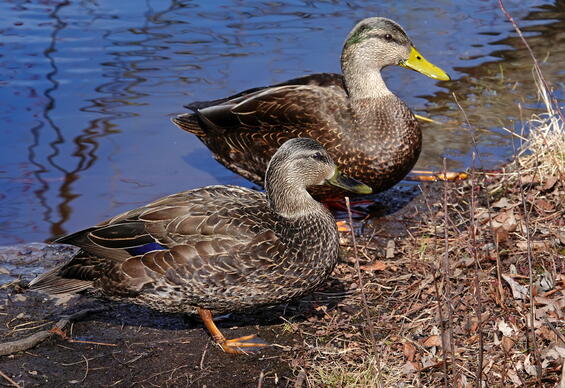
The American Black Duck also has a dark brown body, but it tends to look more uniformly dark overall. Its head is brown as well, though usually a bit lighter than the body, with subtle streaking on the cheeks and throat. A darker line often runs through the crown and eye area, giving the face a slightly more blended appearance compared to the Mottled Duck. Like the Mottled Duck, males and females look very similar, but their bills differ: males have a yellow bill, while females have a dull greenish bill with darker markings.
Overall, while both species share that dark, mottled look, the Mottled Duck often shows a bit more contrast in the head and brighter bill tones, whereas the American Black Duck appears darker and more uniform, especially in the face and body.
Key Differences
Let’s now focus on the key features you should look for when trying to tell these two duck species apart.
Size
If you were to place adult birds of these two species side by side, the first clear clue you could use to distinguish them is size: the American Black Duck is significantly larger and bulkier than the Mottled Duck.
The American Black Duck is one of the heaviest ducks in the Anas genus. On average, it weighs about 720–1,640 g (1.6–3.6 lb), with a body length of around 54–59 cm (21–23 in) and a wingspan of 88–95 cm (35–37 in). Overall, it looks more solid and powerful, and appears bigger even when not directly compared side by side.
In contrast, the Mottled Duck is smaller and closer in size to a Gadwall. It measures about 44–61 cm (17–24 in) in length. Males typically weigh 880–1,240 g (30.9–43.8 oz), while females are slightly lighter at 700–1,150 g (24.7–40.6 oz). Their wingspan usually ranges from about 80–87 cm (31.5–34.3 in), making them noticeably more compact than Black Ducks.
In simple terms, if the bird looks large, heavy, and robust, it is more likely a Black Duck. If it appears smaller and slimmer in comparison, it is more likely a Mottled Duck.
Overall Plumage
As hinted above, another easy visual clue you can use to distinguish these two species is their overall plumage tone.
The American Black Duck tends to look noticeably darker and more uniform in colour compared to the Mottled Duck. Its body appears deep brown throughout, giving it a more solid and shadowy look at a distance.
In contrast, the Mottled Duck usually shows a slightly lighter, more varied brown tone with more visible mottling, especially around the body and head. This gives it a bit more contrast overall.
Speculum
If you were to observe these ducks closely enough, the speculum (wing patch) is another useful features you can use to tell them apart.

The Mottled Duck typically has a blue to green speculum. It usually shows a black leading edge and a clear white trailing edge, which helps give the wing patch a more defined, bordered look.

The American Black Duck, on the other hand, has a darker, more purple to violet speculum. Unlike the Mottled Duck, it usually has black on both the leading and trailing edges, and it rarely shows a strong white border. In some cases, a faint whitish line may appear on the trailing edge, but it is often much less obvious.
In flight, these differences can become even clearer. The Black Duck may show a subtle contrast with a slightly lighter underwing, sometimes with a faint whitish lining, while its overall wing patch remains darker and more purple-toned. The Mottled Duck, by comparison, tends to show a brighter blue-green speculum with more obvious white edging, making it stand out more cleanly against the darker wing.
Range
Finally, where you spot the bird can be a very helpful clue, especially because one of these species is non-migratory.
The Mottled Duck has a fairly limited and split range. It has two main populations: one along the Gulf Coast, stretching from Alabama through Texas and into Mexico, and another found in Florida extending north into parts of South Carolina. Unlike many other ducks, Mottled Ducks are non-migratory, meaning they stay in the same general areas throughout the year. So, if you see one along the Texas or Gulf Coast in any season, it is very likely a Mottled Duck.
The American Black Duck is native to eastern North America and has a much wider breeding range. During the breeding season, it is typically found in freshwater and coastal wetlands from the Canadian provinces (such as Saskatchewan) down through the northeastern United States, including the Great Lakes and the Adirondack region. It is a partially migratory species, and many individuals move south during winter, especially into the east-central and coastal parts of the United States.
Because of this difference, location can also be useful way of narrowing down your identification.
Duck Identification Posters/Charts
Celebrate the beauty of ducks with detailed, high-resolution identification posters designed for both learning and decor. Each chart features vibrant colors, sharp details, and a smooth premium finish that’s perfect for classrooms, study spaces, living rooms, or offices.