How to Identify Drake Vs Hen Black Duck: Key Differences
Black ducks exhibit sexual monomorphism, which means that males (drakes) and females (hens) are nearly identical in appearance. As a result, distinguishing between them can be a bit challenging, especially when compared to ducks that show strong sexual dimorphism, such as Mallards.
The good news is that there are still distinct features you can use to help identify the sexes accurately in the field, whether you’re observing, hunting, or simply enjoying nature.
Introduction to Male vs Female Duck Identification
Sexing Ducks
Some ducks show obvious visual differences between the sexes, while others look almost identical, making identification more challenging. However, there are many ways that you can use to tell the sex of a duck, including:
1. Plumage Differences
In many species, males are more brightly coloured, especially during the breeding season, while females tend to have duller, mottled brown feathers that provide camouflage while nesting. This difference, known as sexual dimorphism, is clearly seen in species like Mallards, where the male has a glossy green head and the female is mottled brown.
However, plumage is not always a reliable indicator. Some species are monomorphic, meaning males and females look very similar or even identical. The American black duck fall into this category, so other characteristics must be used to determine sex.
2. Size and Body Structure
Size and body shape can sometimes provide helpful clues, although the differences are usually subtle. Males tend to be slightly larger and more robust, often with a thicker neck or broader head. Females are generally a bit smaller and may appear more streamlined. These differences are easiest to notice when males and females are seen side by side, but they can be difficult to judge in isolation.
3. Bill Characteristics
The bill can also offer useful hints in some species. Males often have cleaner, more uniform bill coloration, while females may show darker markings or blotches. While not universally reliable, bill patterning can be a helpful supporting feature when combined with other traits.
4. Tail Features (Drake Feather)
In many duck species, adult males develop a curled feather at the top of the tail, commonly known as the drake feather. This feature is absent in females, which have straight tail feathers. When present, it can be one of the most reliable visual indicators of sex. However, it may not always be visible during molting periods, and younger males may not yet show this feature clearly.
5. Voice and Vocalisation
Vocal differences is another dependable ways to sex ducks, especially in species where males and females look alike. Females typically produce the familiar loud “quack,” while males usually have softer, raspier, or whistling calls.
6. Behavioural Clues
Behaviour can also provide useful context, particularly during the breeding season. Males may be more active in courtship displays, such as head-bobbing, chasing, or vocalising to attract females. Females, on the other hand, are often more secretive, especially when nesting, and may show more cautious or protective behaviour. While not definitive on its own, behaviour can reinforce other identification clues.
7. Seasonal Changes (Eclipse Plumage)
One of the most confusing periods for sexing ducks occurs during eclipse plumage, when males temporarily shed their bright breeding feathers and adopt a dull, female-like appearance. During this time, males can closely resemble females, making visual identification difficult. In these cases, voice, behaviour, and subtle features like the drake feather become especially important.
Male vs Female Black Duck Identification
Plumage
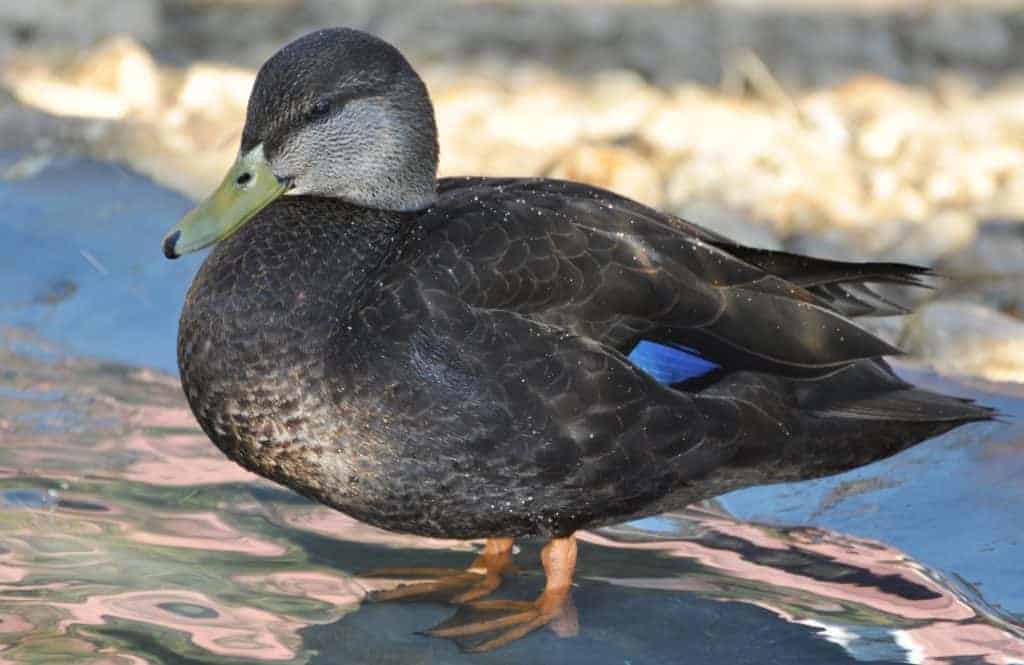
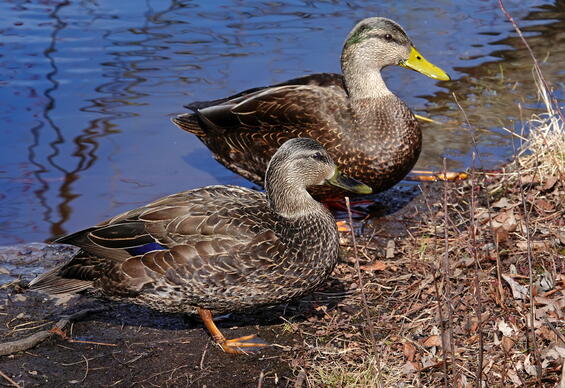
The American Black Duck somewhat resembles the female Mallard in overall coloration, although its plumage is noticeably darker and more uniformly toned. Males in alternate plumage are typically dark blackish-brown across most of the body, with a paler grayish head and neck. This lighter area often shows fine, dark streaking, creating a subtle contrast with the deeper tones of the back and breast.
Females appear quite similar to males, which is part of what makes this species challenging to sex in the field. However, they are often slightly paler overall, with a more muted and less sharply contrasted appearance. In addition, females tend to show duller reddish-orange legs and feet compared to males, which can sometimes help as a supporting field mark when observing closely.
Size
There are only slight size differences between male and female American Black Ducks, and these are often difficult to detect unless the birds are seen side by side.
On average, males are a bit larger and heavier than females. Males typically weigh between 2.4 and 2.9 pounds, while females generally range from about 2.1 to 2.4 pounds. In terms of wingspan, males usually measure around 10.7 to 11.5 inches, whereas females are slightly smaller at approximately 10.2 to 10.9 inches.
Although these differences exist, they are quite subtle in the field, and size alone is not a reliable way to confidently distinguish between the sexes.
Bill Color
The drake and hen American Black Duck are generally very similar in appearance, but the bill can offer one of the most useful clues for telling them apart.
In males, the bill is typically a more uniform greenish-yellow to bright yellow tone, giving it a slightly cleaner and lighter appearance overall. This contrast can stand out subtly against the darker plumage of the head.
Females, on the other hand, tend to have a duller bill that ranges from olive green to dark greenish-black. It is also common for the female’s bill to show darker markings or mottling, particularly along the upper mandible.
While this difference is not always dramatic, it can be a helpful field feature when observed closely, especially in good lighting conditions.
Calls
The vocalisations of male and female American Black Ducks are very similar to those of Mallards, with both sexes producing a range of loud quacks, often delivered in quick succession. In general, however, males tend to be noticeably less vocal than females, which can be a useful clue in the field when observing behaviour over time.
Male calls are typically described as a softer, more reedy “reab” sound, which closely resembles the subdued vocalisations of a male Mallard. These calls are usually less frequent and less forceful, often heard during interaction or mild agitation rather than constant communication.
Females, on the other hand, produce the classic loud “quack,” which is more pronounced and carries further across water or open areas. Their calls can sound sharper and more emphatic, especially when alarmed or communicating with ducklings.
Behavior
During courtship, males are typically more active and territorial, spending much of their time defending preferred habitat and interacting with rival males. The highest breeding densities are found in regions such as Maine and Nova Scotia, where pairs form in a wide variety of wetland habitats, including alkaline marshes, acid bogs, lakes, stream margins, and both freshwater and coastal estuaries.
Once a pair bond is formed, the female takes on the primary reproductive role, laying an average of around nine eggs, though clutches can range from six to fourteen. She selects well-concealed nesting sites and carries out most of the incubation duties, which last approximately 25 to 30 days depending on conditions. During this period, the male often remains nearby and continues to defend the territory for part of the incubation stage, typically until the female reaches the middle of incubation, after which his involvement decreases.
After hatching, the female leads the ducklings to rearing areas rich in vegetation and invertebrates, where they feed and develop. The young take about six weeks to fledge. While both sexes are involved in the early stages of reproduction through pair bonding and initial incubation support, their roles diverge significantly as the season progresses, with females becoming highly focused on brood care and males shifting back toward more independent and territorial behaviour.
Duck Identification Posters/Charts
Celebrate the beauty of ducks with detailed, high-resolution identification posters designed for both learning and decor. Each chart features vibrant colors, sharp details, and a smooth premium finish that’s perfect for classrooms, study spaces, living rooms, or offices.