Hen Cinnamon Teal Vs Blue Wing Teals: Key ID Differences
Males of cinnamon teals and blue-winged teals are fairly easy to differentiate for most parts of the year, thanks to their striking plumage. It’s hard to confuse the cinnamon drake’s rich cinnamon-colored head, neck, breast, and belly with the blue-winged drake’s slate-blue to purplish head, especially with that bold white facial crescent sweeping from the jawline up past the eye.
But when it comes to the hens, that’s where things get tricky. They are so identical that birders always have a hard time telling them apart even when they are put side by side, let alone when observing them at a distance or in flight. Both species share brown, mottled plumage, along with nearly identical wing patterns, which all feature powder-blue shoulder patches and dark green (almost emerald) speculum feathers.
Still, there’s hope. In this guide, we’ll walk you through a few key identification clues to help separate the hens of these two species. Just keep in mind that none of these features is foolproof on its own. The differences are subtle, so the best approach is to combine multiple clues to confidently nail the ID.
Bill Shape and Structure
Bill shape and structure are among the most useful features for telling cinnamon teal and blue-winged teal hens apart, though the differences are usually subtle and are best judged when you have the chance to observe the two ducks side by side or up close (and, of course, with practice).
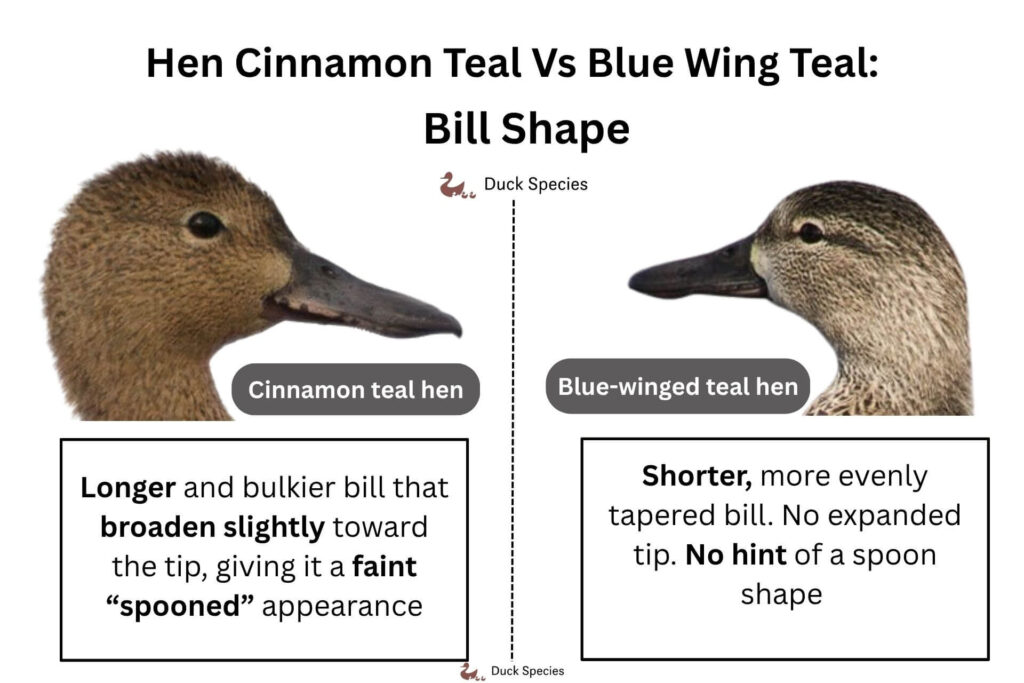
The hen cinnamon teal shows a noticeably longer and bulkier bill, often around 10% longer than that of a blue-winged teal. More importantly, it has a subtle but distinctive shape: the bill tends to broaden slightly toward the tip, giving it a faint “spooned” or shoveler-like appearance. It’s not nearly as exaggerated as a Northern Shoveler, but the influence is there. This comes from the expanded tip, slightly flared edges, and a gentle narrowing toward the base, making the bill look more substantial overall.
In contrast, the hen blue-winged teal has a shorter, slimmer, and more evenly tapered bill. It lacks that expanded tip and instead looks more delicate and proportionate throughout—closer in structure to a Green-winged Teal. The overall impression is a shorter, neater, finer bill without any hint of a spoon shape like hen cinnamon teal’s bill .
Eyes and Face
The eyes and facial patterning offer another useful set of clues for separating hen cinnamon teal from hen blue-winged teal, especially at closer range.
Quick definition of terms we’ve used in this section:
Supraloral spot: A distinct patch of color or feathers located just above the lores (the area between the eye and the bill) in birds
Nape feathers: The feathers located on the back of a bird’s neck, directly behind the head
The hen blue-winged teal typically shows a more contrasting and better-defined facial pattern. To begin with, there is more prominent whitish area around the eyelids, along with coarser, more noticeable streaking across the face. The dark line running through the eye is usually more distinct, and the facial pattern as a whole feels sharper and more segmented.
The supraloral area is also pale or whitish, forming a distinct light patch above the lores. This pale area is typically separated from the darker forehead by a clearer contrast, and it may extend forward toward the bill base. This feature is much more consistently visible in blue-winged teal than in cinnamon teal, where the supraloral area is usually less sharply defined and blends more smoothly into the surrounding facial plumage.
In the hen cinnamon teal, the overall facial expression tends to look softer and more uniform, with a relatively bland, less sharply marked face. The loral spot is faint or barely present, and the dark eye stripe is thinner, usually fading out before it reaches the darker nape feathers. Both the eye line and eye ring are subdued, giving the face a more blended, less contrasting appearance.
Overall Plumage
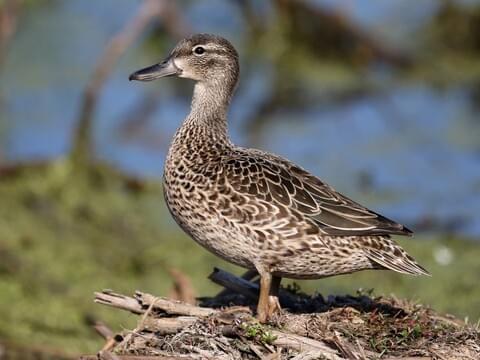
In overall plumage, the hen blue-winged teal tends to show a slightly cooler, greyer-brown tone compared to cinnamon teal, which gives it a more muted and subtly “dusty” appearance in the field. The feathering can also appear a bit more finely patterned, with a slightly crisper overall contrast between the mottled body feathers and the background tone.
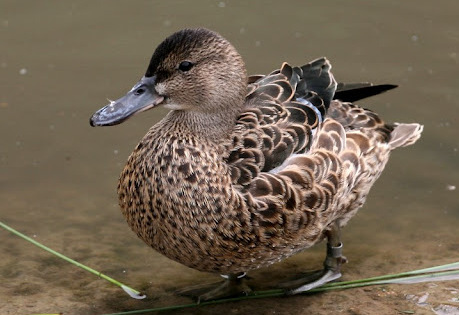
In contrast, the hen cinnamon teal typically shows noticeably warmer plumage tones, especially at close range. Its body feathers are a richer, more cinnamon-tinged brown, and the edges of the feathers generally show less contrast, contributing to a more blended look overall.
Another useful clue is their throats. The hen blue-winged teal usually has a more conspicuous whitish throat patch, which is often larger and more clearly defined than in cinnamon teal. In the hen cinnamon teal, the throat patch is typically smaller and less sharply defined, blending more gradually into the surrounding warm facial and neck plumage.
Size
The cinnamon teal averages slightly larger than the blue-winged teal, with a marginally longer body and heavier overall build. However, this difference is very subtle and of limited practical use in the field, as size overlap between individuals is significant and direct comparison is rarely possible under typical birding conditions.
Range
Range can be a helpful supporting clue for identification in areas where each species is expected, but it should always be used with caution, as it becomes unreliable when birds are observed outside their normal distribution.

The cinnamon teal primarily breeds in marshes and ponds across the western United States, extending into extreme southwestern Canada. Outside this core range, it is generally uncommon and becomes a rare visitor to the eastern United States.
In contrast, the blue-winged teal has a much broader distribution, breeding across most of North America, but notably avoiding western and northern Alaska, northern Yukon Territory, northern Northwest Territories, and northeastern Canada. While widespread, it is uncommon in the desert southwest and along the west coast. Like cinnamon teal, its preferred breeding habitat consists of marshes and ponds.
Association with Males (Use with Caution)
Another commonly suggested approach is identifying the hens by association i.e., observing which drake they are paired with or moving alongside in a group. In theory, this can sometimes provide helpful context, especially during the breeding season when pairs are more stable.
However, this clue should be treated with caution. Mixed flocks are common, and both species can occur together on shared wetlands, meaning hens may associate loosely with multiple males. Pairs can also break down outside of the breeding period, and in flight or feeding groups, individuals may not always be directly linked to a specific mate. As a result, relying on association alone can easily lead to incorrect identification, particularly where the species overlap in range.
Side note
It is also worth remembering that juvenile male cinnamon teals can closely resemble both female cinnamon teal and female blue-winged teal, but they typically show a useful clue: red eyes, which can help distinguish them from the two hens when you have an opportunity to observe them closely.