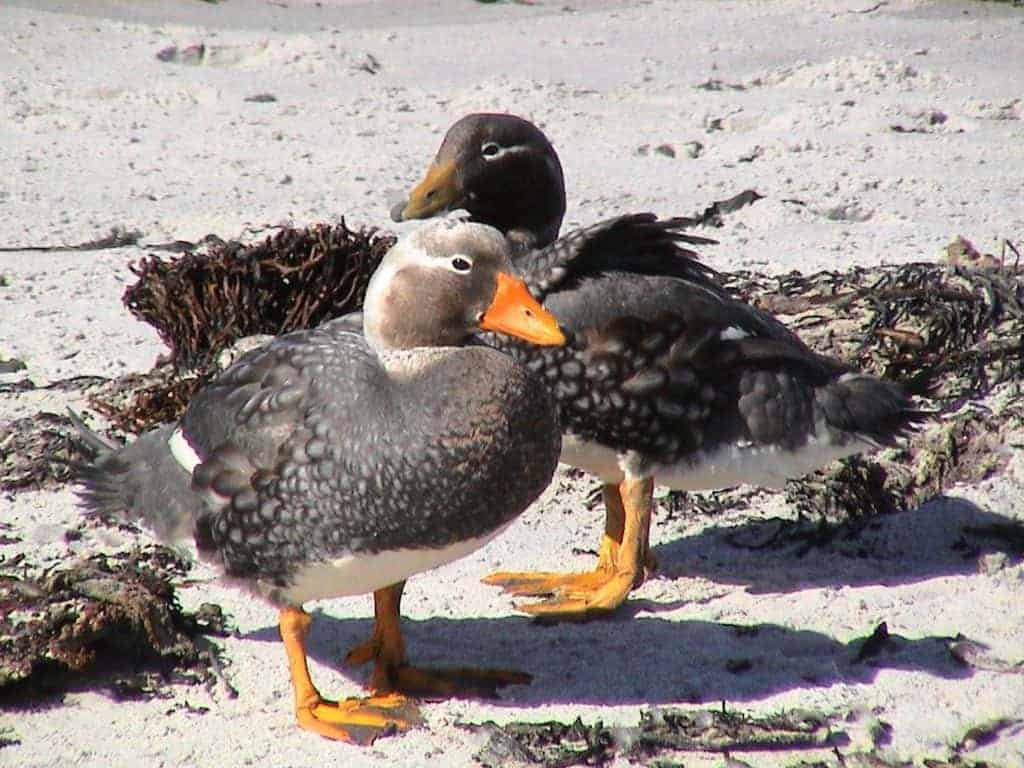
Falkland Steamer Duck

Scientific Name

Tachyeres brachypterus

Alternative Names

Falkland Flightless Steamer Duck

Measurements

FeatureMaleFemale
Length61–74 cm61–74 cm
Weight3.3–4.8 kg2.9–4.2 kg
Wingspan84–94 cm84–94 cm

Status

Endemic to the Falkland Islands and listed as Least Concern due to its stable population, estimated between 27,000 and 48,000 individuals.

Identification

A large, heavy duck with a short tail and strong build. Males have grey-brown plumage, a light grey head, and a bright orange bill. Females are darker, with brown heads and olive-green bills. Both have a white eye ring, white streak behind the eye, and yellow-orange feet. The wings are small with white patches and sharp spurs used for fighting. This species is flightless and moves by splashing and flapping across the water like a paddle steamer.

Voice

Males give loud, rasping whistles and ticking notes, especially during breeding season. Females produce deeper grunts and may join the males in duets.

Diet

Feeds mostly on marine mollusks and crustaceans. It dives and uses its strong feet and small wings to swim underwater. Occasionally upends to feed in shallow water.

Distribution

Found only on the Falkland Islands and nearby islets in the South Atlantic Ocean. Common along rocky coasts and in sheltered bays but can also visit ponds up to 400 m inland.

Habitat

Prefers rugged shorelines, kelp beds, and coastal areas with rocky outcrops. Sometimes nests among tall grass, seaweed piles, or even old penguin burrows near the shore.

Breeding

Breeding starts in September and continues through December, though some pairs may nest year-round. Females lay 4–12 eggs and incubate them for about 34 days. Nests are lined with down and hidden in vegetation or rocks. Males guard the territory aggressively using their wing spurs. Chicks hatch covered in brown-and-white down and stay with their parents for up to 12 weeks.

Wintering

Non-migratory. Remains around the Falkland coasts throughout the year, often forming family groups or large gatherings of up to 300 birds outside the breeding season.

Conservation

The species remains stable but faces some risks from invasive rats and potential oil spills that could harm its food sources. Predators include gulls and skuas that take chicks, while adult ducks have few natural enemies. Continued monitoring is recommended to protect their coastal breeding sites.

Similar Posts

  • Australian Shelduck

    Scientific name Tadorna tadornoides Alternative names Also called the Chestnut-breasted Shelduck or Mountain Duck. Measurements Feature Range Length 56–72 cm (22–28 in) Wingspan 94–132 cm (37–52 in) Weight 1.3–1.6 kg (2.9–3.5 lb) Status Protected under the National Parks and Wildlife Act 1974. Populations are stable, and the species benefits from farmland and water body conservation…

  • Labrador Duck

    Scientific Name Camptorhynchus labradorius Alternative Names Pied duck, Skunk duck, Sand shoal duck Measurements Feature Measurement Body Length Approximately 51–58 cm Wingspan Estimated around 80–90 cm Weight Not well-documented, but believed to be similar to sea ducks of comparable size (around 1–1.5 kg) Status Extinct. The Labrador duck became extinct in the late 19th century….

  • Common Merganser

    Scientific name Mergus merganser Alternative names Goosander (Eurasia), Common Merganser (North America) Subspecies Subspecies Description Distribution M. m. merganser Typical form Northern Europe and northern Asiatic Russia M. m. orientalis Slightly larger, more slender bill Central Asian mountains M. m. americanus Broader-based bill, black bar across inner wing in males North America Measurements Feature Range…

  • Stiff-Tailed Ducks: Meet the Upright-Tailed Divers of the Oxyurini Tribe

    Stiff-tailed ducks are a distinctive group of freshwater diving ducks that belong to the Oxyurini tribe within the duck family Anatidae. Most species are placed in the genus Oxyura and are easily recognized by their compact bodies, large swollen bills, and the long, stiff tail feathers they often hold upright while resting on the water….

  • Smew

    Scientific Name Mergellus albellus Alternative Names White Nun, Panda Duck, Redhead Smew (female) Measurements Feature Male Female Length 38–44 cm (15–17 in) 38–44 cm (15–17 in) Weight 450–650 g (16–23 oz) 450–650 g (16–23 oz) Wingspan 56–69 cm (22–27 in) 56–69 cm (22–27 in) Status A small diving duck found across northern Europe and Asia,…

  • Pacific Black Duck

    Scientific Name Anas superciliosa Alternative Names Pacific Black Duck, Grey Duck (New Zealand), Pārera (Māori name), Island Black Duck (subspecies A. s. pelewensis) Measurements Feature Male Female Length 54–61 cm (21–24 in) 54–61 cm (21–24 in) Wingspan Approx. 90–100 cm (35–39 in) Approx. 90–100 cm (35–39 in) Weight Around 1 kg (2.2 lb) Slightly lighter…

Leave a Reply

Your email address will not be published. Required fields are marked *