
Red-billed Teal
Scientific name
Anas erythrorhyncha
Alternative names
Red-billed Teal, Red-billed Duck
Measurements
| Feature | Range / Note |
|---|---|
| Length | 43–48 cm (17–19 in) |
| Wingspan | Not precisely measured, typical for medium-sized dabbling ducks |
| Weight | 400–600 g (approx.) |
Status
Not considered endangered. Estimated 410,000–790,000 mature individuals as of 2023. Population trend appears slightly decreasing but remains large and stable enough for a Least Concern classification.
Identification
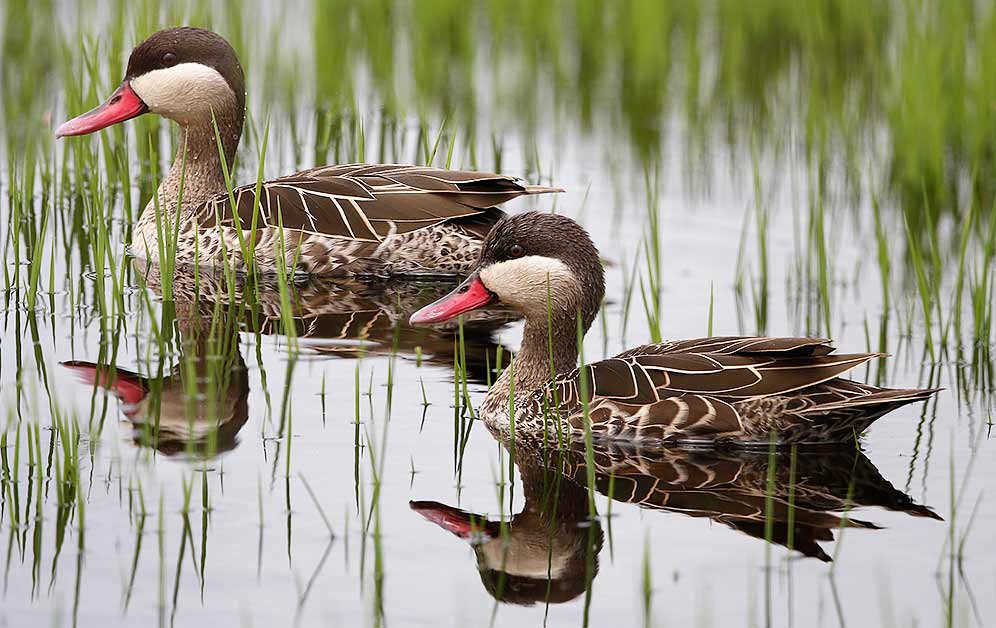
Red-billed Teals have a blackish cap and nape with a pale face and a bright red bill. Their body is dark brown with white scalloping. The secondary flight feathers are buff with a black stripe. Males and females look alike, but juveniles are duller. This species is generally quiet, although males make a whzzt sound when displaying and females give a soft mallard-like quack.
Behavior
They are mostly sedentary or nomadic, moving long distances (up to 1,800 km) when water is scarce. Highly social outside the breeding season, they can form flocks of thousands. Breeding pairs are dispersed, and adults undergo a flightless wing molt after raising young.
Distribution
Native to southern and eastern Africa, generally south of 10° S. Found in countries such as South Africa, Namibia, Botswana, Angola, Zambia, Mozambique, and Madagascar.
Habitat
Favors shallow freshwater habitats with dense vegetation, including lakes, marshes, small rivers, seasonal pools, farm ponds, and temporarily flooded fields. Also grazes in rice fields and stubble lands. During the dry season, prefers large open water with emergent vegetation for molting.
Feeding
Omnivorous, feeding on aquatic plants, grains, grasses, sedges, seeds, fruits, roots, and rhizomes. They also eat aquatic invertebrates like molluscs, insects, crustaceans, worms, tadpoles, and occasionally small fish. Feeding usually occurs in the evening or at night.
Breeding
Nests are built on the ground in dense vegetation near water, often in a depression lined with grass. Breeding occurs between December and April in southern Africa. Clutch size and incubation details are similar to other dabbling ducks, with both parents caring for ducklings post-hatching.
Wintering
Mostly non-migratory, but local dispersal occurs during dry periods to find suitable water sources.
Conservation
Red-billed Teals face minor threats from leech infestations and habitat changes, particularly in Madagascar. Hunting is common but does not currently threaten the population. Overall, the species is stable and abundant.