
Harlequin Duck
Scientific Name
Histrionicus histrionicus
Alternative Names
Painted Duck, Rock Duck, Glacier Duck, Mountain Duck, White-eyed Diver, Lords and Ladies, Blue Streak
Measurements
| Feature | Measurement |
|---|---|
| Length | 38–43 cm (15–17 in) |
| Weight | Around 600 g (1.3 lb) |
| Wingspan | 66 cm (26 in) |
| Wing | 188–202 mm (7.4–8.0 in) |
| Tail | 77–101.5 mm (3.03–4.00 in) |
| Culmen | 25–27 mm (0.98–1.06 in) |
| Tarsus | 36.5–38.5 mm (1.44–1.52 in) |
Status
While the Harlequin Duck remains stable in many regions, the eastern North American population is declining and is listed as endangered. Threats include oil spills and the construction of hydroelectric dams that alter their natural river habitats.
Identification
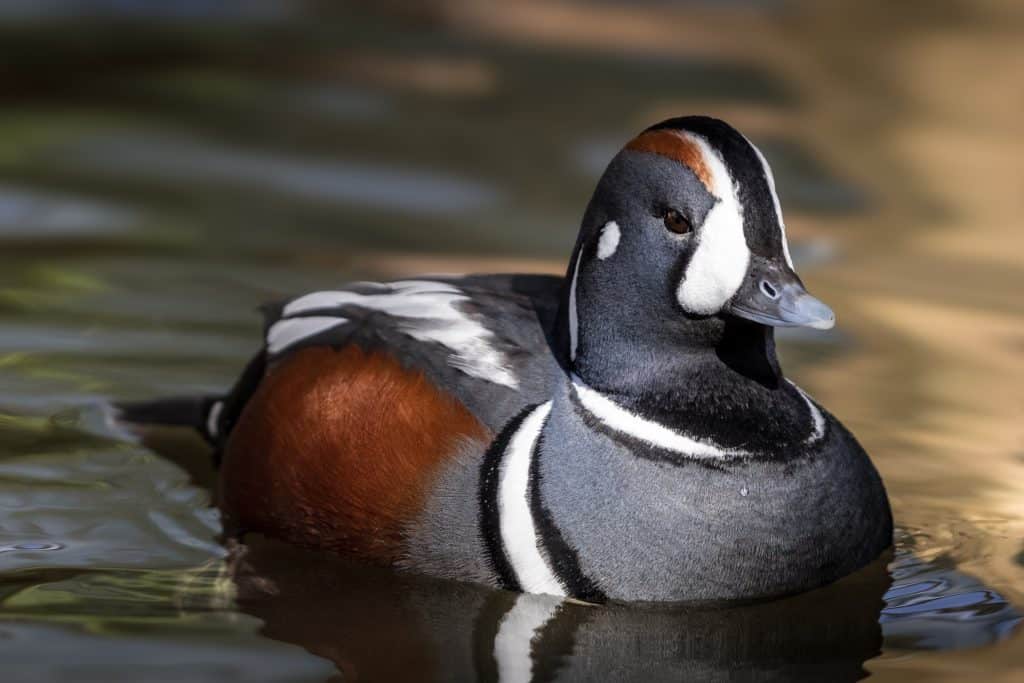
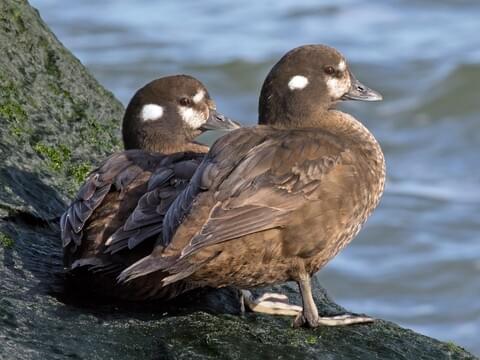
The male Harlequin Duck is one of the most striking ducks in the world, dressed in a dramatic mix of slate blue, white, and chestnut. It has bold white crescents around the eyes and neck, with spots and stripes that look like brushstrokes of paint — perfectly fitting for its “harlequin” name. The female is brownish-gray with three white facial patches, giving her a softer but still recognizable look.
Voice
Harlequin Ducks are often nicknamed “sea mice” because of their high-pitched squeaking calls. Males give a sharp, chirping whistle, while females make softer grunts and clucks.
Diet
They feed mostly by diving in fast-flowing rivers and rocky coastal waters. Their diet includes aquatic insects, mollusks, and small crustaceans, which they skillfully pluck from underwater rocks.
Distribution
Found in North America, Greenland, Iceland, and eastern Russia, Harlequin Ducks breed along cold, fast-moving mountain streams and rivers. During winter, they move to rocky coastlines, especially along the Pacific and Atlantic coasts.
Habitat
Prefers rugged habitats — turbulent rivers for breeding and wave-battered shorelines in winter. Their dense feathers help trap air, keeping them warm and buoyant even in icy waters.
Breeding
Harlequin Ducks form strong, long-term pair bonds. Courtship begins in winter, often with males showing off by bobbing and calling on the water. The nest is well hidden near streams, and only the female incubates the eggs, while the male defends nearby territory before leaving for molting grounds.
Wintering
These ducks migrate short distances to coastal regions, where they gather in small groups among rocks and breaking waves — a sight both rare and mesmerizing to witness.
Conservation
Harlequin Ducks are sensitive to environmental change. Conservation efforts focus on protecting breeding rivers from dams and pollution and safeguarding coastal waters from oil contamination, ensuring that this “painted duck” continues to bring color to cold waters.