
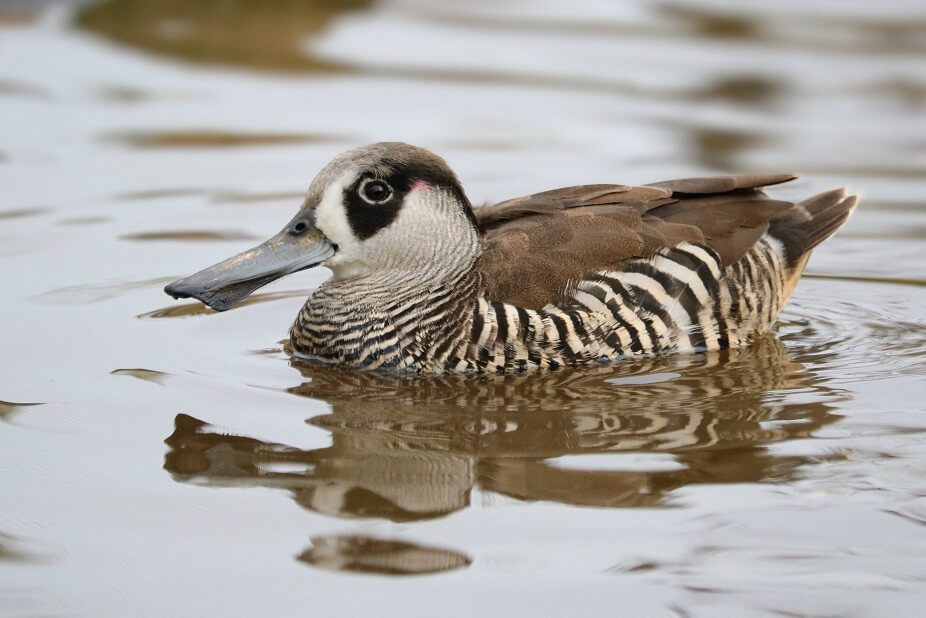
Pink-eared Duck

Scientific Name

Malacorhynchus membranaceus

Alternative Names

Pink-eared Duck, Zebra Duck (rarely used), New Holland Duck (historical name)

Measurements

FeatureMaleFemale
Length38–40 cm (15–16 in)38–40 cm (15–16 in)
WeightNot well documentedNot well documented
WingspanNot well documentedNot well documented

Status

A native Australian species that is still common in many areas. It is not considered globally threatened but depends on suitable water conditions to breed.

Identification

A small duck with a large spatula-shaped bill. It has a white face with bold black eye patches, black-and-white barred sides, and a brown crown and back. A tiny pink spot near the ear gives the bird its name, though it is only seen up close. Both sexes look similar.

Voice

Soft, high-pitched whistles and quacks. Generally quiet unless in groups or during courtship.

Diet

Feeds mainly on plankton, algae, tiny crustaceans, insects, and other small aquatic life. Uses its wide bill to filter food from the water. Sometimes feeds by spinning in pairs to stir up food (called vortexing).

Distribution

Found across most of Australia. Moves widely depending on water availability and often appears in temporary wetlands after flooding.

Habitat

Prefers shallow freshwater lakes, floodplains, swamps, and temporary pools. Often found in dry inland regions when water becomes available.

Breeding

Breeding depends on rainfall and flooding. Nests in tree hollows or in dense vegetation near water. Lays 6–10 eggs. If conditions are poor, they may skip breeding completely.

Wintering

Highly mobile rather than migratory. Moves to areas with available water and food during dry seasons.

Conservation

Not currently endangered, but depends on healthy wetland systems. Duck hunting is legal in most Australian states except Tasmania. Some birds suffer injuries from lead shot, raising concerns from animal welfare groups.
Similar Posts

  • Red-billed Teal

    Scientific name Anas erythrorhyncha Alternative names Red-billed Teal, Red-billed Duck Measurements Feature Range / Note Length 43–48 cm (17–19 in) Wingspan Not precisely measured, typical for medium-sized dabbling ducks Weight 400–600 g (approx.) Status Not considered endangered. Estimated 410,000–790,000 mature individuals as of 2023. Population trend appears slightly decreasing but remains large and stable enough…

  • Radjah Shelduck

    Scientific Name Radjah radjah Alternative Names Radjah shelduck, Raja shelduck, Black-backed shelduck, Burdekin duck Measurement Measurement Male Female Length ~61 cm ~61 cm Weight ~1 kg ~1 kg Status and Origin Native to northern Australia, New Guinea, and parts of the Moluccas in eastern Indonesia. It is protected in all Australian states and territories. Identification…

  • African Black Duck

    Scientific Name Anas sparsa Alternative Names Black River Duck, Ethiopian Black Duck, West African Black Duck Measurements Feature Male Female Length 48–57 cm (19–22 in) Slightly smaller Weight About 1 kg (2.2 lb) Slightly less Wingspan 80–90 cm (31–35 in) 80–90 cm (31–35 in) Status The African Black Duck is a shy and beautiful waterbird…

  • Pacific Black Duck

    Scientific Name Anas superciliosa Alternative Names Pacific Black Duck, Grey Duck (New Zealand), Pārera (Māori name), Island Black Duck (subspecies A. s. pelewensis) Measurements Feature Male Female Length 54–61 cm (21–24 in) 54–61 cm (21–24 in) Wingspan Approx. 90–100 cm (35–39 in) Approx. 90–100 cm (35–39 in) Weight Around 1 kg (2.2 lb) Slightly lighter…

  • Northern ‘Borealis’ Eider

    Scientific Name Somateria mollissima borealis Alternative Names Common Eider, Northern Eider, Borealis Eider, St. Cuthbert’s Duck, Cuddy’s Duck Measurements Measurement Range Imperial Length 500–710 mm 20–28 in Weight 0.81–3.04 kg 1.8–6.7 lb Wingspan 800–1100 mm 31–43 in Status Least Concern globally, though the borealis subspecies is considered rare in Britain and under review by the…

  • King Eider

    Scientific name Somateria spectabilis Alternative names King Eider Measurements Feature Range / Note Length 50–70 cm (20–28 in) Wingspan 86–102 cm (34–40 in) Weight Males ~1.668 kg (3.68 lb), females ~1.567 kg (3.45 lb); can vary 0.9–2.2 kg (2–4.9 lb) Status Not considered endangered. Population is large and widespread, and the species is classified as…

Leave a Reply

Your email address will not be published. Required fields are marked *