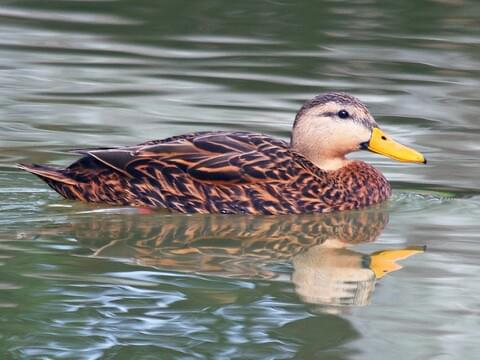
Identifying Scaup vs Tufted Duck: Key Differences to Watch For
Scaups and Tufted Ducks are both diving ducks with similar black-and-white plumage, which can make them easy to confuse at first glance. The most obvious way many birders tell them apart is by the tuft or drooping crest at the back of the Tufted Duck’s head. However, there are times when this feature isn’t clearly visible or may be reduced or even absent, such as when males are in eclipse plumage. The tuft can also be less noticeable in females. In these situations, telling Tufted Ducks from scaups becomes more challenging. Still, there are several reliable features you can use to distinguish between them.
Greater and Lesser Scaups
It’s also important to keep in mind that “scaup” actually refers to two species: Greater and Lesser Scaup. So once you’ve ruled out a Tufted Duck, the next step is to determine which of the two scaups you’re looking at. This means you’ll need to be familiar with the differences between Greater and Lesser Scaup as well in order to make an accurate identification.
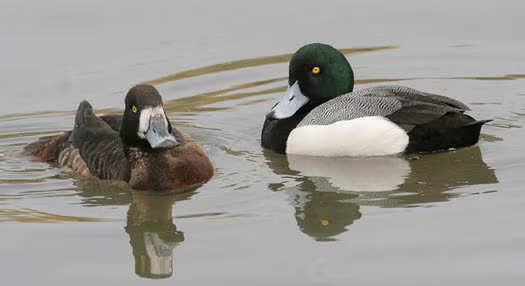
Picture 1 (Greater Scaups)
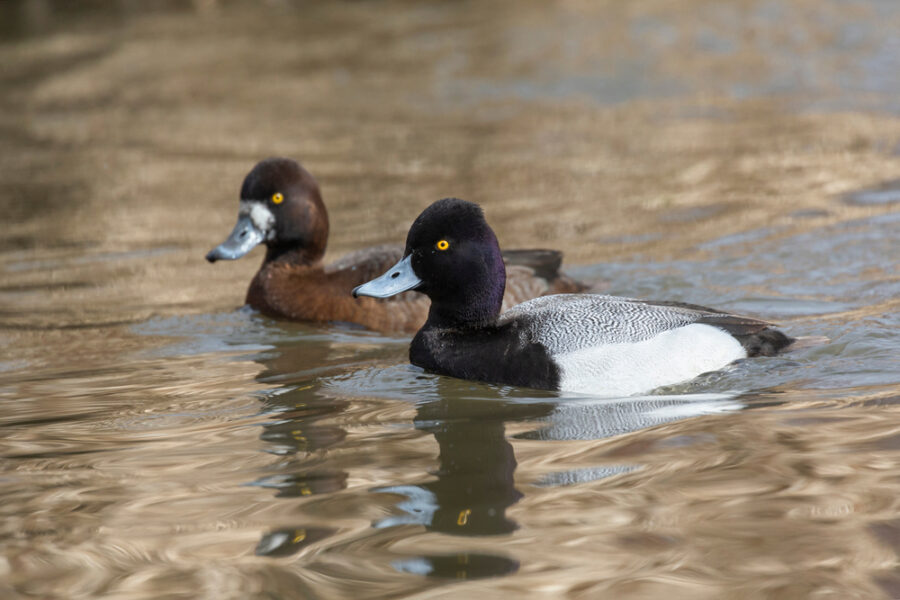
Picture 2 (Lesser Scaups)
The male Greater Scaup (picture 1) has a dark head with a glossy sheen that can look green, blue, or purple depending on the light. Its breast is black, the belly is white, and the back is pale grey. In flight, it shows a strong white wing stripe, which is quite noticeable. The bill is fairly wide and looks more rounded at the tip, with a broader black nail.
When resting on water, the forehead often looks fuller or more “bulging,” while the back of the head has a smooth, gently sloping curve.
The male Lesser Scaup (picture 2) also has a dark, glossy head, but it often looks more purple than green. It may show a small tuft at the back of the head. The breast is black, the belly is white, and the back is whitish-grey with fine dark markings. The wings are darker overall compared to the Greater Scaup.
Its bill is smaller and narrower, giving the head a slimmer profile. The black tip of the bill is also narrower compared to the Greater Scaup.
The head shape is one of the best clues to different Lesser scaups from Greater scaups. The forehead of the Lesser is less bulky, and the back of the head curves more sharply, sometimes even looking slightly angular because of the small crest. When the bird lifts its head, this shape difference becomes easier to see, especially when you compare both species side by side.
Greater Scaup female has a brownish body with a lighter belly and often shows a pale patch around the base of the bill. The head is fairly rounded and smooth, without any crest. The Lesser Scaup female is similar to the Greater, but slightly smaller with a more noticeable dark cap and sometimes a faint pale ring around the bill. Its overall look is compact and subtly patterned.
Tufted Duck

The male Tufted Duck is a striking black-and-white duck with a glossy black head, back, and chest, contrasted by bright white flanks. Its most distinctive feature is the long, drooping crest (tuft) at the back of the head, which is usually clearly visible. Unlike scaups, the Tufted Duck appears darker overall due to its solid black back.
The female Tufted Duck is dark brown overall, often appearing richer and darker than female scaups. She usually has a shorter, less obvious crest compared to the male, but it is still present. A pale area around the base of the bill may be visible, though it is typically less pronounced than in scaups.
Key Differences
Now that we have a rough idea of what all three species look like, let’s narrow things down to some of the most important features to focus on when trying to separate Tufted Ducks from scaups.
1. Presence of a Tuft
The Tufted Duck has a clear drooping crest or “tuft” at the back of its head. This feature is usually quite noticeable and gives the bird a slightly pointed or elongated head shape compared to scaups. Even when the tuft is not fully extended, it still tends to create a subtle bump or trailing shape behind the head that scaups simply do not have. However, in some situations (such as when the bird is resting, preening, or in eclipse plumage) the tuft may look smaller, flatter, or less distinct, which is why it should not be the only feature you rely on.
2. Back colour
Another strong clue is the back colour. Tufted Ducks have a very dark, almost solid black back that blends smoothly with the rest of the body, making the bird appear more uniformly dark overall. In contrast, scaups tend to look lighter and more contrasting. Greater Scaup often shows a pale grey back, while Lesser Scaup usually has darker, finely barred or vermiculated upperparts rather than a solid black appearance. This difference in back pattern and tone often stands out even when other details are hard to see, especially on distant birds floating on open water.
3. Bill
Scaups (both Greater and Lesser) have a broad, flat bill that looks quite wide and noticeable, often with a bluish tone and a clear black tip (nail). In females, the bill is similarly broad and flat, and may also show a pale patch near the base along with the black tip. In contrast, Tufted Ducks have a shorter and noticeably narrower bill that looks more compact and less heavy on the face. The male’s bill is usually greyish-blue with a black tip, while the female’s is smaller, darker, and less distinctly marked compared to scaups.
4. Flight
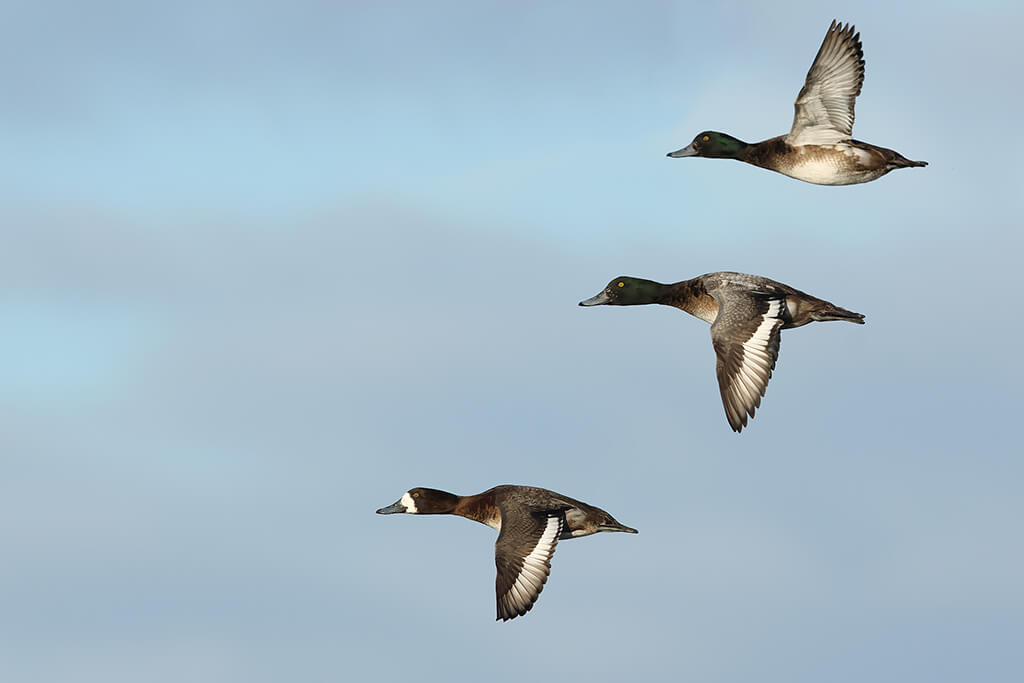
Picture 3 (Flying Greater scaups)
Picture 4 (flying tufted duck)

In flight, you can distinguish scaups from Tufted Ducks by their overall contrast and body tone. Scaups appear lighter and more two-toned in the air, with bright white underparts and a noticeable white wing stripe that stands out clearly against their darker head and upper body (see picture 3). This gives them a clean, contrasting look, especially when they are flying in good light.
Tufted Ducks, however, look darker and more uniformly coloured in flight. Their bodies appear mostly black, with only the white flanks showing briefly as a flash during wingbeats (see picture 4). They lack the strong wing stripe seen in scaups, so they tend to look more compact and less contrasting overall.
Duck Identification Posters/Charts
Celebrate the beauty of ducks with detailed, high-resolution identification posters designed for both learning and decor. Each chart features vibrant colors, sharp details, and a smooth premium finish that’s perfect for classrooms, study spaces, living rooms, or offices.