
Khaki Campbell
Scientific Name
Anas platyrhynchos domesticus
Alternative Names
Campbell, Dark Campbell, White Campbell, Pied Campbell
Measurements:
| Feature | Male | Female |
|---|---|---|
| Weight | 2.3–2.5 kg (5–5.5 lb) | 2.0–2.3 kg (4.4–5 lb) |
| Length | 55–60 cm (22–24 in) | 50–55 cm (20–22 in) |
| Wingspan | 80–90 cm (31–35 in) | 75–85 cm (29–33 in) |
Status
The Khaki Campbell is not at risk according to the FAO (2007). In the United States, it is listed as “Watch” by the American Livestock Breeds Conservancy. The breed remains widely maintained due to its prolific egg-laying ability and adaptability.
Average Life Span
8–10 years
Breed History
The Khaki Campbell was developed in Gloucestershire, England, around the turn of the 20th century by Mrs. Adele Campbell. She initially crossed Indian Runner ducks with Rouens and Mallards to produce a bird with excellent egg-laying ability. The Khaki variety was introduced in 1901, named after the resemblance of its coloration to British army uniforms. The Khaki Campbell Duck Club was formed in 1923, and the breed was accepted to the UK Standards of the Poultry Club in 1924 and the American Standard of Perfection in 1941. It gained popularity in the United States during the 1970s due to its prolific laying and adaptability.
Identification
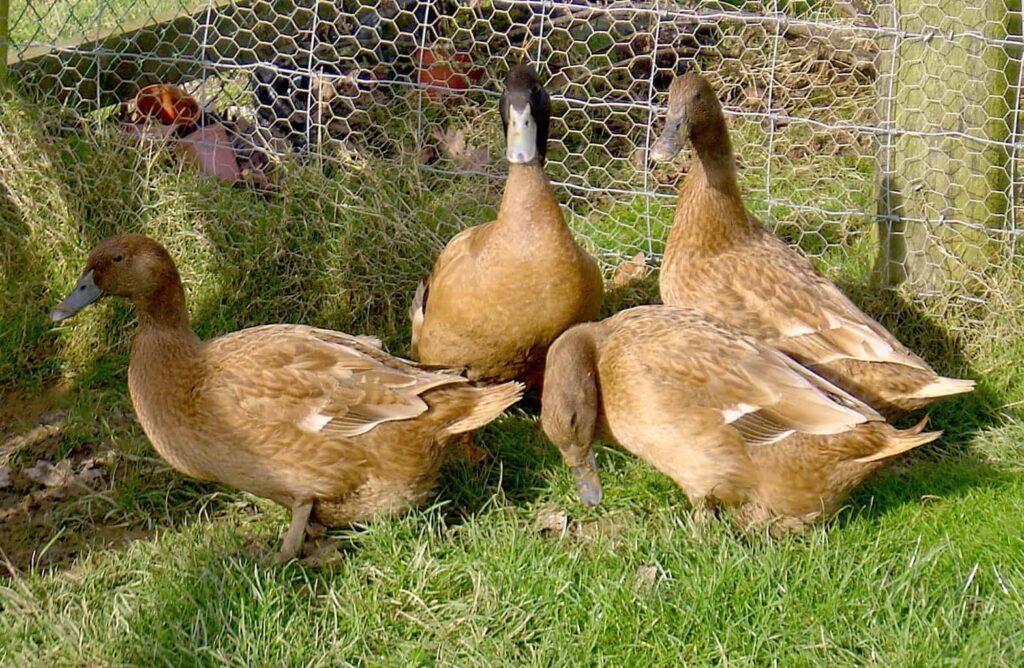
Khaki Campbells come in four color varieties: Khaki, Dark, White, and Pied, with Khaki being the only APA-recognized color. The drake has a mostly khaki-colored body with a darker olive-green head and rich dark-orange legs and feet. The duck is fully khaki with brownish head and neck tones. Dark Campbells are a darker version of Khaki, and White Campbells are pure white with bright orange legs, feet, and bill. Pied Campbells display fawn plumage. These ducks are lightweight, active, and have a streamlined appearance with a long neck, head, and body held at a 20–40 degree angle above horizontal.
Purpose
Khaki Campbells are primarily bred for egg production but also serve as active foragers and garden-friendly ducks. They are not typically raised for meat due to their leaner bodies. They perform well in free-range systems, consuming insects and snails while fertilizing the soil.
Breed Eggs
Khaki Campbells are exceptional layers, capable of producing 250–340 eggs per year. They reach maturity around 5–7 months of age. Eggs are white, and incubation takes approximately 23–28 days, typically requiring mechanical incubators or broody hens since the ducks have limited brooding instinct.
Temperament & Behavior
Khaki Campbells are active, energetic, and intelligent. They are social but can be wary of humans if not hand-raised, though hand-raised individuals imprint well and form strong bonds with their keepers. They are generally quiet, gentle, and non-destructive, making them ideal for garden environments. These ducks are excellent foragers, adaptable to a wide range of climates, and thrive in flocks of 50–200 birds.
Genetic Profile
Khaki Campbells were developed through crossing Indian Runner, Rouen, and Mallard ducks. Selection emphasized prolific egg laying, modest body size, and adaptability to varied environments. The breed has minimal brooding instinct due to selective breeding for egg production, and color varieties exhibit consistent inheritance patterns with Khaki being the primary standard.