
Northern Pintail
Scientific Name
Anas acuta
Alternative Names
Northern Pintail, Pintail Duck
Measurements
| Feature | Male | Female |
|---|---|---|
| Length | 59–76 cm (23–30 in) | 51–64 cm (20–25 in) |
| Weight | 450–1,360 g (0.99–3.00 lb) | 454–1,135 g (1.00–2.50 lb) |
| Wingspan | 80–95 cm (31–37 in) | 80–95 cm (31–37 in) |
Status
The Northern Pintail is a common migratory duck found across the northern parts of Europe, Asia, and North America. It breeds in the Arctic and subarctic zones and migrates south for winter, reaching Africa, South Asia, and even parts of Central America. Although global numbers remain strong, local populations have declined due to hunting, habitat loss, and disease outbreaks.
Identification
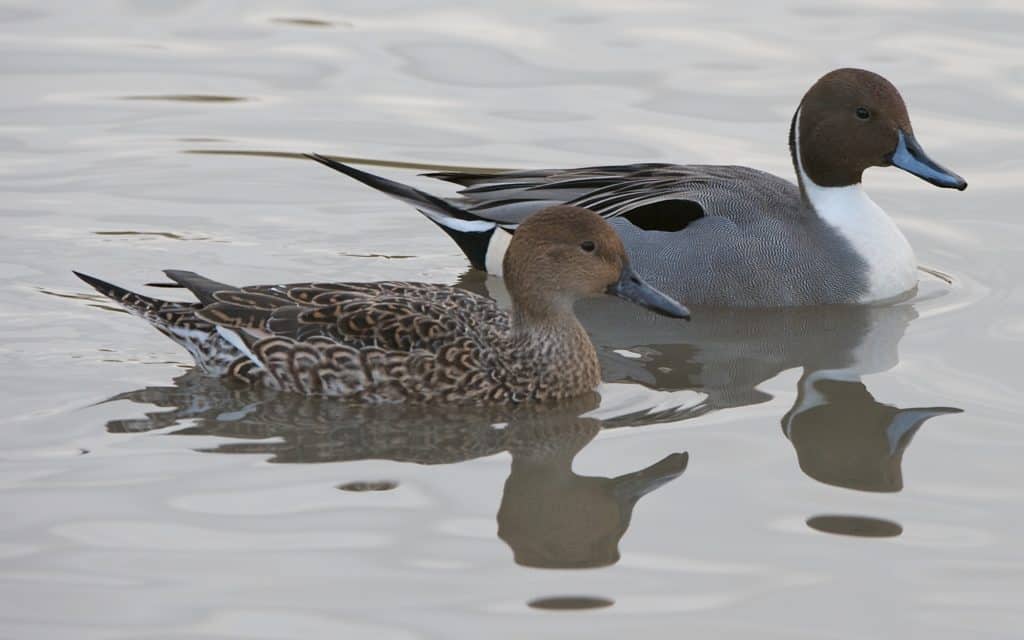
A tall, graceful duck known for its long neck and slender build. Males are easy to recognize by their chocolate-brown heads, white neck stripe, and long pointed tail feathers. Their backs are grey with fine black markings, and they have a blue-grey bill. Females are smaller and brown with mottled patterns, making them well-camouflaged. Both sexes have grey legs and feet.
Voice
Males make a soft whistling sound—proop-proop—while females produce a low, raspy quack similar to a mallard’s call.
Diet
Northern Pintails feed mainly by dabbling in shallow water. They eat seeds, grasses, aquatic plants, and occasionally small insects and snails during breeding season. Their long necks help them reach food deeper than most other dabbling ducks.
Distribution
Breeds across northern North America, Europe, and Asia. Winters as far south as Central America, Africa, India, and Southeast Asia. Small flocks sometimes reach Pacific islands like Hawaii.
Habitat
Prefers open wetlands—marshes, wet meadows, and lake edges. In winter, it frequents estuaries, flooded fields, and coastal lagoons. It often joins large mixed flocks of other duck species.
Breeding
Pairs form during migration or winter. Nests are built on the ground, often far from water, hidden among tall grass. The female lays 7–9 cream-colored eggs and incubates them for about 23 days. Ducklings are led to water soon after hatching and can fly after about 7 weeks.
Wintering
A long-distance migrant. Northern Pintails spend winters in mild regions near wetlands and flooded fields, often mixing with other dabbling ducks.
Conservation
Though still widespread, the species faces habitat loss from farming, wetland drainage, and climate change. It’s also affected by hunting and diseases like avian botulism. The Northern Pintail is protected under the Agreement on the Conservation of African-Eurasian Migratory Waterbirds (AEWA) and is listed as “Least Concern” by the IUCN, but some local populations—especially in Europe—are declining.