
Lesser Whistling Duck
Scientific Name
Dendrocygna javanica
Alternative Names
Indian Whistling Duck, Lesser Whistling Teal
Measurements
| Feature | Male & Female |
|---|---|
| Length | 41–45 cm (16–18 in) |
| Weight | 500–900 g (1.1–2 lb) |
Status / Origin
Native to the Indian subcontinent and Southeast Asia. Widespread and common throughout India, Nepal, Bangladesh, Sri Lanka, Myanmar, Thailand, Malaysia, Indonesia, and surrounding islands such as the Andamans, Nicobars, and Maldives. Considered a species of Least Concern.
Identification
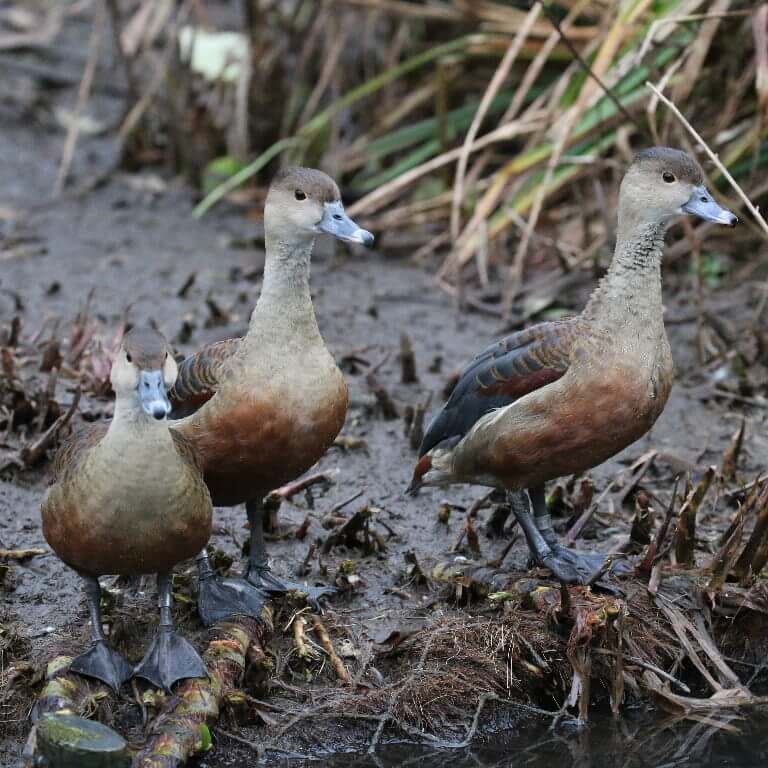
A small, chestnut-brown duck with a long neck and rounded head. The body is warm brown with a darker crown and pale face. It has chestnut upper-tail coverts (rump), which separates it from the similar fulvous whistling duck that has a creamy white rump. Eyes are surrounded by a yellow to orange ring. The wings are broad and dark, especially noticeable in flight. Sexes look alike.
Voice
Gives a loud, two-note wheezy whistle, often repeated. Very vocal, especially in flight or when in groups. Local names like sili and silhahi are based on this call.
Diet
Eats aquatic plants, rice grains from fields, seeds, and grasses. Also consumes small fish, frogs, molluscs, worms, and invertebrates. Feeds at night and rests during the day in shallow water, paddy fields, or lake edges.
Distribution
Found across lowland wetlands in India, Pakistan (rare), Nepal, Sri Lanka, Southeast Asia, Myanmar, Thailand, Vietnam, Malaysia, Indonesia, and nearby islands. Large numbers gather in urban wetlands in cities like Kolkata and Goa.
Habitat
Prefers freshwater lakes, ponds, marshes, flooded fields, swamps, and rice paddies with good vegetation. Often seen perching on trees or even resting on open sea near coasts. Can also be seen on reservoirs and quiet village ponds.
Breeding
Breeds during the monsoon or rainy season. Nest is built in tree holes, forks of branches, old nests of kites or herons, or on the ground among reeds. Lined with grass and down. Lays 7–12 white eggs, sometimes up to 17, which may be due to brood parasitism. Both parents incubate for 22–24 days. Chicks may ride on the parents’ backs. More than one brood can be raised in a season.
Behaviour
Gregarious and seen in flocks around wetlands. Nocturnal feeders, resting during the day. Good swimmers and can dive when needed. Capable of perching on branches and nesting in tree holes. Fly with slow wingbeats and produce a loud whistling sound. Courtship includes the male dipping and raising his bill in water while circling the female.
Wintering
Mostly resident but may make local movements depending on rainfall and water levels. Northern birds move slightly south during colder months.
Conservation / Threats
Global population is secure with estimates between 2–20 million individuals. Not heavily hunted as they are not considered good for eating. Main threats include wetland drainage, pollution, and agricultural changes. In some regions, ducklings are raised for use as live decoys by hunters.
