
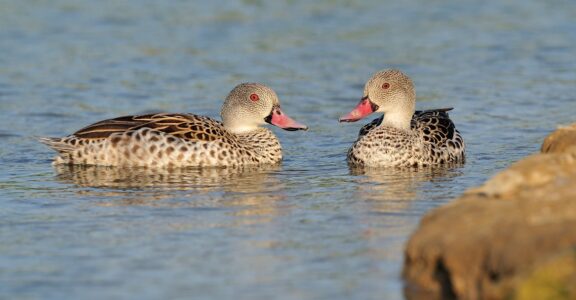
Cape Teal

Scientific name

Anas capensis

Alternative names

Cape Wigeon, Cape Widgeon

Measurements

FeatureRange / Note
Length44–46 cm
Weight316–502 g (11–18 oz)
WingspanNot specifically recorded

Status

Not considered endangered. Classified as Least Concern, population is large and appears to be increasing.

Identification

Cape Teals are small, pale ducks with mostly grey mottled plumage, a browner back, pink bill, and reddish eyes. The speculum is green and black, bordered with white. Males and females look similar, though females are slightly smaller, paler, and less speckled. Juveniles lack the pink on the bill.

Behavior

They are mostly quiet; males emit a high-pitched whistle during displays, and females respond with a soft nasal quack. They are dabbling ducks but occasionally dive underwater. Cape Teals perform “nod swimming” courtship displays without actually nodding. Both parents help raise ducklings and defend them aggressively.

Distribution

Found across sub-Saharan Africa, including Angola, Botswana, Chad, Ethiopia, Kenya, Mozambique, Namibia, Niger, Nigeria, South Africa, Sudan, Tanzania, Zambia, and Zimbabwe.

Habitat

Occupies shallow saline lakes, seasonal and permanent brackish or saline pools, rivers, seasonally flooded wetlands, farm dams, reservoirs, coastal shorelines, estuaries, lagoons, tidal mudflats, and wastewater treatment pools.

Feeding

Omnivorous. Diet includes stems, leaves, seeds of pondweeds, aquatic insects, crustaceans, tadpoles, and small invertebrates obtained by dabbling.

Breeding

Nest is a hollow scrape on the ground, concealed among small trees, thorny bushes, or aquatic vegetation, often near water. Females lay 7–8 eggs, incubated for 25–26 days. Both parents rear the ducklings. Ducklings fledge in about 6 weeks. Sexual maturity is reached at 1–2 years.

Wintering

Non-migratory, but may move opportunistically with rainfall and flooding. Forms moulting flocks up to 2,000 birds.

Conservation

Population is large and stable, benefiting from dams, reservoirs, and irrigation projects. Potential threats include wetland destruction, altered flood regimes, habitat degradation, and disturbance from tourism. Species is also hunted for food by humans and predators.

Similar Posts

  • Puna Teal

    Scientific Name Spatula puna Alternative Names None widely recognized; sometimes referred to as Andean Teal Measurements Feature Male Female Length About 48 cm (19 in) About 48 cm (19 in) Weight Around 600–700 g (1.3–1.5 lb) Slightly lighter Wingspan Not well documented — Status Listed as Least Concern on the IUCN Red List. Populations are…

  • Northern ‘Borealis’ Eider

    Scientific Name Somateria mollissima borealis Alternative Names Common Eider, Northern Eider, Borealis Eider, St. Cuthbert’s Duck, Cuddy’s Duck Measurements Measurement Range Imperial Length 500–710 mm 20–28 in Weight 0.81–3.04 kg 1.8–6.7 lb Wingspan 800–1100 mm 31–43 in Status Least Concern globally, though the borealis subspecies is considered rare in Britain and under review by the…

  • African Black Duck

    Scientific Name Anas sparsa Alternative Names Black River Duck, Ethiopian Black Duck, West African Black Duck Measurements Feature Male Female Length 48–57 cm (19–22 in) Slightly smaller Weight About 1 kg (2.2 lb) Slightly less Wingspan 80–90 cm (31–35 in) 80–90 cm (31–35 in) Status The African Black Duck is a shy and beautiful waterbird…

  • Bronze-winged Duck

    Scientific name Speculanas specularis Alternative names Also called the Spectacled Duck or Pato Perro (“Dog Duck”). Measurements Feature Range / Note Length ~56–60 cm (estimated from related sources) Weight ~1–1.3 kg (estimated) Wingspan Data not widely documented Status Near Threatened (IUCN). Population estimated at fewer than 7,000 individuals. Identification A river duck with striking markings….

  • Southern Pochard

    Scientific Name Netta erythrophthalma Measurements Measurement Range Body Length 45–50 cm Wingspan Approximately 75–85 cm Weight 700–1,200 g Egg Count 6–15 eggs per clutch Incubation 20–28 days Status The Southern Pochard is currently listed as Least Concern by the IUCN, but its population has been steadily declining since the 1970s. In South America, estimates from…

  • Ruddy Duck

    Scientific name Oxyura jamaicensis Common name Ruddy Duck Measurements Feature Average Length 34–43 cm (13.5–17 in) Wingspan 47 cm (18.5 in) Weight 560 g (1.23 lb) Status The ruddy duck is a compact, stiff-tailed diving duck native to North and South America. It has also established populations in Europe after being introduced to the United…

Leave a Reply

Your email address will not be published. Required fields are marked *