
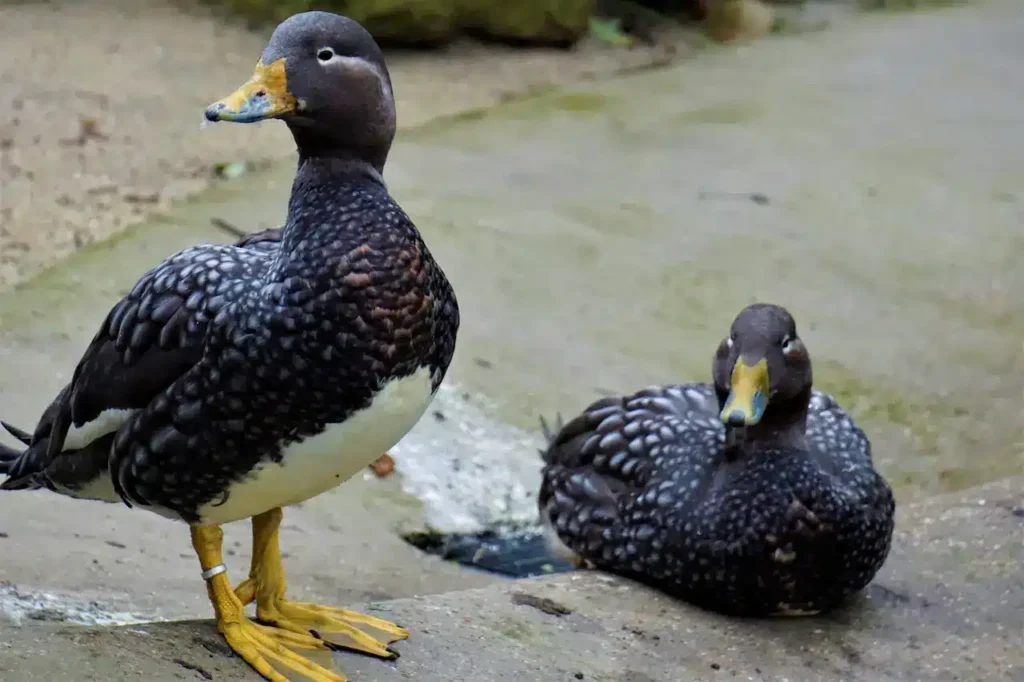
Flying Steamer Duck

Scientific Name


Tachyeres patachonicus

Alternative Names

Flying steamer-duck, flying steamerduck

Measurements

MeasurementMaleFemale
WeightHeavierLighter
WingspanSlightly smallerSlightly larger
BillDark grey with yellow toneOrange with black tip

Status / Origin

Native to southern Chile, Argentina, Tierra del Fuego, and the Falkland Islands. Classified as Least Concern.

Identification

Smallest of the four steamer ducks. Has brown head and neck with a white stripe from the eye to the nape. Body is brown-grey with a white underbelly and orange feet. Males are heavier but have slightly shorter wings and smaller skulls than females. Both sexes have orange, hardened wing knobs used for display and combat.

Voice

Low, grunt-like calls. Females make rapid, low-pitched grunts of similar tone. Males produce three whistle-like grunts: rasping, ticking, and sibilant.

Diet

Forages mostly in pairs. Dives in shallow zones or around deep-water kelp. Eats mollusks, crustaceans, and other marine invertebrates.

Distribution

Found across Chile, Argentina, Tierra del Fuego, and the Falkland Islands. More widespread than other steamer ducks due to its ability to fly.

Habitat

Freshwater lakes, slow-moving rivers, coastal bays, estuaries, and kelp-lined shorelines.

Breeding

Thought to be mostly monogamous. Courtship starts with both birds dipping their bills into the water rhythmically. The female submerges, the male mounts, and afterward both raise their bills high and grunt loudly.

Wintering

Does not migrate long distances. Remains within its home range throughout the year.

Threats

Nests are preyed on by Chimango Caracaras, Crested Caracaras, Fuegian Culpeo Foxes, and introduced American mink. Highly territorial and aggressive, sometimes killing other waterbirds such as grebes and shovelers.

Conservation

Listed as Least Concern. However, increased predation by American mink on nests of flightless steamer ducks in Tierra del Fuego may threaten populations in the future.

Similar Posts

  • White-winged Scoter

    Scientific name Melanitta deglandi Common name White-winged Scoter Measurements Feature Average Length 48–60 cm (19–24 in) Wingspan 80 cm (31.5 in) Weight 950–2,128 g (2.1–4.7 lb) Status The white-winged scoter is the largest North American scoter and one of the most widespread sea ducks on the continent. The IUCN lists it as Least Concern, though…

  • Wandering Whistling Duck

    Scientific Name Dendrocygna arcuata Alternative Names Whistling Tree-Duck, Water Whistling Duck, Red Whistler Measurements Feature Male & Female Length 54–60 cm (21–24 in) Weight Around 750 g (1.65 lb) Status / Origin This species is native to tropical and subtropical regions of Australia, Indonesia, the Philippines, Papua New Guinea, Timor-Leste, Borneo, and nearby Pacific Islands….

  • Mottled Duck

    Scientific Name Anas fulvigula Alternative Names Mottled Mallard Measurements Sex Length Weight Wingspan Male 50–57 cm (19.7–22.5 in) 880–1,240 g (30.9–43.8 oz) 83–87 cm (32.7–34.3 in) Female 47–53 cm (18.5–21.0 in) 700–1,150 g (24.7–40.6 oz) 80–83 cm (31.5–32.7 in) Status Fairly common within its range. Populations are stable but closely monitored due to hybridization risks…

  • Knob-billed Duck

    Scientific name Sarkidiornis melanotos Common name Knob-billed Duck or African Comb Duck Measurements Feature Average Length 56–76 cm (22–30 in) Wingspan 116–145 cm (46–57 in) Weight 1.03–2.9 kg (2.3–6.4 lb) Status The knob-billed duck is a large, distinctive waterfowl found across Sub-Saharan Africa, Madagascar, and parts of South and Southeast Asia. It inhabits tropical and…

  • Steller’s Eider

    Scientific Name Polysticta stelleri Measurements Feature Measurement Length 43–46 cm (17–18 in) Weight 800–860 g (1.8–1.9 lb) Wingspan 69 cm (27 in) Wing 21–22.5 cm (8.3–8.9 in) Culmen 3.7–4.2 cm (1.5–1.7 in) Tarsus 3.6–4.0 cm (1.4–1.6 in) Status Steller’s Eider is listed as Vulnerable by the IUCN. The Alaska-breeding population is Threatened under U.S. law…

Leave a Reply

Your email address will not be published. Required fields are marked *