
Falcated Duck
Scientific Name
Mareca falcata
Alternative Names
Falcated Teal
Measurements:
| Feature | Male | Female |
|---|---|---|
| Length | 46–53 cm (18–21 in) | 46–53 cm (18–21 in) |
| Weight | 422–770 g (15–27 oz) | Slightly lighter |
| Wingspan | 79–91 cm (31–36 in) | 79–91 cm (31–36 in) |
Status
The Falcated Duck is listed as Near Threatened on the IUCN Red List. While its global population is estimated at around 89,000 individuals, habitat loss and hunting still pose serious risks. Populations are found in several protected areas, and the species is legally protected under international migratory bird treaties.
Identification
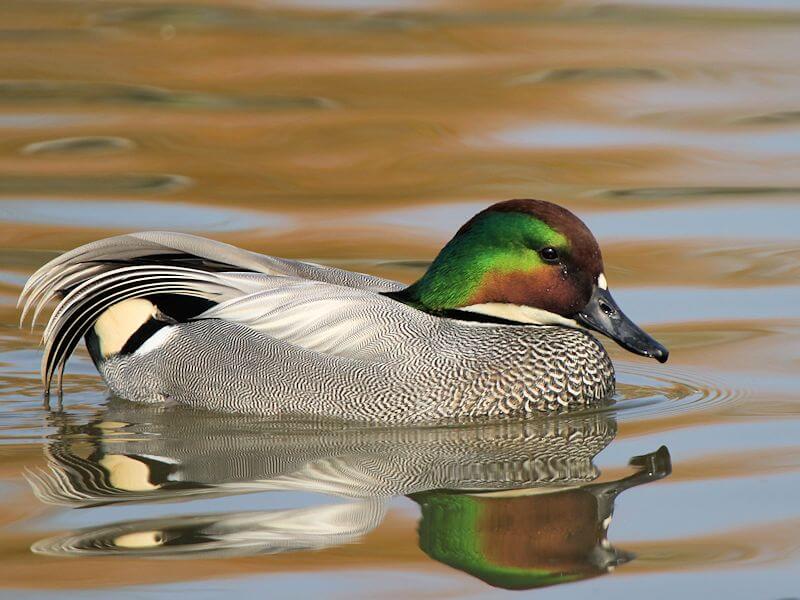
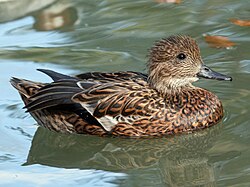
A medium-sized dabbling duck similar in size to the Gadwall. The male is unmistakable — his head shines with rich green and bronze tones, the throat is white, and long curved tertial feathers sweep gracefully off his back, giving the bird its name “falcated,” meaning sickle-shaped. The female is brown and patterned like a female wigeon, with a long gray bill. In flight, both sexes show a pale gray underwing and a blackish speculum edged in white.
Voice
Usually quiet, though males give a high, whistling “tyu-tyu-vit” call during courtship, while females produce a rough quack and short, high-pitched calls.
Diet
Mainly herbivorous, feeding on aquatic plants, seeds, grains, and nuts, but also eats small insects, larvae, crustaceans, and mollusks. Falcated Ducks dabble on the water’s surface or graze on land. They may help disperse seeds across wetlands.
Distribution
Breeds across eastern Siberia, Mongolia, northeastern China, and northern Japan, with wintering grounds stretching across Southeast Asia and northeastern India. Occasional strays have been sighted as far as North America and Europe, though many of these may be escapees from captivity.
Habitat
Favors lowland wetlands, lakes, flooded meadows, and marshes. During migration and winter, they gather in large flocks on shallow freshwater or coastal wetlands.
Breeding
They build their nests on the ground, often hidden in thick grass or low bushes near water. The female lays 6–10 creamy white eggs and incubates them for about 24–25 days. Males leave during incubation. Chicks are precocial and follow the female soon after hatching.
Wintering
Strongly migratory, moving south to China, Vietnam, Myanmar, India, and Southeast Asia during the colder months. Flocks are often seen on calm lakes and rice fields.
Conservation
Threats: Habitat loss from wetland drainage, hunting for meat and feathers, and the impacts of urban development and pollution in East Asia.
Protection: They are found in several wildlife reserves and protected under the Migratory Bird Treaty Act. Conservation actions include stricter hunting controls, better management of wetlands, and community awareness programs to protect migratory waterfowl.
