
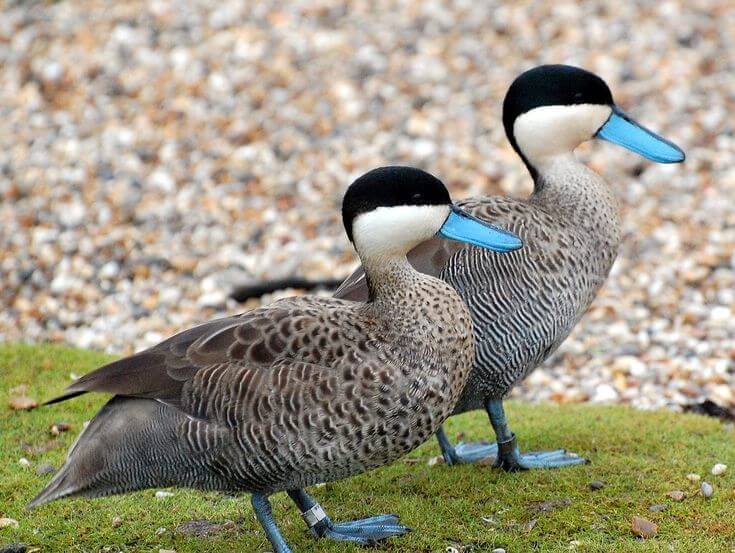
Puna Teal

Scientific Name

Spatula puna

Alternative Names

None widely recognized; sometimes referred to as Andean Teal

Measurements

FeatureMaleFemale
LengthAbout 48 cm (19 in)About 48 cm (19 in)
WeightAround 600–700 g (1.3–1.5 lb)Slightly lighter
WingspanNot well documented

Status

Listed as Least Concern on the IUCN Red List. Populations are stable across the Andean regions of Peru, Bolivia, Chile, and Argentina.

Identification

A small dabbling duck with a striking light blue bill marked by a black line down the center. It has a black cap extending below the eyes, a creamy white neck and face, and light coffee-brown plumage with dark spotting. The tail coverts are gray, and the flanks are dark with fine stripes.

Voice

Quiet species; generally silent except for soft quacks and low whistles during breeding.

Diet

Feeds mainly on aquatic plants, seeds, and small invertebrates found in shallow lakes and pools of the high Andes.

Distribution

Resident in the Andes of Peru, western Bolivia, northern Chile, and northwestern Argentina, typically found at high altitudes on large lakes and ponds.

Habitat

Prefers high-altitude wetlands and freshwater lagoons in the altiplano region, often over 3,000 meters above sea level.

Breeding

Nests are made in long grass, sometimes away from water. Eggs are creamy pink, and both parents share the responsibility of rearing the ducklings—an uncommon trait among ducks. Breeding occurs mainly between April and June.

Wintering

Largely non-migratory but may move locally within the Andes to lower elevations when temperatures drop.

Conservation

Currently stable and not threatened, though dependent on the conservation of Andean wetlands that provide vital feeding and nesting areas.

Similar Posts

  • Black Scoter

    Scientific Name Melanitta americana Alternative Names Black Scoter, American Scoter, Macreuse noire (French) Measurements Measurement Range Imperial Length 430–550 mm 17–21.5 in Weight 950 g 2.09 lb Wingspan 710 mm 28 in Wing 213–233 mm 8.4–9.2 in Tail 83–97 mm 3.3–3.8 in Culmen 42–45.5 mm 1.65–1.79 in Tarsus 45–48.5 mm 1.77–1.91 in Status Near Threatened…

  • Mandarin Duck

    Scientific name Aix galericulata Alternative names Mandarin Duck Measurements Feature Range / Note Length 41–49 cm (16–19 in) Wingspan 65–75 cm (26–30 in) Weight 450–600 g (approx.) Status Not considered endangered. Global population is hard to estimate, but introduced populations in Europe and small feral populations in the U.S. are stable. Native populations in East…

  • Auckland Teal

    Scientific Name Anas aucklandica Alternative Names Auckland Islands teal, Tētē kākāriki (in Māori) Measurements Feature Measurement Length 40–45 cm Weight 400–600 g Wingspan 60–65 cm (reduced, flightless) Status The Auckland teal is classified as Near Threatened but considered the most secure of New Zealand’s three brown-plumaged teals. It is extinct from the main Auckland Island…

  • Chiloé Wigeon

    Scientific Name: Mareca sibilatrix Alternative Names: Chiloé Wigeon, Southern Wigeon, Pato Overo Measurements: Feature Male Female Length 46–56 cm (18–22 in) 46–56 cm (18–22 in) Weight Around 800 g (28 oz) Slightly lighter Wingspan 75–86 cm (30–34 in) 75–86 cm (30–34 in) Status Classified as Least Concern. Populations are stable and widespread in southern South…

  • Chubut Steamer Duck

    Scientific Name Tachyeres leucocephalus Alternative Names Chubut steamer duck, white-headed flightless steamer duck Measurements Measurement Male Female Length About 65–75 cm (estimated, similar to other steamer ducks) Slightly smaller Weight Around 4–6 kg (estimate, similar species data) Slightly lighter Wingspan Flightless, wings short and paddle-like Same Status / Origin A flightless duck species found only…

  • Cape Teal

    Scientific name Anas capensis Alternative names Cape Wigeon, Cape Widgeon Measurements Feature Range / Note Length 44–46 cm Weight 316–502 g (11–18 oz) Wingspan Not specifically recorded Status Not considered endangered. Classified as Least Concern, population is large and appears to be increasing. Identification Cape Teals are small, pale ducks with mostly grey mottled plumage,…

Leave a Reply

Your email address will not be published. Required fields are marked *