
Steller’s Eider

Scientific Name

Polysticta stelleri

Measurements

FeatureMeasurement
Length43–46 cm (17–18 in)
Weight800–860 g (1.8–1.9 lb)
Wingspan69 cm (27 in)
Wing21–22.5 cm (8.3–8.9 in)
Culmen3.7–4.2 cm (1.5–1.7 in)
Tarsus3.6–4.0 cm (1.4–1.6 in)

Status

Steller’s Eider is listed as Vulnerable by the IUCN. The Alaska-breeding population is Threatened under U.S. law due to a dramatic decline in nesting sites and ongoing habitat threats. Conservation and recovery plans are active in both the U.S. and Europe.

Identification

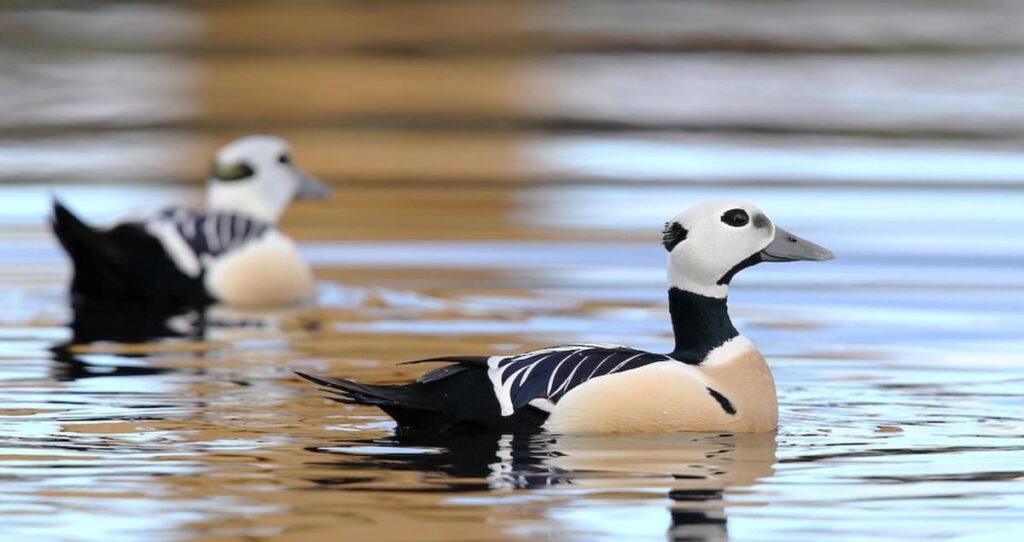
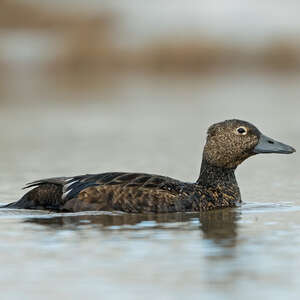
The smallest and fastest of all eiders, Steller’s Eider is a compact sea duck with a large head and thick bill. Breeding males are striking—white-headed with a black cap, cinnamon breast marked with a black spot, and green patches behind the eyes. Females are brown with pale eye-rings and a purplish-blue speculum edged in white.

Voice

Males produce low growling or crackling sounds, while females give soft “qua-haaa” calls. Their flight feathers also emit a whistling sound in flight.

Diet

Feeds mainly near shore on crustaceans, mollusks, polychaete worms, and mussels. During the summer, it eats aquatic insects and plant material such as pondweeds and berries.

Distribution

Breeds along Arctic coastlines of Alaska and Russia and winters in the Barents, Baltic, and Bering seas. Small numbers are also found in northern Norway.

Habitat

Favors marshy tundra for nesting, building nests on slightly raised mounds covered with mosses and grasses near small ponds. Winters in shallow coastal lagoons and bays rich in eelgrass and invertebrates.

Breeding

Pairs form in late winter or early spring. The female builds a grass- and down-lined nest and lays 1–8 olive to brownish-orange eggs, which she incubates for about 25 days. The young hatch with down and feed themselves but stay near the mother until fledging.

Molt

After breeding, Steller’s Eiders gather in dense flocks in Arctic lagoons to molt all their feathers at once, remaining flightless for about three weeks. The molt season runs from July to October.

Conservation

Protected under international law, Steller’s Eiders are part of recovery programs led by the U.S. Fish and Wildlife Service and the European Union. Critical habitats have been designated across Alaska. The global population is estimated at 110,000–125,000 individuals.

Similar Posts

  • Hawaiian Duck

    Scientific Name Anas wyvilliana Alternative Names Hawaiian duck, koloa, koloa maoli Measurements Feature Male Female Length 48–50 cm (19–19.5 in) 40–43 cm (15.5–17 in) Weight 604 g (21.3 oz) 460 g (16 oz) Status Vulnerable on the IUCN Red List. The overall population is slowly increasing, but pure Hawaiian ducks are decreasing due to hybridization…

  • Mexican Duck

    Scientific Name Anas diazi Alternative Names Mexican Mallard Measurements Measurement Range Imperial Length 510–560 mm 20–22 in Status Least Concern globally; populations show a slow decline due to hybridization, habitat loss, and overhunting. Identification A medium-sized dabbling duck resembling a female mallard but with a darker overall body tone. Both sexes are mainly brown with…

  • Greater Scaup

    Scientific Name Aythya marila Alternative Names Scaup, Bluebill (North America) Measurements Length: 39–56 cm (15–22 in)Wingspan: 71–84 cm (28–33 in)Weight: 726–1,360 g (1.6–3.0 lb) Status Listed as Least Concern by the IUCN, though populations have been declining since the 1980s due to habitat loss, pollution, and reduced female survival rates. Identification A medium-sized diving duck…

  • Brazilian Teal

    Scientific Name Amazonetta brasiliensis Alternative Names Brazilian Teal, Brazilian Duck Measurements Feature Male Female Length 38–45 cm (15–18 in) 38–45 cm (15–18 in) Weight Around 500–600 g (1.1–1.3 lb) Slightly lighter than males Wingspan Around 70–80 cm (28–31 in) Around 70–80 cm (28–31 in) Status This species is common and listed as Least Concern. It…

  • Long-Tailed Duck

    Scientific Name Clangula hyemalis Alternative Names Oldsquaw, Coween, Old Wife, South-Southerly Measurements Feature Measurement Length 44–60 cm (17–23.5 in) Wingspan 71 cm (28 in) Weight 740 g (1.6 lb) Tail 16.5–23.7 cm (6.5–9.3 in) Status The Long-Tailed Duck is listed as Vulnerable on the IUCN Red List due to declining populations, particularly in the Baltic…

  • Bufflehead

    Scientific name Bucephala albeola Common name Bufflehead Measurements Feature Average Length 32–40 cm (13–16 in) Wingspan 55 cm (21.6 in) Weight 270–550 g (9.5–19.4 oz) Status The bufflehead is a small, active sea duck found across North America. It breeds in Alaska and Canada and spends the winter in coastal waters and large lakes farther…

Leave a Reply

Your email address will not be published. Required fields are marked *