
Eurasian Wigeon

Scientific Name

Mareca penelope

Alternative Names

Eurasian Wigeon, European Wigeon, Widgeon

Measurements

FeatureMaleFemale
Length42–52 cm (17–20 in)42–52 cm (17–20 in)
Weight500–1,073 g (1–2 lb)500–1,073 g (1–2 lb)
Wingspan71–80 cm (28–31 in)71–80 cm (28–31 in)

Status

A common and widespread dabbling duck across Europe and Asia. Classified as Least Concern under the Agreement on the Conservation of African-Eurasian Migratory Waterbirds (AEWA).

Identification

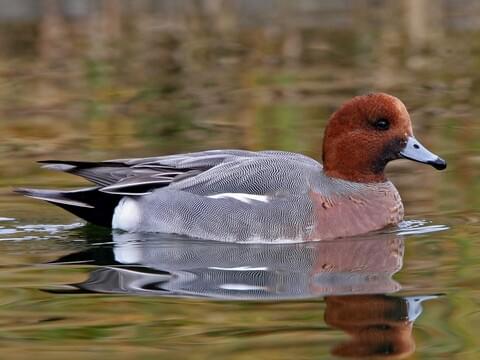
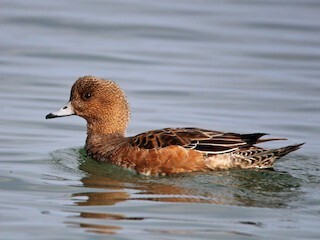
A medium-sized duck with a rounded head and short bill. The breeding male has a pinkish breast, white belly, gray back and flanks, and a black rear. Its chestnut head is marked by a creamy-yellow crown, and its wings show a striking white patch and dark green speculum. Females are light brown with two common color forms—one rufous and the other grayish. In non-breeding (eclipse) plumage, males look more like females but retain subtle hints of their bright markings.

Voice

Males make a clear, whistling sound like “pjiew pjiew.” Females give a soft growling call that sounds like “rawr.”

Diet

Feeds mainly on aquatic plants, grasses, and roots. Often grazes on land like a goose and sometimes dabbles in shallow water for vegetation.

Distribution

Breeds in northern Europe and across the Palearctic region. During winter, it migrates south to Africa and southern Asia. Common as a winter visitor in Great Britain and Ireland, but breeds only in small numbers in northern parts of the British Isles. Occasionally seen in North America, especially along the Atlantic and Pacific coasts.

Habitat

Prefers open wetlands such as marshes, flooded meadows, and lakes with some tall vegetation nearby. In winter, it can also be found on coastal estuaries and inland reservoirs.

Breeding

Nests are built on the ground near water, hidden under grass or low plants. The female lays and incubates the eggs, while the male may stay nearby for a short time before joining flocks.

Wintering

Highly migratory—spending winters in southern regions where water remains unfrozen. Often seen in large, social flocks that may mix with other duck species.

Conservation

The species is widespread and abundant. Protected under international agreements for migratory waterbirds, and its global population is considered stable.

Similar Posts

  • King Eider

    Scientific name Somateria spectabilis Alternative names King Eider Measurements Feature Range / Note Length 50–70 cm (20–28 in) Wingspan 86–102 cm (34–40 in) Weight Males ~1.668 kg (3.68 lb), females ~1.567 kg (3.45 lb); can vary 0.9–2.2 kg (2–4.9 lb) Status Not considered endangered. Population is large and widespread, and the species is classified as…

  • Northern Shoveler

    Scientific name Spatula clypeata Alternative names Shoveler, Northern Shoveller, Common Shoveler Measurements Feature Range Length 44–52 cm (17.3–20.5 in) Wingspan 70–84 cm (27.6–33.1 in) Weight 500–800 g (1.1–1.8 lb) Status The Northern Shoveler is classified as Least Concern by the IUCN and is protected under the Agreement on the Conservation of African-Eurasian Migratory Waterbirds (AEWA)….

  • Madagascar Pochard

    Scientific Name Aythya innotata Alternative Names Fotsy maso or Onjo (in Malagasy) Measurements Measurement Range Body Length 42–56 cm Wingspan ~70–80 cm (estimated) Weight Approximately 600–800 g Clutch Size 6–10 eggs Diving Time (Adult) ~24 seconds Diving Time (Ducklings) ~10 seconds from 14 days old Status Critically Endangered. Thought to be extinct in the late…

  • American Wigeon

    Scientific Name Mareca americana Alternative Names Baldpate Measurements Feature Measurement Length 42–59 cm (17–23 in) Wingspan 76–91 cm (30–36 in) Weight 512–1,330 g (1.1–2.9 lb) Status The American Wigeon is listed as Least Concern on the IUCN Red List. Its population is stable overall, though regional shifts have occurred — with declines in Canada’s Prairie…

  • White-cheeked Pintail

    Scientific Name Anas bahamensis Alternative Names Bahama pintail, Bahama duck, White-cheeked duck Measurements Feature Male Female Body Length 38–51 cm 38–51 cm Weight 474–710 g 505–670 g Wingspan Around 76–84 cm Around 76–84 cm Status Listed as Least Concern, though some local populations face pressure from habitat loss and hunting. Identification A medium-sized dabbling duck…

  • Yellow-billed Teal

    Scientific Name Anas flavirostris Alternative Names Chilean Teal, Sharp-winged Teal Measurements Measurement Range Imperial Length 360–430 mm 14–17 in Weight 400–500 g 0.9–1.1 lb Wingspan 600–700 mm 24–28 in Status Listed as Least Concern by the IUCN due to its wide distribution and stable population across South America. Identification A small, compact teal characterized by…

Leave a Reply

Your email address will not be published. Required fields are marked *