
Surf Scoter
Scientific name
Melanitta perspicillata
Common name
Surf Scoter
Measurements
| Feature | Average |
|---|---|
| Length | 44–48 cm (17–19 in) |
| Wingspan | 76–77 cm (30 in) |
| Weight | 900–1,050 g (2.0–2.3 lb) |
Status
The surf scoter is a large, migratory sea duck native to North America. Though its population has declined by an estimated 50–70% over the past four decades, it remains classified as Least Concern by the IUCN due to its broad range and relatively large population, estimated between 250,000 and 1.3 million individuals. Local populations face ongoing pressures from oil spills, habitat degradation, and declines in marine prey abundance.
Identification
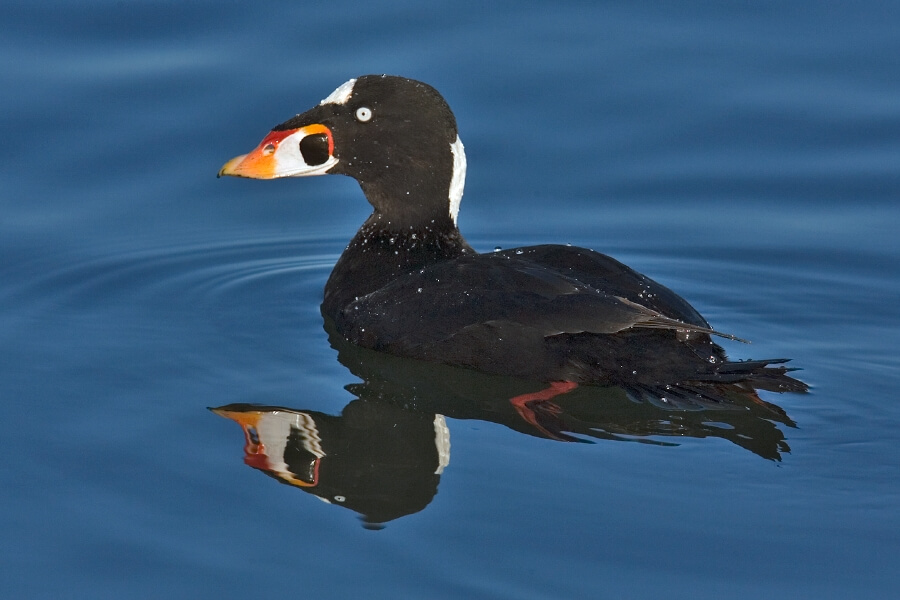
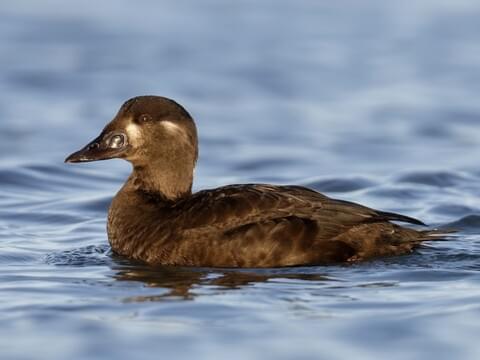
Adult males are almost entirely black with distinctive white patches on the forehead and nape, and a large, multicolored bill patterned in orange, red, white, and black. Females are smaller, uniformly brown, and have pale patches on the cheeks and sometimes the nape. Juveniles resemble females but are lighter and browner overall. The surf scoter’s all-dark wings in flight distinguish it from other scoters.
Voice
Usually silent outside the breeding season. During courtship, males produce low gurgling and “puk-puk” calls, while females use harsh, crow-like cries to defend their brood. Alarmed birds make a short “guk” sound before taking flight.
Distribution
Breeding occurs in northern Canada and Alaska, typically near freshwater lakes in the boreal forest and tundra zones. During winter, surf scoters migrate to the Pacific and Atlantic coasts of North America, forming large flocks in bays and estuaries from Alaska and British Columbia down to Baja California and the Gulf of Mexico. Small numbers occasionally reach western Europe.
Habitat
Surf scoters nest near northern lakes and rivers, often close to spruce cover. They molt in sheltered coastal bays or estuaries rich in food and low in predators. In winter, they inhabit shallow marine waters, especially near mussel beds and rocky shorelines.
Behavior
Pairs form on wintering or staging grounds before migration north. Nests are shallow depressions lined with down and vegetation, usually hidden near water. Females lay 5–9 eggs and incubate for 28–30 days. Ducklings feed themselves soon after hatching, though the female guards them for several weeks before leaving them to fledge independently at around 55 days.
Surf scoters are highly synchronized divers, often submerging and resurfacing in unison within large feeding flocks. They molt all flight feathers simultaneously in midsummer, rendering them flightless for several weeks.
Diet
These ducks primarily eat benthic invertebrates, including mussels, small crustaceans, snails, and clams. In freshwater breeding habitats, they feed on aquatic insects and larvae. In coastal wintering grounds, they switch to marine prey such as bivalves, herring eggs, and amphipods. They dive underwater to capture prey, often selecting smaller shellfish that require less energy to process.
Wintering
In winter, surf scoters gather in large rafts on coastal waters where mussel beds and herring spawning sites are abundant. They migrate southward as northern waters freeze, wintering from Alaska to Mexico on the Pacific coast and from Newfoundland to Florida on the Atlantic coast.
Conservation
Though not currently endangered, surf scoters face several threats, including oil spills, loss of marine foraging habitats, and pollution. The 2007 San Francisco Bay oil spill killed thousands of seabirds, about 40% of which were surf scoters. Climate-driven shifts in prey availability and ocean conditions also pose growing risks. Conservation actions focus on protecting molting and wintering habitats, monitoring population trends, and reducing pollution impacts in coastal ecosystems.
