
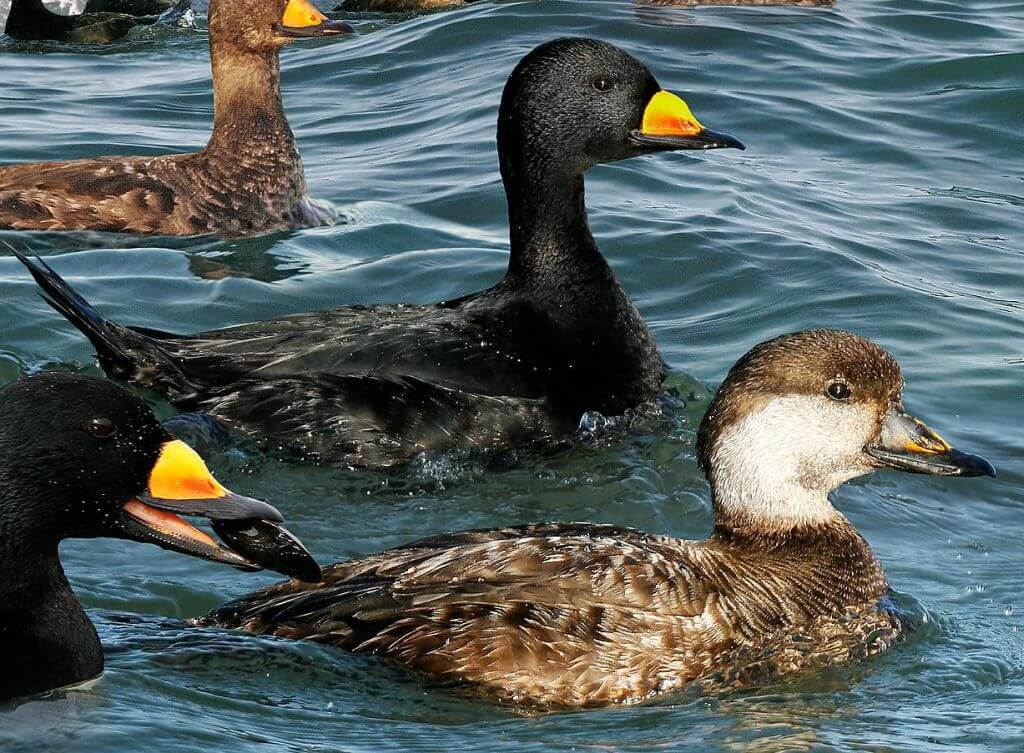
Black Scoter

Scientific Name

Melanitta americana

Alternative Names

Black Scoter, American Scoter, Macreuse noire (French)

Measurements

MeasurementRangeImperial
Length430–550 mm17–21.5 in
Weight950 g2.09 lb
Wingspan710 mm28 in
Wing213–233 mm8.4–9.2 in
Tail83–97 mm3.3–3.8 in
Culmen42–45.5 mm1.65–1.79 in
Tarsus45–48.5 mm1.77–1.91 in

Status

Near Threatened (IUCN)

Identification

A large sea duck with a heavy build and thick bill. Adult males are completely black with a distinctive swollen yellow-orange bill. Females are brown with pale cheeks, closely resembling female Common Scoters but with more extensive pale areas. Males average 49 cm (19 in) in length and 1,100 g (2.4 lb), while females average 45 cm (18 in) and 980 g (2.16 lb).

Voice

Black Scoters produce distinct calls from those of the Common Scoter. The male’s call is a mellow whistling note, while females give rougher, lower sounds.

Diet

Feeds mainly by diving for crustaceans and molluscs along coastal waters. During nesting, it eats aquatic insects, larvae (especially caddisflies), fish eggs, and occasionally vegetation such as duckweed.

Distribution

Breeds in northern North America—particularly in Labrador, Newfoundland, and around Hudson Bay—and in northeastern Siberia near the Yana River. Winters along the northern U.S. and Canadian coasts, from the Pacific coast south to San Francisco Bay and along the Atlantic and Gulf coasts. In Asia, winters as far south as China. Rare vagrant to western Europe.

Habitat

Prefers northern coastal and inland freshwater habitats during breeding—often near lakes, rivers, or tundra regions. In winter, it favors sheltered bays and coastal waters with mixed depths.

Breeding

Nests later than most North American ducks. Pairs form in late winter or spring. The nest is lined and built on the ground near water in tundra or woodland. Lays 5–7 eggs weighing 60–74 g each (about 8% of the female’s body weight). Incubation lasts 27–31 days. Females brood the young for about three weeks before they become independent.

Conservation

Threatened by habitat loss and pollution affecting breeding and wintering grounds. Monitoring continues due to its Near Threatened status, with conservation attention focused on protecting northern breeding habitats and coastal feeding areas.

Similar Posts

  • Freckled Duck

    Scientific Name Stictonetta naevosa Alternative Names Monkey Duck, Oatmeal Duck Measurements Feature Adult Male Adult Female Length 50–60 cm 50–60 cm Weight 700–1200 g 600–1200 g Status / Origin Endemic to Australia. Mostly found in inland eastern regions but disperses to coastal and subcoastal wetlands during drought. Population fluctuates and is affected by habitat loss,…

  • Maccoa Duck

    Scientific Name Oxyura maccoa Alternative Names None widely recognized Measurements Feature Male Female Length 48–51 cm (19–20 in) Slightly smaller Weight Around 650–750 g (1.4–1.6 lb) Slightly lighter Wingspan About 65–70 cm (26–28 in) — Status Listed as Near Threatened due to habitat loss, pollution, and bycatch, though some populations remain stable in protected wetland…

  • White-cheeked Pintail

    Scientific Name Anas bahamensis Alternative Names Bahama pintail, Bahama duck, White-cheeked duck Measurements Feature Male Female Body Length 38–51 cm 38–51 cm Weight 474–710 g 505–670 g Wingspan Around 76–84 cm Around 76–84 cm Status Listed as Least Concern, though some local populations face pressure from habitat loss and hunting. Identification A medium-sized dabbling duck…

  • Redhead

    Scientific name: Aythya americana Alternative names: Red-headed duck, Red-headed pochard Measurements Feature Range Length 40–56 cm (16–22 in) Weight 1,030–1,080 g (36–38 oz) Wingspan 74–84 cm (29–33 in) Status The redhead’s population is healthy and stable, with an estimated 1.4 million birds in North America. It accounts for about 2% of the continent’s duck population….

  • Radjah Shelduck

    Scientific Name Radjah radjah Alternative Names Radjah shelduck, Raja shelduck, Black-backed shelduck, Burdekin duck Measurement Measurement Male Female Length ~61 cm ~61 cm Weight ~1 kg ~1 kg Status and Origin Native to northern Australia, New Guinea, and parts of the Moluccas in eastern Indonesia. It is protected in all Australian states and territories. Identification…

  • Wandering Whistling Duck

    Scientific Name Dendrocygna arcuata Alternative Names Whistling Tree-Duck, Water Whistling Duck, Red Whistler Measurements Feature Male & Female Length 54–60 cm (21–24 in) Weight Around 750 g (1.65 lb) Status / Origin This species is native to tropical and subtropical regions of Australia, Indonesia, the Philippines, Papua New Guinea, Timor-Leste, Borneo, and nearby Pacific Islands….

Leave a Reply

Your email address will not be published. Required fields are marked *