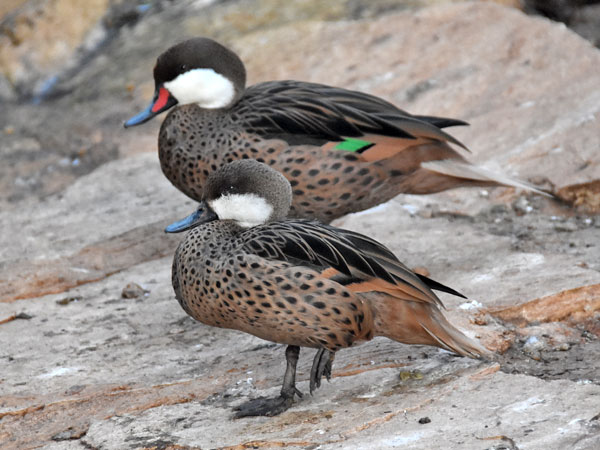
White-cheeked Pintail

Scientific Name

Anas bahamensis

Alternative Names

Bahama pintail, Bahama duck, White-cheeked duck

Measurements

FeatureMaleFemale
Body Length38–51 cm38–51 cm
Weight474–710 g505–670 g
WingspanAround 76–84 cmAround 76–84 cm

Status

Listed as Least Concern, though some local populations face pressure from habitat loss and hunting.

Identification

A medium-sized dabbling duck with brown mottled plumage, distinct white cheeks, and a grey bill with a red base. Both sexes look similar, with females slightly duller. The speculum shows an iridescent green sheen. Tail feathers are pointed but less pronounced than in the Northern Pintail. Juveniles have duller plumage and a less colorful bill.

Voice

Soft, high-pitched whistles from males, especially during courtship. Females produce a quieter, rasping quack.

Diet

Feeds by dabbling in shallow water. Eats aquatic plants, grass seeds, algae, insects, small aquatic invertebrates, and occasionally small crustaceans.

Distribution

Found in the Caribbean, northern and southern parts of South America, and the Galápagos Islands.

Habitat

Prefers shallow wetlands, brackish lagoons, mangrove swamps, estuaries, and freshwater pools. Often seen in coastal lowlands but can also occur in higher elevations up to 2,550 m, especially in the rubrirostris subspecies.

Breeding

Nests on the ground, hidden in vegetation close to water. The nest is a shallow scrape lined with down. Clutches typically contain 6–10 eggs. Both parents guard the young, but incubation is mainly by the female.

Wintering

This species is mostly resident and does not undertake long migrations. Some individuals make local movements in response to rainfall or changing water conditions.

Conservation

Overall numbers are stable, but wetland drainage, habitat disturbance, and hunting pose local threats. Protection of wetlands and control of hunting help safeguard populations. Subspecies on the Galápagos Islands are of special concern due to their limited range.

Similar Posts

  • Salvadori’s Teal

    Scientific Name Salvadorina waigiuensis Alternative Names Salvadori’s Duck, Salvadori’s Teal Measurements Feature Male Female Length 38–43 cm (15–17 in) 38–43 cm (15–17 in) Wingspan 56–71 cm (22–28 in) 56–71 cm (22–28 in) Weight Slightly above 342 g (12 oz) Around 342 g (12 oz) Status Salvadori’s Teal is native to New Guinea and lives in…

  • How Many Species Of Ducks Are There?

    When people mention ducks, many are actually thinking of all waterfowl species in general—the birds in the family Anatidae, which includes ducks, geese, and swans. Naturally, that group contains many species. According to the International Ornithological Committee (IOC), there are about 174 species in the Anatidae family worldwide. However, this total includes ducks, geese, and…

  • Pink-headed Duck

    Scientific Name Rhodonessa caryophyllacea. Measurements Measurement Range Body Length 41–43 cm Egg Length 1.71–1.82 inches Egg Width 1.61–1.70 inches Status This species is currently listed as Critically Endangered by the IUCN and is widely believed to be extinct, although unconfirmed reports from remote wetlands in northern Myanmar have left open the possibility that a small…

  • Red-billed Teal

    Scientific name Anas erythrorhyncha Alternative names Red-billed Teal, Red-billed Duck Measurements Feature Range / Note Length 43–48 cm (17–19 in) Wingspan Not precisely measured, typical for medium-sized dabbling ducks Weight 400–600 g (approx.) Status Not considered endangered. Estimated 410,000–790,000 mature individuals as of 2023. Population trend appears slightly decreasing but remains large and stable enough…

  • Blue-winged Teal

    Scientific Name Spatula discors Common Name Blue-winged Teal Measurements Feature Average Length 40 cm (16 in) Wingspan 58 cm (23 in) Weight 370 g (13 oz) Status A small dabbling duck native to North America, the Blue-winged Teal breeds from southern Alaska to Nova Scotia, extending southward to northern Texas. It winters along both U.S….

  • King Eider

    Scientific name Somateria spectabilis Alternative names King Eider Measurements Feature Range / Note Length 50–70 cm (20–28 in) Wingspan 86–102 cm (34–40 in) Weight Males ~1.668 kg (3.68 lb), females ~1.567 kg (3.45 lb); can vary 0.9–2.2 kg (2–4.9 lb) Status Not considered endangered. Population is large and widespread, and the species is classified as…

Leave a Reply

Your email address will not be published. Required fields are marked *